Keeping generative artificial intelligence reliable in omics biology
Thomas Burger

TL;DR
This paper discusses how generative AI can revolutionize omics research but warns about the risks of unrealistic data generation and suggests ways to address them.
Contribution
The paper introduces strategies to reduce hallucination risks in generative AI for reliable omics research.
Findings
Generative AI can create realistic data for complex biological processes.
Hallucinations in AI-generated data pose significant risks in molecular biology.
Use cases are proposed to safely harness the potential of generative methods.
Abstract
Generative artificial intelligence can be used to create realistic new data, even for complex real-world processes that cannot be exhaustively modeled: the model is simply learned from preexisting data. Generative artificial intelligence is therefore expected to be a game changer in omics research, where data collection is hampered by considerable experimental constraints. However, it can also “hallucinate”—i.e., create data that are too original to be realistic—which is a critical issue in molecular biology, as hallucinated inferences could have devastating consequences. The author thus explores various use cases to mitigate hallucination-induced risks and to safely unleash the full potential of generative methods. Generative artificial intelligence can be used to create realistic new data, even for complex real-world processes that cannot be exhaustively modeled: the model is simply…
Genes, proteins, chemicals, diseases, species, mutations and cell lines named across the full text — each resolved to its canonical identifier and authoritative record.
Click any figure to enlarge with its caption.
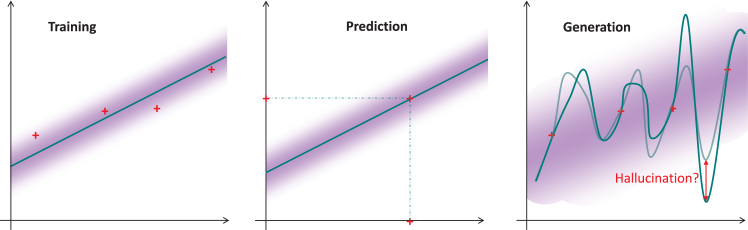 Figure 1
Peer Reviews
No public reviews on file for this paper yet. If you reviewed it on a platform where reviews are public (OpenReview, ICLR, NeurIPS, ICML), you can paste yours below so the community can read it here.
Videos
No videos yet. Explain this paper in a talk, walkthrough, or lecture? Add one.
Taxonomy
TopicsBioinformatics and Genomic Networks · Genetics, Bioinformatics, and Biomedical Research · Computational Drug Discovery Methods