High genetic similarity between Clostridioides difficile isolates from a woman with community-acquired infection and her dog
Júlia Meireles, Suzana Leite, Amanda Macedo Trindade de Castro Brandt, Geraldo Alves Neto, Rodrigo Otávio Silveira Silva, Eliane de Oliveira Ferreira

TL;DR
A woman and her dog had genetically similar C. difficile infections, suggesting possible transmission or shared exposure outside of hospitals.
Contribution
The study presents evidence of potential zoonotic transmission or shared exposure of C. difficile between humans and pets.
Findings
The human and dog isolates had the same ribotype and only four SNP differences.
This genetic similarity suggests shared exposure or transmission between the woman and her dog.
The case highlights the need to explore companion animals as sources of community C. difficile.
Abstract
Clostridioides difficile infection is a leading cause of diarrhea associated with healthcare settings, but its incidence in the community has increased substantially in recent years, raising questions about possible non-hospital reservoirs. We report a case of community-acquired C. difficile infection in a woman and the concurrent isolation of a toxigenic strain from her dog, which also presented diarrhea. Both isolates showed the same ribotype and differed by only four single-nucleotide polymorphisms in whole-genome sequencing analysis, indicating a high degree of genetic similarity. These findings suggest the possibility of shared exposure or transmission between the patient and her dog and highlight the need to further investigate companion animals as potential sources of community-acquired C. difficile.
Genes, proteins, chemicals, diseases, species, mutations and cell lines named across the full text — each resolved to its canonical identifier and authoritative record.
Click any figure to enlarge with its caption.
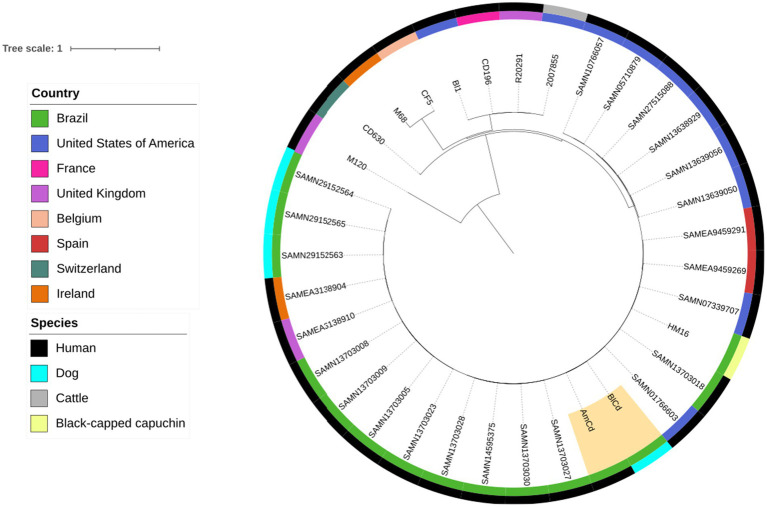 Figure 1
Peer Reviews
No public reviews on file for this paper yet. If you reviewed it on a platform where reviews are public (OpenReview, ICLR, NeurIPS, ICML), you can paste yours below so the community can read it here.
Videos
No videos yet. Explain this paper in a talk, walkthrough, or lecture? Add one.
Taxonomy
TopicsClostridium difficile and Clostridium perfringens research · Helicobacter pylori-related gastroenterology studies · Yersinia bacterium, plague, ectoparasites research