Predictive remapping and allocentric coding as consequences of energy efficiency in recurrent neural network models of active vision
Thomas Nortmann, Philip Sulewski, Tim C. Kietzmann

TL;DR
This paper shows that complex brain functions like stable vision during eye movements can emerge from simple energy-saving rules in neural networks.
Contribution
The study demonstrates that predictive remapping and allocentric coding can arise from energy efficiency optimization in recurrent neural networks.
Findings
Predictive remapping emerges from energy efficiency optimization in the model.
An allocentric reference frame is learned to guide visual predictions.
Energy efficiency alone can lead to complex neural computations.
Abstract
Despite moving our eyes from one location to another, our perception of the world is stable—an aspect thought to rely on predictive computations that use efference copies to predict the upcoming foveal input. Are these complex computations and required connectivity scaffolds genetically encoded, or could they emerge from simpler principles? Here, we consider the organism’s limited energy budget as a potential origin. We expose a recurrent neural network to sequences of fixation patches and saccadic efference copies, training the model to minimize energy consumption (preactivation). We show that targeted inhibitory predictive remapping emerges from this energy-efficiency optimization alone. Furthermore, this computation relies on the model’s learned ability to re-code egocentric eye coordinates into an allocentric (image-centric) reference frame. Together, our findings suggest that both…
Click any figure to enlarge with its caption.
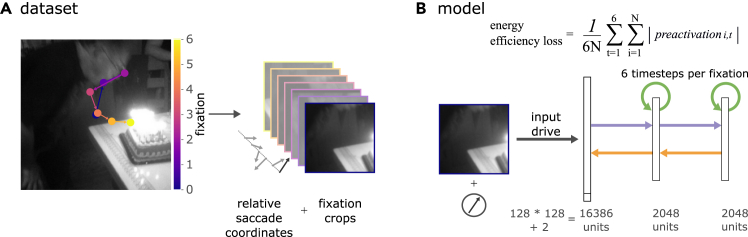 Figure 1
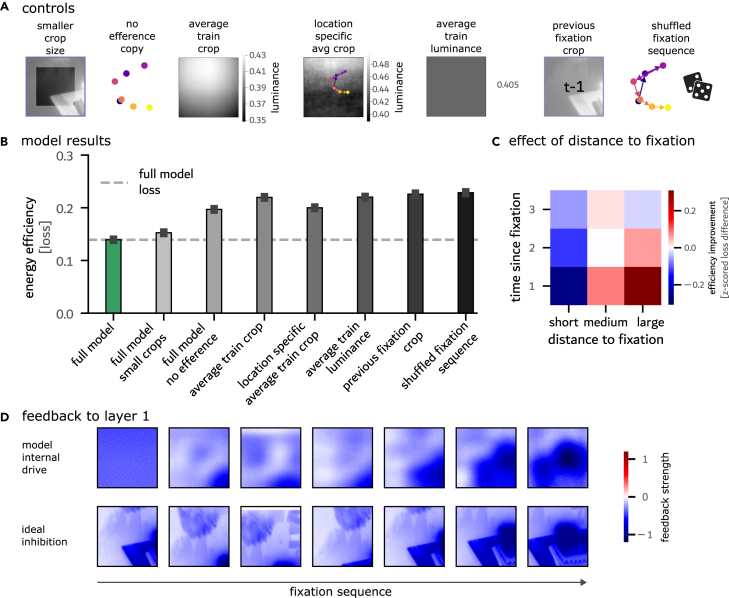 Figure 2
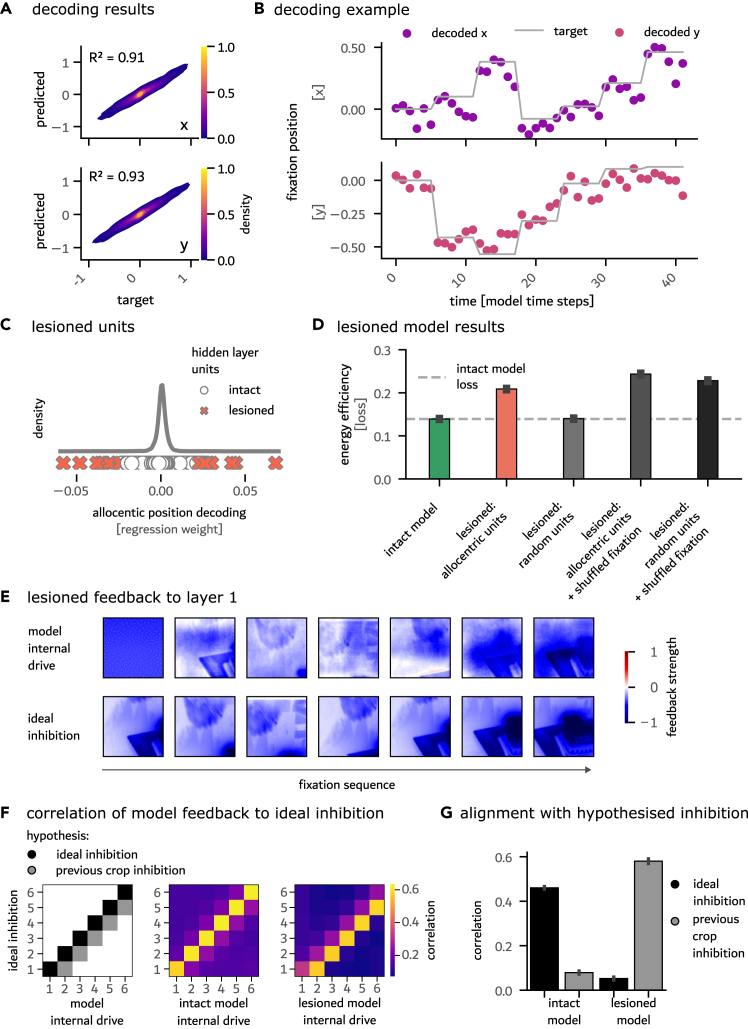 Figure 3
Peer Reviews
No public reviews on file for this paper yet. If you reviewed it on a platform where reviews are public (OpenReview, ICLR, NeurIPS, ICML), you can paste yours below so the community can read it here.
Videos
No videos yet. Explain this paper in a talk, walkthrough, or lecture? Add one.
Taxonomy
TopicsRetinal Development and Disorders · Visual perception and processing mechanisms · Face Recognition and Perception