Cognitive and emotional responses to viewing mummies in an Egyptian museum
M. Iosa, V. Scaramozzino, M. Benente, V. Minucciani, M. Franzò

TL;DR
This study explores how people's brains and emotions react when they view mummies in an Egyptian museum.
Contribution
The study measures cognitive and emotional responses to mummies using EEG and skin conductance in a real museum setting.
Findings
Cognitive workload increased when participants viewed mummies.
Emotional arousal increased after seeing a partially unbandaged mummy.
Mummies increased emotional engagement without causing negative emotions.
Abstract
A recent subfield of neuropsychology is the study of people’s reactions to visiting a museum and observing artworks. However, museums do not only contain artworks or archeological finds, and some of them exhibit human remains, such as mummies. A growing debate concerns the ethical issues of such exhibitions, but the psychological and physiological reactions of visitors when viewing mummies have not yet been measured. In this study, 33 subjects (40.3 ± 14.4 years old) participated in two experiments conducted at the Egyptian Museum of Turin (Italy). In the first experiment, they were asked to observe an empty sarcophagus, an opened sarcophagus with a mummy inside, and an open sarcophagus with the mummy placed between the cover and the coffin of the sarcophagus. Subjects wore an electroencephalographic (EEG) system on their heads, electrodes on their fingers to measure skin conductance…
Genes, proteins, chemicals, diseases, species, mutations and cell lines named across the full text — each resolved to its canonical identifier and authoritative record.
Click any figure to enlarge with its caption.
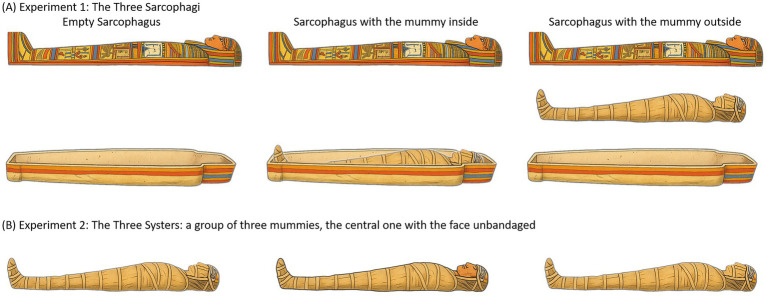 Figure 1
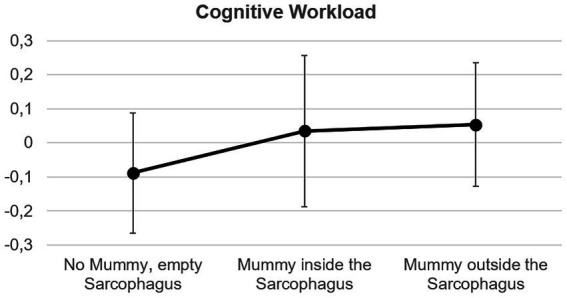 Figure 2
Peer Reviews
No public reviews on file for this paper yet. If you reviewed it on a platform where reviews are public (OpenReview, ICLR, NeurIPS, ICML), you can paste yours below so the community can read it here.
Videos
No videos yet. Explain this paper in a talk, walkthrough, or lecture? Add one.
Taxonomy
TopicsPaleopathology and ancient diseases · Ancient Egypt and Archaeology · Archaeology and Rock Art Studies