The impact of peer relationships and employment pressure on the learning wellbeing of university students in the post-2000s generation
Huajie Shen, Xinzhi Ye, Caixia Bai, Shi He, Fengwu Zhang, Yushan Yang, Jian Qiu

TL;DR
This study explores how peer relationships and job pressure affect university students' learning wellbeing in China.
Contribution
It reveals complex, multidimensional relationships between interpersonal distress, employment pressure, and learning wellbeing dimensions.
Findings
Interpersonal distress negatively affects all dimensions of learning wellbeing.
Moderate employment pressure is positively linked to cognitive and emotional wellbeing.
Interpersonal distress moderates the impact of employment pressure on learning wellbeing patterns.
Abstract
Learning wellbeing has become an important indicator of university students’ academic experience and psychological adjustment. Guided by a correlational and non-causal analytical framework, this study examined how interpersonal distress (as an indicator of low peer relationship quality) and employment pressure are related to the learning wellbeing of post-2000s university students in China. A total of 600 undergraduates from four universities participated in the survey. Standardized questionnaires and quantitative analysis methods were used to assess interpersonal distress, employment pressure, and four dimensions of learning wellbeing (cognitive, emotional, quality-of-life, and growth wellbeing). Quantitative analysis methods, including, descriptive statistics, Pearson correlations, and multiple regression analyses were applied to examine the relationships and interaction effects…
Click any figure to enlarge with its caption.
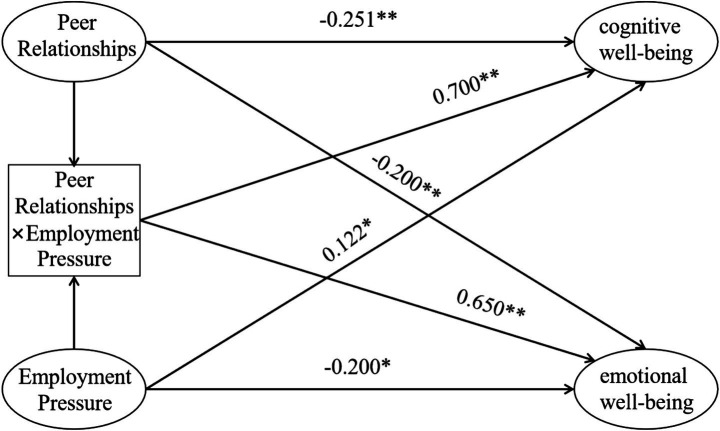 Figure 1
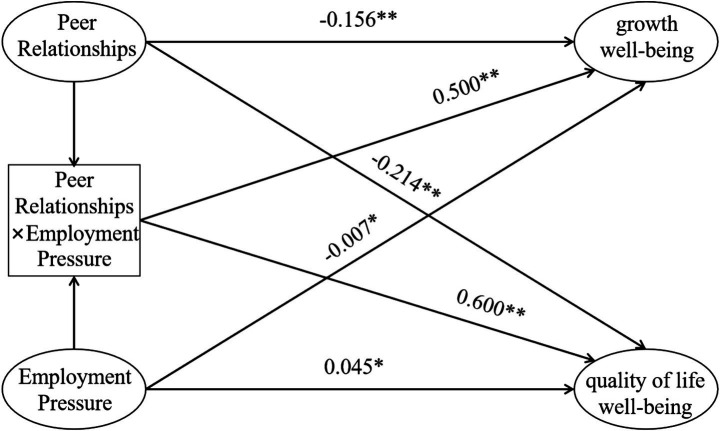 Figure 2
Peer Reviews
No public reviews on file for this paper yet. If you reviewed it on a platform where reviews are public (OpenReview, ICLR, NeurIPS, ICML), you can paste yours below so the community can read it here.
Videos
No videos yet. Explain this paper in a talk, walkthrough, or lecture? Add one.
Taxonomy
TopicsPsychological Well-being and Life Satisfaction · Healthcare professionals’ stress and burnout · Optimism, Hope, and Well-being