Exploring the relationships among interpersonal competence, perceived stress and cognitive reappraisal in Chinese PAP recruits: a longitudinal cross-lag study
Liyun Sun, Min Li

TL;DR
This study explores how interpersonal skills, stress, and emotional regulation change over time in Chinese PAP recruits.
Contribution
It reveals temporal relationships showing how interpersonal competence reduces stress and enhances cognitive reappraisal.
Findings
Higher interpersonal competence at time 1 predicts lower stress at time 2.
Stress at time 1 predicts lower interpersonal competence at time 2.
Interpersonal competence positively predicts cognitive reappraisal over time.
Abstract
The associations among interpersonal competence (IC), cognitive reappraisal (CR) and perceived stress (PS) among recruits of the Chinese People’s Armed Police Force (PAP) are poorly understood. The aim of this study is to clarify the relationships among these variables over time. A three-wave longitudinal study involving 300 recruits of the PAP surveyed over 3 months was conducted. The Chinese version of the Perceived Stress Scale (CPSS), the Brief Interpersonal Competence Questionnaire (ICQ-15), and the cognitive reappraisal scale, excerpted from the Emotion Regulation Questionnaire (ERQ), were chosen to assess PS, IC and CR. Longitudinal connections between these variables were examined via structural equation analysis. Our results revealed that time 1 IC negatively predicted time 2 PS and that time 1 PS negatively predicted time 2 IC. Time 1 IC positively predicted time 2 CR, time…
Click any figure to enlarge with its caption.
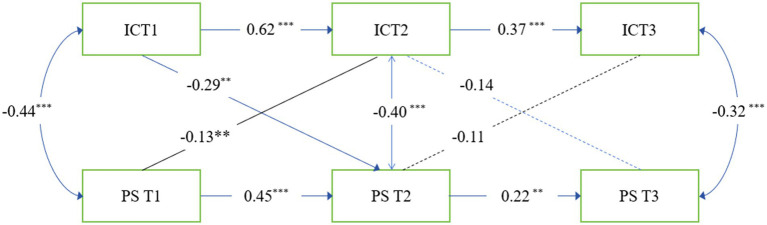 Figure 1
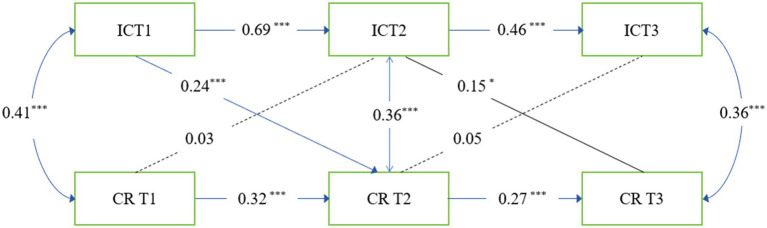 Figure 2
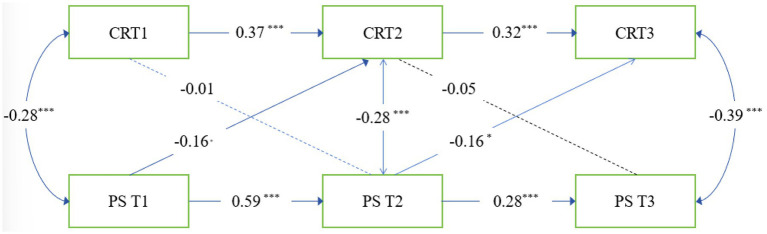 Figure 3
Peer Reviews
No public reviews on file for this paper yet. If you reviewed it on a platform where reviews are public (OpenReview, ICLR, NeurIPS, ICML), you can paste yours below so the community can read it here.
Videos
No videos yet. Explain this paper in a talk, walkthrough, or lecture? Add one.
Taxonomy
TopicsPosttraumatic Stress Disorder Research · Emotional Intelligence and Performance · Personality Traits and Psychology