The association of eight-year trajectories in total, cognitive-affective, and somatic depressive symptoms with incident stroke: a 10-year follow-up study using HRS and ELSA cohorts
Haining Zhang, Jiange Chen, Yuntian Ye, Hongyi Wang, Shun Fan, Wei Zhang, An Bao, Huanan Li, Jingui Wang

TL;DR
Long-term changes in depressive symptoms, especially increasing or fluctuating patterns, are linked to higher stroke risk in older adults.
Contribution
This study is the first to examine longitudinal trajectories of total and subtype depressive symptoms in relation to stroke risk using repeated assessments.
Findings
Increasing, fluctuating, and consistently high total depressive symptoms were associated with elevated stroke risk.
Cognitive-affective symptoms increasing over time and consistently high somatic symptoms showed the strongest stroke risk associations.
Decreasing depressive symptoms were not significantly linked to increased stroke risk.
Abstract
Earlier research has documented an association between depressive symptomatology and heightened stroke risk. However, prior work largely assessed depressive manifestations at isolated time points and failed to differentiate symptom subtypes. This investigation seeks to characterize the longitudinal progression of depressive symptoms via repeated measurement and explore their link to stroke risk by considering total depressive symptoms alongside cognitive-affective and somatic dimensions. This prospective cohort study included individuals aged ≥ 45 years from the Health and Retirement Study (HRS) in the United States and the English Longitudinal Study of Ageing (ELSA) in the United Kingdom, excluding those with a history of stroke during the exposure period. Depressive symptoms were measured using the 8-item Center for Epidemiologic Studies Depression Scale (CES-D) across four biennial…
Genes, proteins, chemicals, diseases, species, mutations and cell lines named across the full text — each resolved to its canonical identifier and authoritative record.
Click any figure to enlarge with its caption.
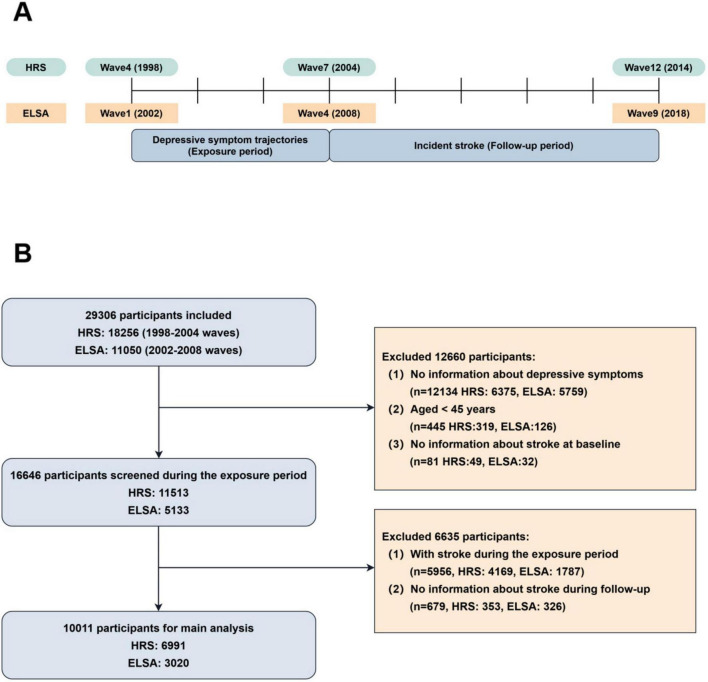 Figure 1
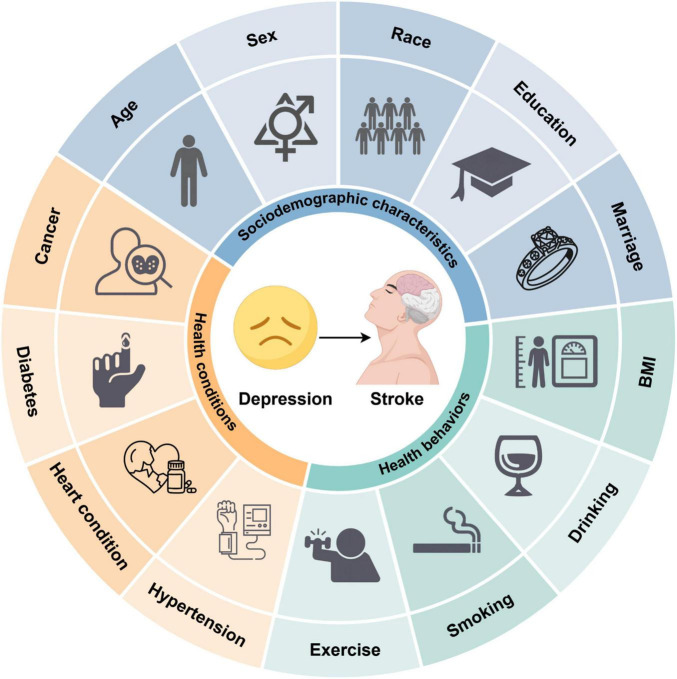 Figure 2
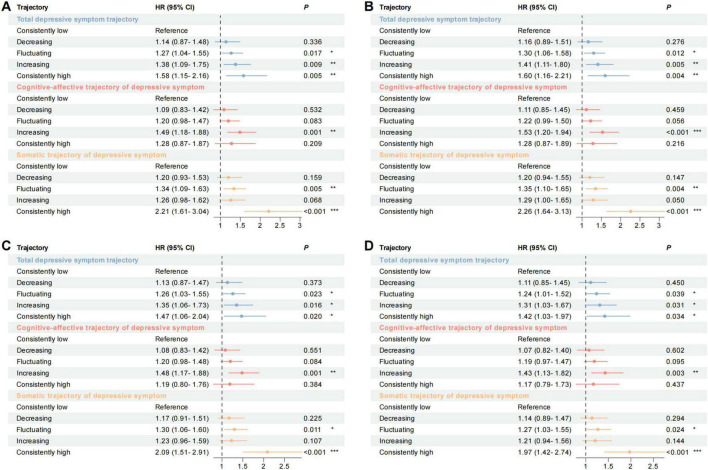 Figure 3
Peer Reviews
No public reviews on file for this paper yet. If you reviewed it on a platform where reviews are public (OpenReview, ICLR, NeurIPS, ICML), you can paste yours below so the community can read it here.
Videos
No videos yet. Explain this paper in a talk, walkthrough, or lecture? Add one.
Taxonomy
TopicsStroke Rehabilitation and Recovery · Cardiac Health and Mental Health · Acute Ischemic Stroke Management