Unmasking the Clever Hans effect in AI models: shortcut learning, spurious correlations, and the path toward robust intelligence
Abhay Kumar Pathak, Manjari Gupta, Garima Jain

TL;DR
This paper explores how AI models can exploit misleading patterns in data, similar to the Clever Hans effect, and suggests ways to build more reliable and ethical AI systems.
Contribution
The paper introduces a comprehensive roadmap for robust AI development by addressing spurious correlations through benchmarking, causality, and ethical frameworks.
Findings
The Clever Hans effect is widespread in AI domains like vision, NLP, and medical imaging due to spurious correlations.
Current evaluation methods often fail to detect reliance on artifacts rather than causal relationships.
Mitigation strategies include model-centric and data-centric approaches, along with human-in-the-loop auditing.
Abstract
The Clever Hans (CH) effect is a historical analogy of a horse solving mathematical problems based on some cues, representing a critical failure in artificial intelligence (AI) systems, where models achieve higher performance by utilizing spurious correlations and artifacts presented in the datasets rather than relying on causal relationships or task-related features. This effect or phenomenon is prevalent across multiple domains of AI such as computer vision, natural language processing, medical imaging, and reinforcement learning. This review examines the Clever Hans effect, the conceptual foundation of spurious correlations, and current evaluation methods that obscure such behavior. We further survey state-of-the-art detection and mitigation strategies, focusing on both model-centric and data-centric techniques. Building on these insights, we propose a roadmap for robust AI…
Genes, proteins, chemicals, diseases, species, mutations and cell lines named across the full text — each resolved to its canonical identifier and authoritative record.
Click any figure to enlarge with its caption.
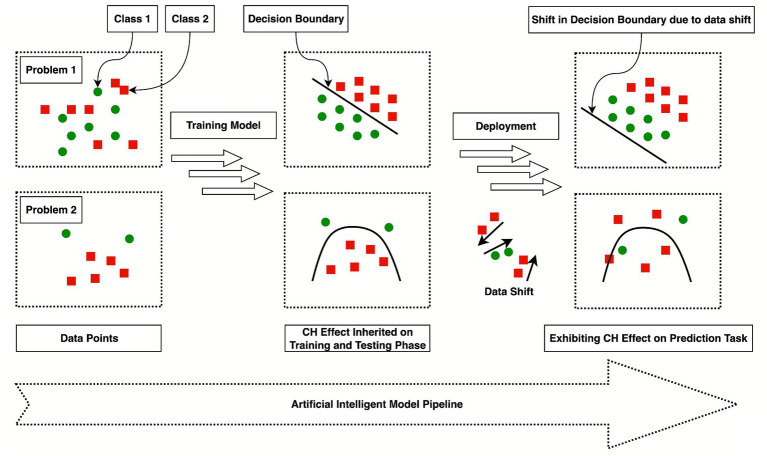 Figure 1
Peer Reviews
No public reviews on file for this paper yet. If you reviewed it on a platform where reviews are public (OpenReview, ICLR, NeurIPS, ICML), you can paste yours below so the community can read it here.
Videos
No videos yet. Explain this paper in a talk, walkthrough, or lecture? Add one.
Taxonomy
TopicsEthics and Social Impacts of AI · Explainable Artificial Intelligence (XAI) · Artificial Intelligence in Healthcare and Education