The link between Wnt-related, stress-related, and circadian genes in the dermal fibroblasts of individuals with attention-deficit hyperactivity disorder
Denise Palm, Lukasz Smigielski, Adriana Uzoni, Oliver Tucha, Johannes Thome, Edna Grünblatt

TL;DR
This study explores how genes related to circadian rhythms, stress, and Wnt signaling behave differently in fibroblasts from people with ADHD compared to healthy individuals.
Contribution
The study reveals subtle changes in circadian gene expression and unique integration of Wnt and stress pathways in ADHD.
Findings
Core clock genes like BMAL1 and CRY1 showed delayed expression peaks in ADHD individuals.
ADHD was linked to altered rhythmicity and gene-gene associations involving CRY1–SIRT1 and PER3–FOXO1.
Phase and amplitude of circadian genes correlated with ADHD symptoms and sleep measures.
Abstract
Attention-deficit/hyperactivity disorder (ADHD) has been associated with circadian rhythm disturbances, altered stress responses, and, in neural stem cells from ADHD patients, aberrant Wnt signaling. However, little is known about how these molecular pathways interact. This study aimed to investigate rhythmic expression of circadian, Wnt signaling, and stress-related genes in the context of ADHD. Human dermal fibroblasts were obtained via skin biopsy from participants diagnosed with ADHD (n = 13) and healthy controls (n = 13). Fibroblast cultures were synchronized using dexamethasone, with samples collected every 4 h over 28 h. Gene expression of Wnt signaling, stress-related, and circadian clock genes was quantified by qRT-PCR. Harmonic regression was applied to estimate rhythmicity (amplitude and phase), followed by mixed-effects modeling and likelihood ratio tests to assess…
Genes, proteins, chemicals, diseases, species, mutations and cell lines named across the full text — each resolved to its canonical identifier and authoritative record.
Click any figure to enlarge with its caption.
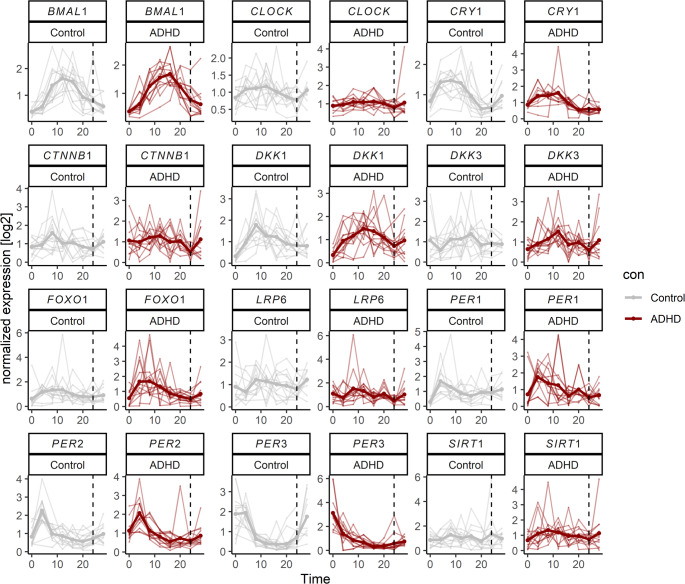 Figure 1
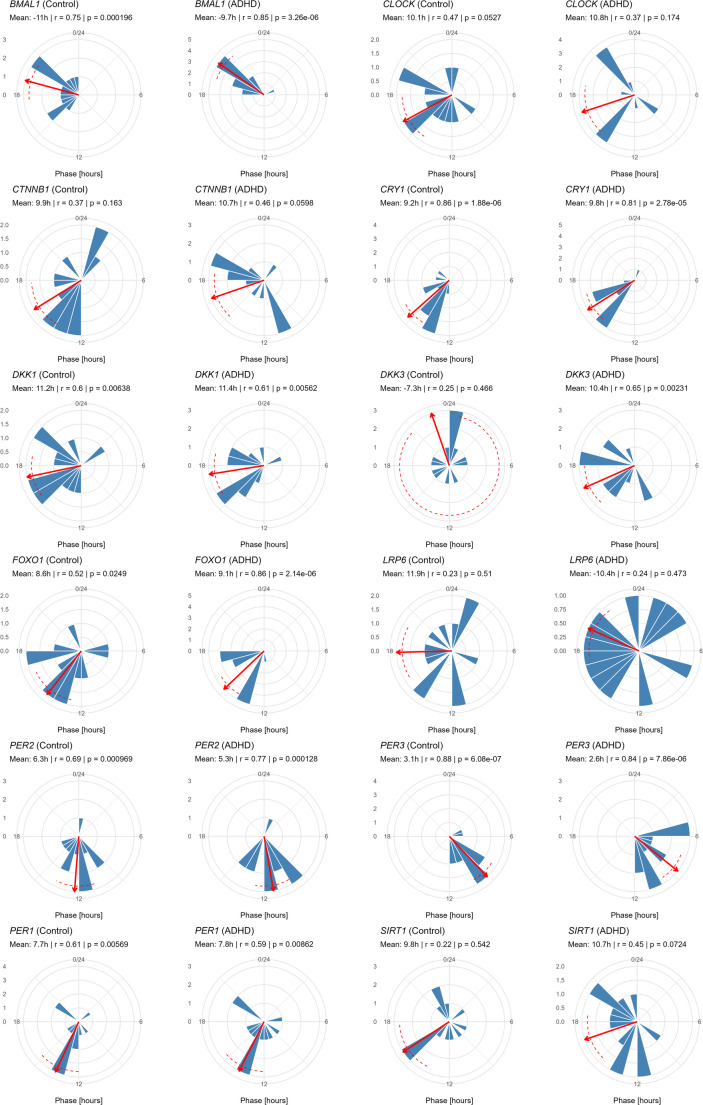 Figure 2
Peer Reviews
No public reviews on file for this paper yet. If you reviewed it on a platform where reviews are public (OpenReview, ICLR, NeurIPS, ICML), you can paste yours below so the community can read it here.
Videos
No videos yet. Explain this paper in a talk, walkthrough, or lecture? Add one.
Taxonomy
TopicsCircadian rhythm and melatonin · Attention Deficit Hyperactivity Disorder · Genetics, Aging, and Longevity in Model Organisms