Does adding coaching calls into an online lifestyle intervention for cancer survivors make it more acceptable and feasible than a self-guided version?
Nicola Freeman, Morgan Leske, Bogda Koczwara, Julia Morris, Anthony Daly, Lisa Beatty

TL;DR
Adding brief coaching calls to an online lifestyle program for cancer survivors is more acceptable and feasible than a self-guided version.
Contribution
The study introduces and evaluates the feasibility of adding coaching calls to an online cancer survivorship program.
Findings
Participants with coaching found the program more acceptable and easier to use.
Control participants expressed a strong demand for coaching calls.
Coaching calls helped improve both physical and psychosocial health outcomes.
Abstract
While online interventions increase access to support, self-guided online programs have lower engagement and (potentially) efficacy than guided programs. However, the acceptability of guided programs to cancer survivors is less established. This study qualitatively explored whether the addition of guidance via two brief coaching calls to the Healthy Living after Cancer (HLaC) Online program, an online lifestyle intervention, was feasible and more acceptable than the self-guided version. Participants were adult Australian cancer survivors randomized to receive either HLaC Online + coaching (n = 25) or HLaC Online (n = 27) as part of a larger clinical trial. Semi-structured telephone interviews were conducted (n = 21), and transcripts were analyzed via framework analysis, using deductive analysis of four a priori feasibility domains (adaption, acceptability, demand, practicality) and…
Genes, proteins, chemicals, diseases, species, mutations and cell lines named across the full text — each resolved to its canonical identifier and authoritative record.
Click any figure to enlarge with its caption.
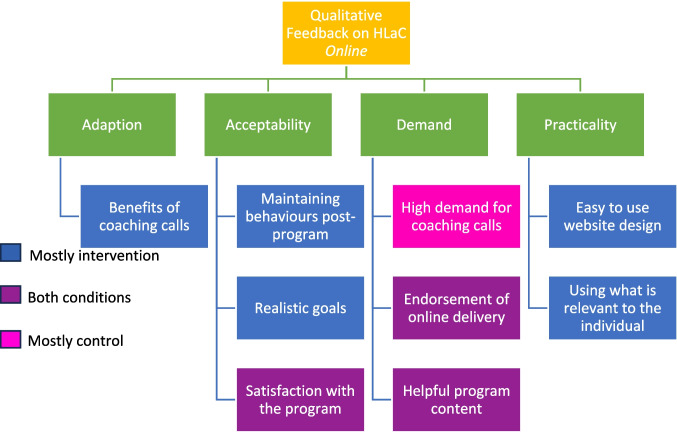 Figure 1
- —This work was funded internally by Cancer Council SA and the Flinders University Innovation Partnership Seed Grant.
- —Flinders University
Peer Reviews
No public reviews on file for this paper yet. If you reviewed it on a platform where reviews are public (OpenReview, ICLR, NeurIPS, ICML), you can paste yours below so the community can read it here.
Videos
No videos yet. Explain this paper in a talk, walkthrough, or lecture? Add one.
Taxonomy
TopicsCancer survivorship and care · Mental Health and Patient Involvement · Childhood Cancer Survivors' Quality of Life
Introduction
There are more than 1 million cancer survivors in Australia [1]. The number of cancer survivors is expected to increase, not only in Australia but worldwide, due to advancements in technology, screening, and treatments [2, 3]. Yet, cancer survivors still face many lifestyle and personal challenges in life after cancer, including chronic fatigue, pain, mental health challenges, cancer recurrence and mortality, and/or co-morbid conditions [2–5]. Maintaining a healthy lifestyle after cancer, via regular physical activity and a healthy diet, can help reduce these adverse effects and enhance quality of life (QoL) [6, 7]. However, improving health behaviors can be difficult to enact and sustain due to factors such as low motivation and post-treatment fatigue [8]. In Australia, cancer survivors have low long-term adherence to health guidelines, such as physical activity and diet recommendations [9], as well as poorer physical health compared to people who have not received a cancer diagnosis [10].
Notably, when considering healthy lifestyle guidelines, cancer survivors define a healthy lifestyle as incorporating both physical and mental health strategies [11]. This is unsurprising, given a cancer diagnosis negatively impacts mental health outcomes, such as elevating distress [12] and reducing QoL [13], with survivors frequently reporting unmet needs in these domains [14]. Furthermore, depression and anxiety can increase the risk of cancer mortality in multiple cancer types by more than 20% [15], while high QoL can act as a protective factor against recurrence and mortality [6]. Therefore, both physical health and psychosocial support are critical to address in any healthy lifestyle program throughout cancer survivorship to optimize survivorship outcomes [14].
While traditional face-to-face interventions are demonstrably efficacious, they are not regularly implemented throughout cancer survivorship due to cost and resource burden [16]. Further, face-to-face delivery is not accessible to all populations, including those living in rural and remote areas with reduced access to healthcare [17]. To address the need for accessible interventions that cover both physical and psychosocial health factors, the Healthy Living after Cancer (HLaC) Online program was developed [18]. This program was an end-user co-designed adaption of the original telephone-delivered intervention [19]. HLaC Online is a 12-week web-based program, comprised of nine healthy living modules (My Goals, Finding the New Normal, Physical Activity, Healthy Eating, Mental Health, Fatigue Management, Maintaining a Healthy Weight, Peer Support, Staying on Track) and five progress trackers (exercise tracker, meal tracker, weight tracker, thought record, and mood and fatigue monitor) that post-treatment cancer survivors can access to help achieve physical, dietary, and psychosocial goals. Despite being co-designed using end-user feedback, the initial feasibility study for HLaC Online demonstrated low user uptake and engagement in the program [20]. Qualitative feedback suggested this may be a consequence of the self-guided nature of the program and that users might benefit from guidance calls to assist with program navigation, setting up health behavior goals, and accountability [20]. This aligns with recent meta-analytic evidence that guided digital interventions have higher engagement, as well as higher efficacy in the domains of anxiety, fatigue, and distress [21].
Our team has recently conducted a feasibility trial of adding two coaching calls to HLaC Online (HLaC Online + coaching) compared to the unguided version [22]. A stakeholder meeting with Cancer Council SA, an Australian not-for-profit cancer support organization, was held, where the addition of two phone calls was suggested based on a randomized control trial (RCT) by Evans et al. [23], and similarly, Cancer Council concluded two calls would be the feasible dose for potential post-study implementation of HLaC Online + coaching [24]. Although quantitative feasibility and efficacy results from the trial are yet to be published, preliminary findings of the RCT suggest positive long-term lifestyle outcomes for cancer survivors accessing HLaC Online + coaching [22]. Yet, it is unknown whether adding this guidance is experientially acceptable and beneficial to cancer survivors. Qualitative data provides opportunities to investigate more than just whether an intervention is efficacious, but why, and obtains important feedback from end-users. As acceptability can predict higher digital intervention engagement and effectiveness [25, 26], exploring the acceptability of HLaC Online + coaching is essential to help understand the intervention’s impact. Thus, the purpose of this study was to qualitatively explore whether the addition of guidance via two brief coaching calls to HLaC Online resulted in higher feasibility and acceptability than the self-guided version.
Method
The full protocol outlining the methods, measures, and planned analyses for the feasibility RCT has been prospectively registered (ANZCTR, ACTRN12622001111763). In the following, methods relevant to the qualitative analysis of HLaC Online + coaching’s feasibility and acceptability are summarized.
Participants
Participants in this sub-study were Australian cancer survivors over 18 years old who had successfully enrolled in the HLaC Online + coaching feasibility RCT, recruited between 23/08/22 and 17/01/23. With ethics approval (HREC, 2106), participants from both the guided and unguided conditions were invited to participate in a telephone interview, with interviews following the completion of the 12-week intervention period. Potential participants were contacted via telephone, SMS, or email a maximum of three times and were recruited until content saturation of themes occurred.
Intervention conditions
Both intervention (HLaC Online + coaching) and active control (HLaC Online) participants received the 12-week HLaC Online program. The program included access to nine modules and five trackers as previously specified. During the program, participants received weekly SMS reminders to log into the program and two additional email reminders if they had not logged on in 1 or 2 weeks. However, only intervention participants received two additional telephone coaching calls, the first in week 1 and the second in week 4. The week 1 call orientated participants to the website, discussed healthy lifestyle aims, and set SMART (specific, measurable, achievable, relevant, time-bound) goals with signposting to relevant modules. The week 4 call acted as a check-in, where participants discussed their progress, barriers encountered, and how to overcome them, and addressed any questions arising about the program. All coaching calls were facilitated by one coach, a doctoral level provisional psychologist with cancer care experience, and followed a script that had been discussed and reviewed during the Cancer Council SA stakeholder meeting [24].
Procedure
Consenting participants were provided with a topic guide (Table 1) prior to the interview. During the interview, they were asked about their satisfaction with, and the usability of, the program and coaching calls (if relevant). Interviews were conducted by two researchers (NF, DK), psychology students undertaking their honors or work experience placement (respectively) under the supervision of senior authors (ML, LB). Interviews were audio-recorded, transcribed verbatim, and coded. Saturation was determined through an iterative process after each interview; after completing two consecutive interviews with no new data emerging, content saturation was deemed to have occurred. Due to the high information power of the study population [27], saturation was able to be achieved with fewer interviews [28]. Table 1. Topic Guide for Telephone InterviewsSectionQuestions and PromptsSection 1: Accessing the programThis section asks questions about how you accessed Healthy Living after Cancer Online.· Did you receive the program as self-guided or with the telephone coaching calls?· What device did you usually use the program on? Section 2: Satisfaction with program overall This section asks questions about how you used Healthy Living after Cancer Online and to provide your feedback on the program overall.· How did you find the program overall?· Is there anything you would change to the look of the program? · How did you find navigating the website? · What aspects of Healthy Living after Cancer Online were the most useful to you? · What aspects of Healthy Living after Cancer Online were not useful? · Are there any topics that are missing which you would like addressed in this program? · How did you find the email and text reminders? · [If you received the telephone coaching calls] How did you find the telephone coaching calls?Section 3: Trackers This section asks you to provide your feedback on each of the trackers included in the Healthy Living after Cancer Online program.**When providing your feedback on each of the trackers, you may consider the following questions:- *How much did use this tracker? *- *How helpful did you find this tracker? *- *Is there anything you would change about this tracker? **If you did not use one or more of the trackers, that is okay. You may also provide some feedback about why you chose not to use the tracker. *· Exercise tracker · Meal tracker · Weight tracker · Thought record · Mood and fatigue monitorSection 4: Intervention modules This section asks you to provide your feedback on each of the modules included in the Healthy Living after Cancer Online program. When providing feedback on each of the modules, you may consider the following questions:- *Overall, what did you think of this section? *- *How relevant was the information in this section? *- *How helpful was the information is this section? *- *Was the information easy to understand? *- *What did you think of the activities included in this section? *- *Is there anything you would change about this module? **If you did not use the module, that is okay. You may also consider providing feedback about why you chose not to use the module. *· Finding the new normal · My goals · Physical activity · Healthy eating · Mental health · Fatigue management · Maintaining a healthy weight · Staying on track · Peer support· Any other feedback?
Statistical analysis
Participant demographic and clinical characteristics were summarized using descriptive statistics. Qualitative data were coded using NVivo R1 software [29]. Two transcripts were coded independently by two researchers (NF, ML) and compared to confirm consistency of themes and establish a coding framework. The remaining 19 transcripts were coded independently by one researcher (NF). Codes were collated into emergent themes and subthemes using framework analysis [30], a type of thematic analysis where an existing framework is applied to guide and categorize responses. It enables both deductive (top down, coding themes to a priori established categories) and inductive (bottom up, identifying new emergent themes that do not fit existing categories) analyses. As the HLaC Online RCT was a feasibility study, Bowen and colleagues’ [31] feasibility framework was applied to analyses, with four key a priori domains of focus: (i) adaption; (ii) acceptability; (iii) demand; and (iv) practicality.
Data analysis was guided using the six stages of thematic analysis outlined by Braun and Clarke [32]: Stage 1 (familiarization with the data), Stage 2 (initial coding of raw data into specific groups), Stage 3 (categorizing these codes/groups into main themes), Stage 4 (reviewing themes and checking that they were representative of the data set for both conditions), Stage 5 (finalizing and defining themes), and Stage 6 (writing the report itself). As recommended by Braun and Clarke [33], reflexivity was monitored throughout the analytic process via conversations with researchers experienced in qualitative data analysis, active notetaking, and reflection to ensure no personal biases shaped the research. Results were summarized by intervention/control group assignment.
Results
Of the 52 participants in the parent RCT, 21 completed qualitative interviews (11 intervention, 10 control). Table 2 presents participant demographic and clinical characteristics. Participants were aged between 35 and 73 years, with 15 residing in urban communities and six in rural areas. Two-thirds of participants were highly engaged in the website and had completed five or more modules during the intervention period. Three participants (1 intervention, 2 control) did not complete any modules. Average interview time was 27.38 minutes, with the length of interviews ranging from 12 to 42 minutes. Table 2. Participant demographic and clinical characteristicsCharacteristicHLaC Online+ coaching(n = 11)HLaC Online(n =10)Overall (n = 21)AgeM (SD)M (SD)M (SD)57.51 (9.61)58.40 (13.18)57.94 (10.13)Age at diagnosis51.33 (9.29)51.50 (13.45)51.42 (11.35)Time since diagnosis (years)4.22 (4.10)6.43 (8.69)5.39 (6.82)*n *(%)*n *(%)*n *(%)Relationship statusMarried/Defacto7 (63.60)9 (90.00)16 (76.20)Other^a^4 (36.40)1 (10.00)5 (23.80)Educational achievementSecondary school---TAFE1 (9.10)2 (20.00)3 (14.30)Tertiary10 (90.90)8 (80.00)18 (85.70)Country of BirthAustralia8 (72.70)5 (50.00)13 (61.90)Other^b^3 (27.30)5 (50.00)8 (38.10)Cultural BackgroundAustralian9 (81.81)8 (80.00)13 (61.90)English3 (27.27)1 (10.00)4 (19.00)Other^c^3 (27.27)-3 (14.30)LocationUrban7 (63.60)8 (53.30)15 (71.40)Rural4 (36.40)2 (20.00)6 (28.60)Cancer typeBreast10 (90.90)9 (90.00)19 (90.50)Lymphoma-1 (10.00)1 (4.75)Thyroid1 (9.10)-1 (4.75)Completed TreatmentYes11 (100)8 (80.0)19 (90.50)No/Unsure^d^-2 (20.00)2 (9.50)Treatment received^e^Surgery11 (100)9 (90.00)20 (95.20)Chemotherapy10 (90.90)8 (80.00)18 (85.70)Radiotherapy8 (72.70)6 (60.00)14 (66.70)Immunotherapy1 (9.10)4 (40.00)5 (23.80)Hormonal therapy9 (81.80)5 (50.00)14 (66.70)^a^Divorced (n = 4) and Missing (n = 1)- indicates no participants in this group.^b^United Kingdom (n = 5), Canada (n = 1), New Zealand (n = 1), and South Korea (n = 1).^c^ Korean (n = 1), Irish (n = 1), and Scottish (n = 1).^d^ All participants selecting ‘No’ or ‘Unsure’ were currently on hormonal therapy^e^ Multiple responses allowed.
Qualitative findings
Figure 1 displays the final thematic map, where primary themes followed Bowen and colleagues’ [31] feasibility framework: adaption, acceptability, demand, and practicality. There were up to three subthemes for each, which were further color coded to display which group provided the dominant feedback.Fig. 1. Identified themes and subthemes from HLaC online feedback
Adaption
Adaption is related to how an existing program performed when changes were made, this being the addition of two telephone coaching calls. This subtheme was only raised by intervention participants, with one subtheme, benefits of coaching calls.
Benefits of coaching calls
Intervention participants universally commented on the calls’ benefits, describing calls as “helpful,” “valuable,” and even “critical.” Several participants described the benefits of having a personal connection through the calls:Intervention participant, female, 63 years: I think definitely that the personal side of having the calls, you weren’t just client number 479 going through a computer program, you were, you actually became a person. And I think bouncing off someone else helped clarify things. Yeah, I found those very, most valuable.
The importance of contact for motivation was also discussed, with one participant describing that the calls helped in “setting yourself up for success” by having someone “that holds you a little bit to account.” The calls also encouraged participants to continue using the program, with one participant stating they “probably would have given up if I didn’t have that call.” Thus, the calls appeared to re-commit participants: Intervention participant, female, 48 years: I think having the call really refocused me and encouraged me to keep going, and it also really emphasised that the program is called Healthy Living with – after – Cancer, that idea of, you’ve got to still live. If you have a little set back it’s okay, just get up and keep going in the morning. That call, it was absolutely critical for me.
Acceptability
Acceptability is related to the reaction of participants to the program regarding suitability, satisfaction, and appropriateness, as well as positive or negative impacts. This theme was raised by both conditions. Subthemes included maintaining behaviors post-program, realistic goals, and satisfaction with the program.
Maintaining behaviors post-program
While the ability to maintain behaviors initiated during the HLaC Online program in post-program life was mentioned by both groups, this was predominantly discussed by intervention participants. Several participants attributed this maintenance to practical skills learned during the program, ensuring they were “armed with strategies” for success.
Realistic goals
While being able to create realistic SMART goals was mentioned by both groups, it was raised substantially more often by intervention participants. One intervention participant described that “the most useful [aspect] for affecting positive change within myself was definitely the goal setting” and that the module itself paired with the coaching calls “really helped not just set goals but set realistic goals.” Thus, coaching calls appeared to be particularly valuable in breaking down goals: Intervention participant, female, 64 years: I thought that was a really good part of the program … that you had [coach’s name] going through with you … giving you a really good understanding of what a goal is, how you can set it, and then … sort of going through the little steps that you can achieve it. Because sometimes, it’s all very well reading things, but if you haven’t got a practical, a real practical example with another person on the line that you can actually say, “well hold on, have I got that right?”.
For control participants, feedback indicated that a call to help orientate themselves could have helped overcome any initial problems and to set more realistic SMART goals.
Satisfaction with the program
Satisfaction with the program was raised equally by intervention and control participants, describing the program as “helpful, easy to understand” and “very informative.” One control participant highlighted that “everyone should have access to… support, and that’s what your platform does, is give everyone access.” Intervention participants further commented on their satisfaction with the calls, with one participant stating that they “thought that was a really, really good aspect of the program.”
Demand
Demand is related to how much the program was used, the demand for the program, and participant interest. This theme was discussed by both conditions. Subthemes included endorsement of online delivery, high demand for coaching calls, and helpful program content.
Endorsement of online delivery
Most intervention and control participants were in favor of the online modality of HLaC and equally discussed the demand for such a program online due to its accessibility. Participants reported enjoying that they “could go back to it anytime” and “that it was self-paced to fit in with commitments.” A rural participant specifically commented on the benefits for remote survivors due to COVID-19:Intervention participant, female, 64 years: and also, because of COVID… I live in a regional area but some people live in a really remote area and they wouldn’t be able to access these things [in person]. So online’s great.
However, one intervention and two control participants (all aged above 50 years) commented that the online format, even with coaching calls, was not their preference. The intervention participant expressed that “having to type in all those letters in on a… little keyboard was just not my cup of tea.” A control participant described that as they worked online, they were “sick of devices.”
High demand for coaching calls
A key function of program acceptability and feasibility for intervention participants was coaching calls, and for control, there was a high demand for coaching throughout the program. As participants could not be blinded in the RCT, several control participants described that they “had [their] hopes up on talking to someone.” One control participant emphasized the need for human connection, explaining that they would have been “more diligent and committed” to the program if they received calls.
Helpful program content
This subtheme was raised equally by intervention and control participants. Feedback was in favor of the module layout, which allowed participants to use the parts of the program most relevant to them. The most frequently discussed module for both conditions was “Mental Health,” where participants emphasized its importance as “the survivorship journey has been… as much about mental health as it’s been for… physical health.” Another participant pointed out the lack of support for mental health post-treatment, and because of that, including the “Mental Health” module in the program was extremely “valuable”:Control participant, female, 35 years: That was a really difficult thing to find the resources for, and to get my head around, was how to mentally live. Everyone tells you what you have to do physically and you know, to look after your exercise and… look at your diet and all those sorts of things. But no – there’s just- you feel like you’re supposed to be grateful but actually you’re just utterly traumatised. And yeah, it’s such a difficult thing.
Practicality
Practicality related to resources, time, and commitment needed to carry out the program, and the effect on participants was mentioned by both conditions. Subthemes included easy-to-use website design and using what is relevant to the individual.
Easy-to-use website design
Feedback on the ease of navigating the website was positive overall, yet intervention participants found navigation easier than control. Several intervention participants described the program as “easy to navigate” and “it was well set out.” While a few control participants also complimented the “very easy” navigation, the intensity with which this was brought up was lower.
Using what is relevant to the individual
All intervention participants commented on the practicality of the program due to the module approach, compared to only half of the control participants. General feedback was that “people can dip into it and take what they need,” “do the bits that were relevant to them,” and “that you could do it at your own pace.”
Discussion
This study qualitatively explored whether the addition of two brief coaching calls to HLaC Online resulted in higher perceived feasibility and acceptability than the self-guided version from the perspective of end-users. Qualitative feedback supports the recent meta-analytic findings [21], showing that intervention participants emphasized the benefits and acceptability of coaching calls in setting realistic goals, maintaining behavior change, navigating the program, and feeling more supported, accountable, and motivated. In comparison, self-guided participants reported wanting guidance throughout the program.
Participant feedback indicated that including coaching calls in HLaC Online was acceptable and feasible, leading to higher endorsement than the self-guided version. Specific benefits of the coaching calls were the ability to ask questions throughout the program, engage with a facilitator, and increase accountability, these being key factors for continued engagement with the program and setting realistic goals. This is consistent with user feedback from the initial HLaC Online feasibility study, which emphasized that users would benefit from calls to increase accountability and help set goals [20]. Feedback is also consistent with meta-analytic conclusions that guidance increased engagement in digital interventions [21] and previous suggestions that a lack of contact and feedback reduce adherence/engagement in digital interventions [34]. Indeed, research highlights that key influences on digital intervention engagement in patient, public, and cancer populations are motivation, personal tailoring and support [35], and increased social support which can be achieved through phone calls [4]. Higher engagement levels relate to increased digital behavioral intervention effectiveness [36], thus participant feedback that coaching calls promoted higher user engagement suggests that HLaC Online + coaching could be more effective than the self-guided version. Notably, there is still large heterogeneity in the literature surrounding cancer survivors’ engagement in digital interventions; hence, further high-quality research is needed [37].
A key finding from the present study was that intervention participants reported being able to maintain health behaviors post-program more frequently than the control. This indicates that a benefit of the coaching calls was not only facilitating the initiation of behavior change but also supporting long-term maintenance. A meta-analysis by Leung and colleagues [38] indicated that guided digital mental health interventions produce more effective outcomes than unguided, suggesting that guidance may contribute to better or more enduring effects. The mechanisms through which the coaching calls, combined with the online program, work appear to be via providing opportunities for ongoing troubleshooting, skill consolidation, and maintaining motivation. Whether this translates to more sustained quantitative effects of HLaC Online + coaching will be important for future studies to explore.
Intervention participants received just two brief coaching calls, demonstrating that guidance does not need to be exhaustive to be impactful. While brief, these coaching calls provided more guidance than basic technical support, but less guidance than therapy; for example, the coach actively worked with participants to create realistic goals for change. It is noteworthy that intervention participants were satisfied with the number, frequency, and duration of calls provided and did not mention wanting more, while control participants simply discussed wanting contact without specifying how much. This suggests that the dose provided was perceived as appropriate and feasible by end-users. From a sustainability point of view, this dose aligns with Cancer Council SA’s infrastructure, which stated the dose of two calls would be a realistic potential post-study implementation [24]. This contrasts with the original telephone-delivered HLaC program that could not be maintained due to resource heaviness [3]. It is important to note that the optimal dose for guidance has not yet been established [39]; however, the small number and duration of calls are supported by previous studies experiencing implementation challenges, such as calls being time-consuming [3, 40] and participants not answering calls [41]. Thus, additional coaching calls may be unrealistic and unnecessary to implement to achieve adequate user acceptability and satisfaction. Future research could also explore the use of artificial intelligence (AI). Preliminary research using AI coaching suggests this may be a feasible approach; both stand-alone or combined with human support, AI shows initial positive impacts on engagement, accountability, and intervention outcomes [42, 43]. While this is a newly emerging field [42], it could be an avenue to further increase accessibility of support to cancer survivors by reducing resource burden and reliance on training or availability of human coaches.
This study had a number of strengths, including the rigorous approach to analysis and the appropriate qualitative sample obtained with high information power. Drawing on participants from both unguided and guided versions of the program enabled a nuanced comparison of the acceptability, benefits, and impact of coaching vs the digital program itself. This analysis extends quantitative findings that demonstrate whether guidance increases engagement, with why and how intervention participants benefited from the program more than control participants. Specifically, why participants benefited included factors such as motivation and accountability, which is in line with the theoretical Model of Supportive Accountability [44]. This model explains how human support increases the effectiveness of online interventions, providing a reference for factors that may benefit digital programs. Hence, findings extend our understanding and are consistent with previous models of the mechanisms that increase the effectiveness of accessible interventions, as well as providing feedback that can help inform future iterations of HLaC Online. Furthermore, having only one coach conduct calls increased the consistency of coaching approach and delivery. In line with this, evidence suggests that having a coach be a healthcare professional in the area of focus, in this case, cancer care, has the highest rates of improvement for cancer survivors [45]. It should be noted, though, that one coach does limit generalization, as it is unknown how successful training other coaches to facilitate calls would be; hence, this needs to be further explored.
However, there were some notable limitations. Qualitative interviews were conducted several weeks after participants completed HLaC Online in either format, and some participants had stopped using the program earlier than the specified 12-week period. This resulted in a long interval between program use and interviews, which limited the feedback provided by some participants due to their inability to recall the program in detail. Furthermore, interview participants were likely to be high engagers of the intervention and had completed over half of the available modules. Consequently, it is unclear whether these findings are generalizable to participants who engage minimally with online interventions. Finally, coders were not blinded to the condition of participants, leading to potential bias in the form of experimenter expectancies. Yet, reflexivity was used as part of the qualitative analysis process, hence helping account for this bias.
Conclusion
In conclusion, HLaC Online + coaching was acceptable and feasible, more so than the self-guided version. The qualitative feedback from this study strongly supported the inclusion of two coaching calls as a means of maintaining post-program benefits and maximizing survivors’ lifestyle outcomes, confirming and extending the recent meta-analysis findings on the role of guidance in facilitating engagement and outcomes [21]. More broadly, feedback emphasized that HLaC Online + coaching increased accountability and a sense of support compared to HLaC Online; however, the generalizability of the study is limited due to only one coach and engagement factors. Future research should investigate the routine community implementation of the HLaC Online + coaching program at a larger scale, while continuing to obtain end-user feedback to maximize intervention effectiveness. Future program iterations could also explore implementing AI coaching to investigate if acceptability is replicable and resource-burden can be further minimized.
The reference list from the paper itself. Each links out to its DOI / PubMed record.
- 1Australian Institute of Health and Welfare (December 1, 2021) Cancer in Australia 2021, Summary. https://www.aihw.gov.au/reports/cancer/cancer-in-australia-2021/summary
- 2Lumivero (2020) N Vivo (Version R 1) www.lumivero.com