Simultaneous bridging and antegrade stent-in-stent placement via endoscopic ultrasound-guided hepaticogastrostomy using novel multi-hole metal stents
Haruo Miwa, Hiromi Tsuchiya, Shotaro Tsunoda, Kazuki Endo, Ritsuko Oishi, Yuichi Suzuki, Shin Maeda

Abstract
Click any figure to enlarge with its caption.
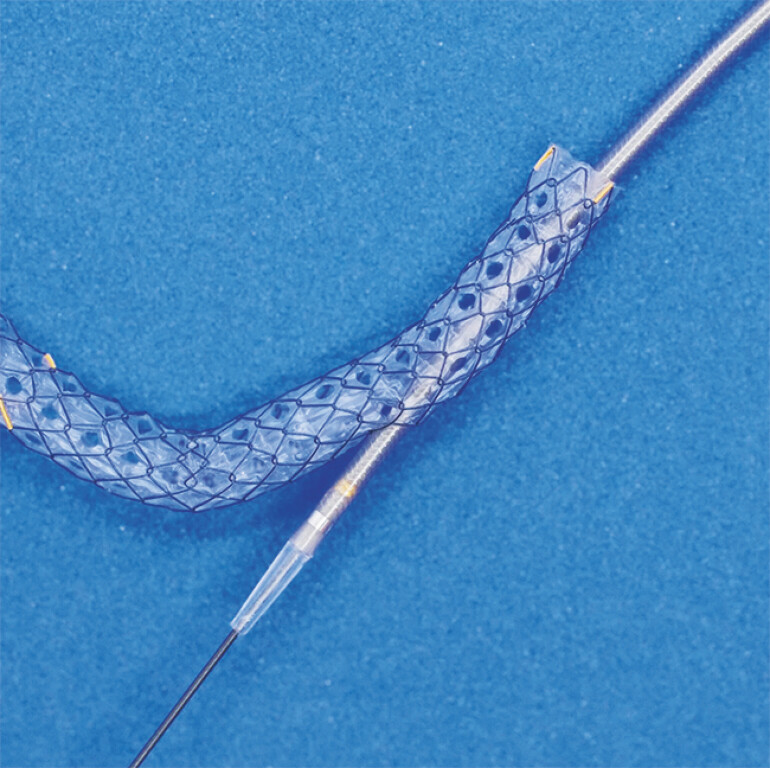 Fig. 1
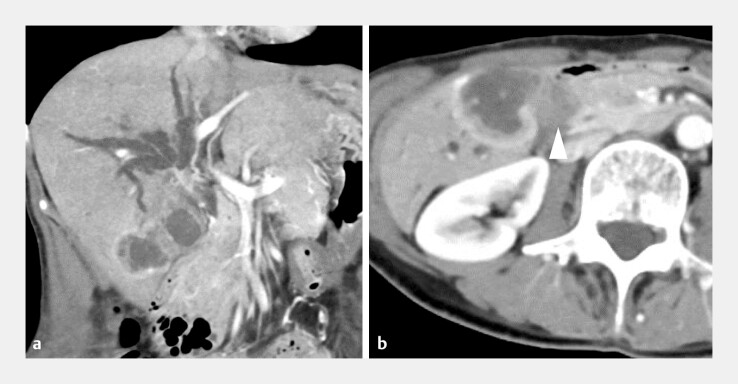 Fig. 2
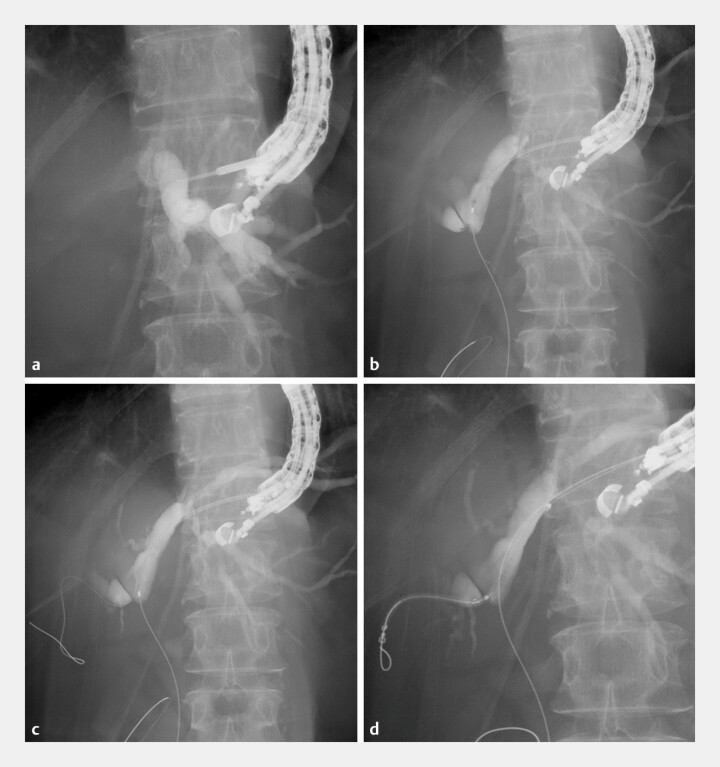 Fig. 3
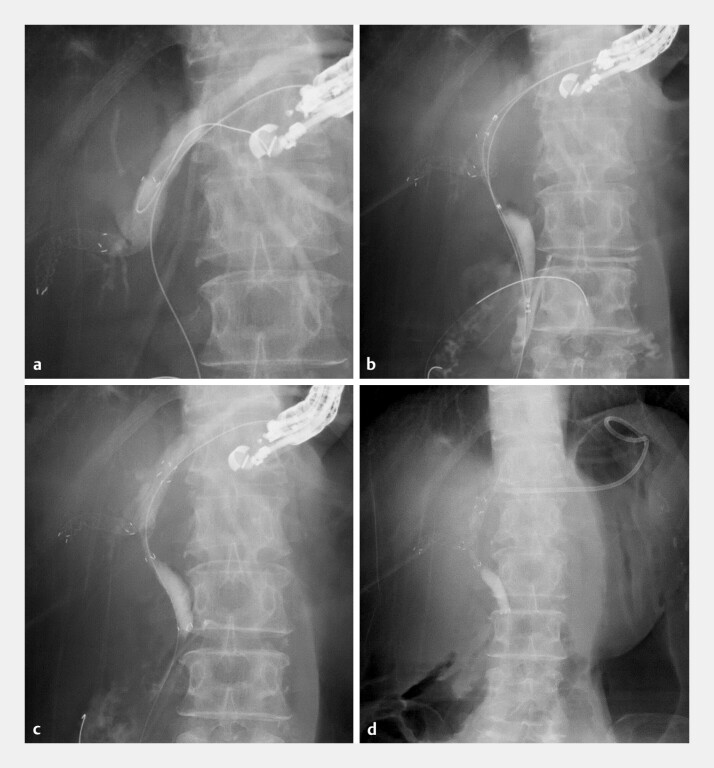 Fig. 4
Peer Reviews
No public reviews on file for this paper yet. If you reviewed it on a platform where reviews are public (OpenReview, ICLR, NeurIPS, ICML), you can paste yours below so the community can read it here.
Videos
No videos yet. Explain this paper in a talk, walkthrough, or lecture? Add one.
Taxonomy
TopicsGallbladder and Bile Duct Disorders · Esophageal and GI Pathology · Organ Transplantation Techniques and Outcomes
Endoscopic ultrasound-guided hepaticogastrostomy (EUS-HGS) has been used in combination with bridging and antegrade stenting 1 2 ; however, uncovered metal stents often suffer from tumor ingrowth and limited patency 3 . A newly developed multi-hole metal stent with a 5.9-Fr slim delivery system (HANAROSTENT Biliary Multi Hole Benefit; M.I. Tech Co., Ltd, Pyeongtaek, South Korea) has been developed ( Fig. 1 4 5 ). Herein, we report a novel EUS-HGS technique achieving simultaneous bridging and antegrade stent-in-stent placement using multi-hole metal stents ( Video 1 ). A 67-year-old woman was referred to our hospital with hilar biliary obstruction due to advanced gallbladder cancer ( Fig. 2 ). Because the duodenum was obstructed, EUS-HGS was selected as the initial drainage approach ( Fig. 3 , Fig. 4 ). The intrahepatic bile duct was punctured using a 19-gauge needle, and after contrast injection, a 0.025-inch guidewire was advanced across the stricture into the common bile duct, followed by insertion of a double-lumen catheter. Cholangiography revealed a bismuth type IIIa stricture, and a second guidewire was inserted into the right anterior branch. A slim delivery system for the multi-hole metal stent was smoothly advanced across the hilar stricture into the anterior brunch. The first multi-hole metal stent (6 mm and 6 cm) was deployed as a bridging stent from the right to the left intrahepatic bile duct. The guidewire was then manipulated through a side hole of the first stent toward the common bile duct, and both the side hole and the stricture were dilated using a balloon catheter. A second multi-hole metal stent was inserted as an antegrade stent through the side hole, resulting in successful partial stent-in-stent placement. Finally, a plastic stent was placed through the hepaticogastrostomy tract. To the best of our knowledge, this is the first report of EUS-HGS with simultaneous bridging and antegrade stent-in-stent placement using multi-hole metal stents. This technique may offer prolonged patency for hilar biliary obstruction with duodenal stenosis.
HANAROSTENT Biliary Multi Hole Benefit (M.I. Tech Co., Ltd, Pyeongtaek, South Korea). The 5.9-Fr slim delivery system can pass smoothly through the side hole.
A novel EUS-HGS technique achieving simultaneous bridging and antegrade stent-in-stent placement using multi-hole metal stents. EUS-HGS, endoscopic ultrasound-guided hepaticogastrostomy.Video 1
Computed tomographic images before biliary drainage. a Coronal imaging shows a bismuth type IIIa hilar biliary obstruction caused by advanced gallbladder cancer. b The duodenum is obstructed by tumor invasion.
Endoscopic ultrasonography-guided hepaticogastrostomy. a The intrahepatic bile duct is punctured using a 19-gauge needle. b A guidewire is advanced across the stricture, and cholangiography confirms hilar biliary obstruction. c A second guidewire is inserted into the right anterior branch using a double-lumen catheter. d The slim delivery system of the first stent is smoothly advanced into the right anterior branch.
Bridging and antegrade stent-in-stent placement under EUS-HGS guidance. a After deployment of the first multi-hole metal stent as a bridging stenting, the guidewire is manipulated through a side hole toward the common bile duct. b The guidewire is advanced across the stricture, followed by 6-mm balloon dilation of both the side hole and the stricture. c The second multi-hole metal stent is deployed as an antegrade stent through the side hole of the first stent. d A 7-Fr plastic stent is finally placed through the hepaticogastrostomy tract. EUS-HGS, endoscopic ultrasound-guided hepaticogastrostomy.
Endoscopy_UCTN_Code_TTT_1AS_2AH
The reference list from the paper itself. Each links out to its DOI / PubMed record.
- 1Ogura T Sano T Onda S Endoscopic ultrasound-guided biliary drainage for right hepatic bile duct obstruction: novel technical tips Endoscopy 201547727510.1055/s-0034-137811125264761 · doi ↗ · pubmed ↗
- 2Inoue T Kitano R Kitada T Novel specialized guidewire for bridging deployment into the right hepatic duct via endoscopic ultrasound-guided hepaticogastrostomy for malignant hilar biliary obstruction Endoscopy 202456 E 943E 94439515763 10.1055/a-2440-7314 PMC 11548957 · doi ↗ · pubmed ↗
- 3Isayama H Nakai Y Kogure H Biliary self-expandable metallic stent for unresectable malignant distal biliary obstruction: which is better: covered or uncovered?: SEMS for malignant distal biliary obstruction Dig Endosc 201325717410.1111/den.1207823617653 · doi ↗ · pubmed ↗
- 4Maruyama H Ishikawa-Kakiya Y Kawata Y Stent-in-stent deployment across the papilla for malignant hilar biliary obstruction using novel slim multi-hole metal stents Endosc Int Open 202513 a 2714245310.1055/a-2714-245341142262 PMC 12551655 · doi ↗ · pubmed ↗
- 5Ogura T Matsuno J Kanadani T Endoscopic hepaticogastrostomy combined with antegrade stent deployment using a multi-hole stent with a 5.9-Fr stent delivery system for patients with complete situs inversus Endoscopy 202557 E 721E 72240614777 10.1055/a-2625-3827 PMC 12227271 · doi ↗ · pubmed ↗