PHScaffolding: a hypergraph clustering and dual-weight integration strategy for scaffolding with Pore-C reads
Quan Su, Junwei Luo, Fei Guo

TL;DR
PHScaffolding is a new method for genome scaffolding that uses Pore-C data to improve accuracy and continuity compared to traditional Hi-C-based methods.
Contribution
Introduces a hypergraph clustering and dual-weight integration strategy specifically for scaffolding with Pore-C reads.
Findings
PHScaffolding outperforms traditional Hi-C-based methods in terms of NA50 and NGA50 metrics.
The method shows robust performance across human and plant genome datasets.
It achieves lower misassembly rates compared to existing scaffolding approaches.
Abstract
Genome assembly aims to construct chromosome-level genome sequences, with scaffolding serving as a critical step, the accuracy of which highly depends on the quality of the input data. Although both Hi-C and Pore-C technologies are used to study genomic 3D structures, Pore-C demonstrates irreplaceable advantages in high-precision assembly due to its ability to capture long-range information and provide multi-fragment interaction information. However, most current scaffolding methods primarily rely on Hi-C data, which is limited by the inherent constraints of the technology, resulting in deficiencies in assembly continuity and accuracy. We propose a scaffolding method based on Pore-C data, named PHScaffolding. This method constructs a hypergraph by leveraging alignment information from Pore-C reads to capture multi-way interactions among contigs. A dedicated weighting scheme for…
Genes, proteins, chemicals, diseases, species, mutations and cell lines named across the full text — each resolved to its canonical identifier and authoritative record.
Click any figure to enlarge with its caption.
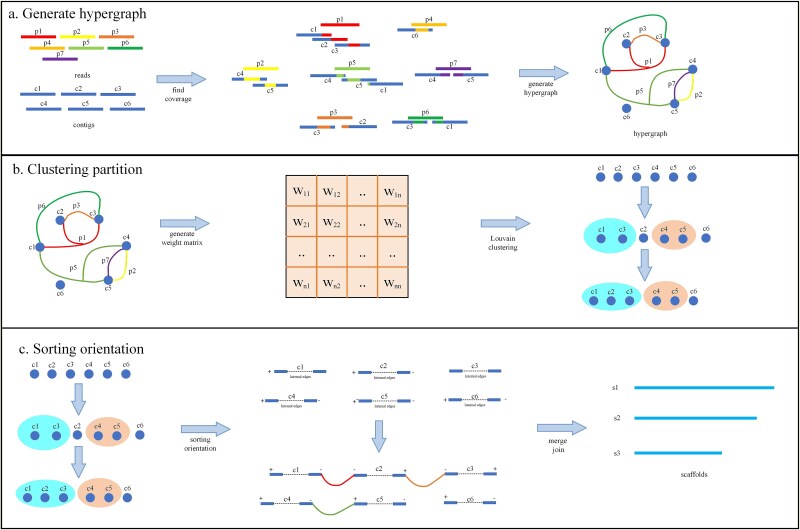 Figure 1
 Figure 2
Peer Reviews
No public reviews on file for this paper yet. If you reviewed it on a platform where reviews are public (OpenReview, ICLR, NeurIPS, ICML), you can paste yours below so the community can read it here.
Videos
No videos yet. Explain this paper in a talk, walkthrough, or lecture? Add one.
Taxonomy
TopicsGenomics and Phylogenetic Studies · Genomics and Chromatin Dynamics · Genome Rearrangement Algorithms