Silapropofol: Carbon–Silicon Isosterism in a Key Anesthetic Scaffold
Sarah Koschabek, Florian Kleemiss, Noel Angel Espinosa-Jalapa, Jonathan O. Bauer

TL;DR
Scientists created silicon-based versions of the anesthetic propofol and found that these analogs have different stability and electronic properties.
Contribution
The first synthesis and characterization of silicon analogs of propofol, revealing new insights into carbon–silicon isosterism in drug design.
Findings
Monosilapropofol (2) undergoes gradual hydrolysis under physiological conditions.
Disilapropofol (3) is remarkably stable in neutral saline solution.
Silicon substitution alters electronic properties and stability in propofol derivatives.
Abstract
Propofol (2,6-di-iso-propylphenol) (1) is one of the most widely used intravenous anesthetics, yet its high lipophilicity, formulation challenges, and incompletely understood binding mode motivate the exploration of structural analogues. Here, we report the synthesis and comprehensive characterization of the first silicon analogues of propofol, monosilapropofol (2) and disilapropofol (3), in which one or both iso-propyl groups are replaced by dimethylsilyl substituents. Key steps involve optimized [1,3]-retro-Brook rearrangements, with tert-butyllithium-mediated Li/Br exchange enabling efficient access to both targets. Crystalline potassium phenolate 2-K provided the first X-ray diffraction analysis of a silapropofol derivative, and complementary quantum chemical analysis based on orbital, topological, and localizability descriptors revealed pronounced polarization effects and bond…
Genes, proteins, chemicals, diseases, species, mutations and cell lines named across the full text — each resolved to its canonical identifier and authoritative record.
Click any figure to enlarge with its caption.
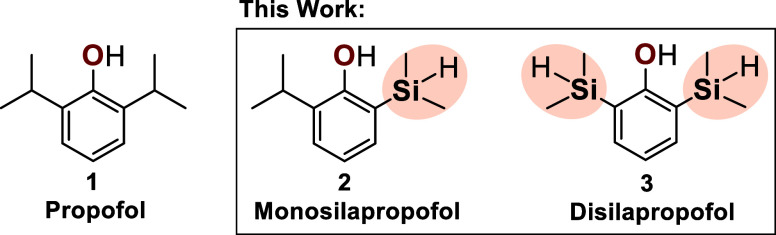 Figure 1
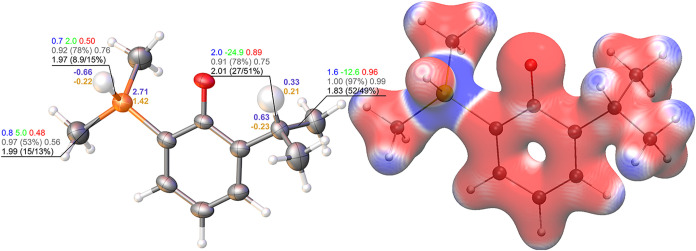 Figure 2
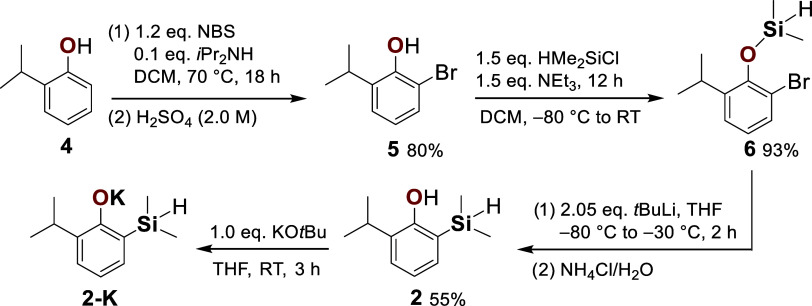 Figure 3
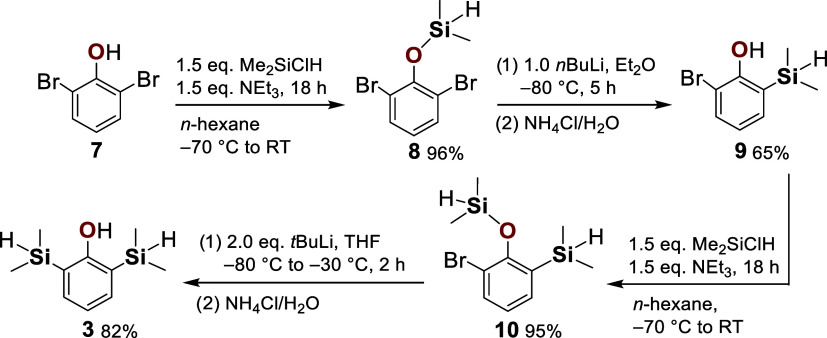 Figure 4
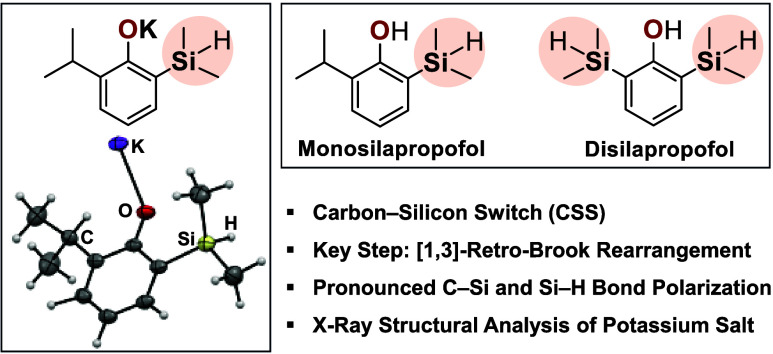 Figure 5
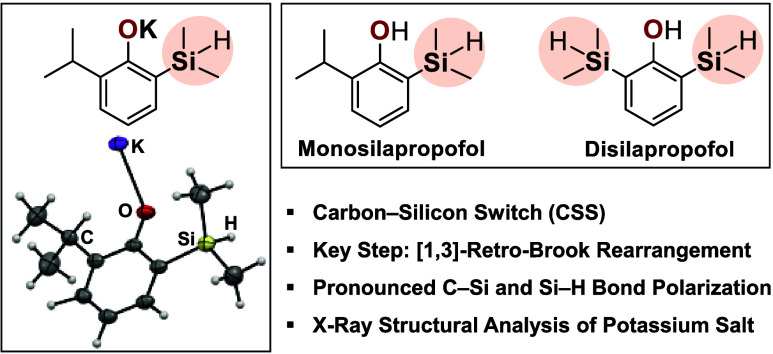 Figure 6
Peer Reviews
No public reviews on file for this paper yet. If you reviewed it on a platform where reviews are public (OpenReview, ICLR, NeurIPS, ICML), you can paste yours below so the community can read it here.
Videos
No videos yet. Explain this paper in a talk, walkthrough, or lecture? Add one.
Taxonomy
TopicsSynthesis and characterization of novel inorganic/organometallic compounds · Coordination Chemistry and Organometallics · Synthesis and Properties of Aromatic Compounds