Spectroscopic Fingerprinting of Coordination‐driven Spin States in Metal‐organic Architectures
Yan Yan Grisan Qiu, Silvia Carlotto, Simone Mearini, Daniel Baranowski, Iulia Cojocariu, Matteo Jugovac, Giovanni Zamborlini, Pierluigi Gargiani, Manuel Valvidares, Vitaliy Feyer, Claus Michael Schneider

TL;DR
This paper uses advanced calculations and X-ray techniques to determine the spin and geometry of cobalt in a metal-organic framework on graphene.
Contribution
A direct method to link coordination geometry to spin and oxidation states in metal-organic systems is established.
Findings
High-spin tetrahedral geometry is confirmed for Co2+ in the supported Co-TCNQ framework.
Spectroscopic fingerprints distinguish between planar and tetrahedral Co structures.
XAS and XMCD validate theoretical predictions of spin and oxidation states.
Abstract
Determining the local geometry of metal‐organic architecture on substrates is challenging, as substrate interactions can alter the metal coordination relative to the free‐standing structure. Here, combining density functional theory (DFT) and restricted open‐shell configuration interaction with singles (ROCIS) calculations on isolated cobalt‐7,7,8,8‐tetracyanoquinodimethane (Co‐TCNQ) complexes, together with X‐ray absorption spectroscopy (XAS) and X‐ray magnetic circular dichroism (XMCD), directly reveals the coordination motifs of Co centers in a 2D Co‐TCNQ framework on graphene. The calculated Co L3,2‐edges spectroscopic fingerprints for nearly planar (Co2+, S = 1/2) and distorted tetrahedral (Co2+, S = 3/2) structures exhibit distinct features, allowing unambiguous assignment of spin and oxidation states of the metal centers, as well as confirmation of the local geometry. Comparison…
Genes, proteins, chemicals, diseases, species, mutations and cell lines named across the full text — each resolved to its canonical identifier and authoritative record.
Click any figure to enlarge with its caption.
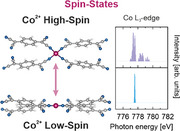 Figure 1
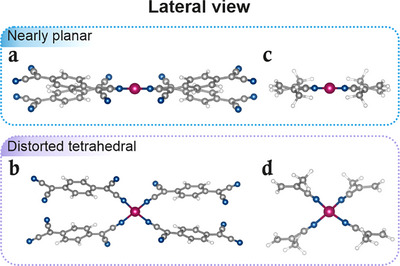 Figure 2
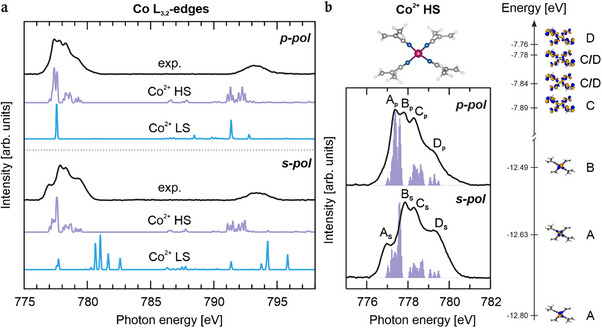 Figure 3
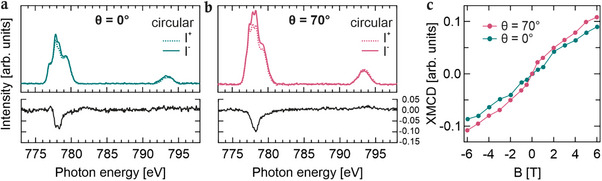 Figure 4
Peer Reviews
No public reviews on file for this paper yet. If you reviewed it on a platform where reviews are public (OpenReview, ICLR, NeurIPS, ICML), you can paste yours below so the community can read it here.
Videos
No videos yet. Explain this paper in a talk, walkthrough, or lecture? Add one.
Taxonomy
TopicsSurface Chemistry and Catalysis · Magnetism in coordination complexes · Organic and Molecular Conductors Research