The Virtual Kitchen Challenge—Version 2: Validation of a Digital Assessment of Everyday Function in Older Adults
Marina Kaplan, Moira McKniff, Stephanie M Simone, Molly B Tassoni, Katherine Hackett, Sophia Holmqvist, Rachel E Mis, Kimberly Halberstadter, Riya Chaturvedi, Melissa Rosahl, Giuliana Vallecorsa, Mijiail D Serruya, Deborah A G Drabick, Takehiko Yamaguchi, Tania Giovannetti

TL;DR
The Virtual Kitchen Challenge—Version 2 is a digital tool that efficiently and accurately assesses everyday functioning in older adults, including those with mild dementia.
Contribution
VKC-2 introduces an objective, standardized digital assessment of everyday function with strong validity and reliability across cognitive aging stages.
Findings
VKC-2 scores significantly differentiate between healthy cognition and cognitive impairment after controlling for demographics.
Strong correlations exist between VKC-2 scores and real-world kitchen performance, cognitive tests, and self/informant reports.
Retest reliability of VKC-2 is moderate to excellent, with improved reliability when cognitive status remains stable.
Abstract
Conventional methods of functional assessment include subjective self- or informant report, which may be biased by personal characteristics, cognitive abilities, and lack of standardization (eg, influence of idiosyncratic task demands). Traditional performance-based assessments offer some advantages over self- or informant reports but are time-consuming to administer and score. This study aims to evaluate the validity and reliability of the Virtual Kitchen Challenge—Version 2 (VKC-2), an objective, standardized, and highly efficient alternative to current functional assessments for older adults across the spectrum of cognitive aging, from preclinical to mild dementia. A total of 236 community-dwelling, diverse older adults completed a comprehensive neuropsychological evaluation to classify cognitive status as healthy, mild cognitive impairment, or mild dementia, after adjustment for…
Genes, proteins, chemicals, diseases, species, mutations and cell lines named across the full text — each resolved to its canonical identifier and authoritative record.
Click any figure to enlarge with its caption.
 Figure 1
 Figure 2
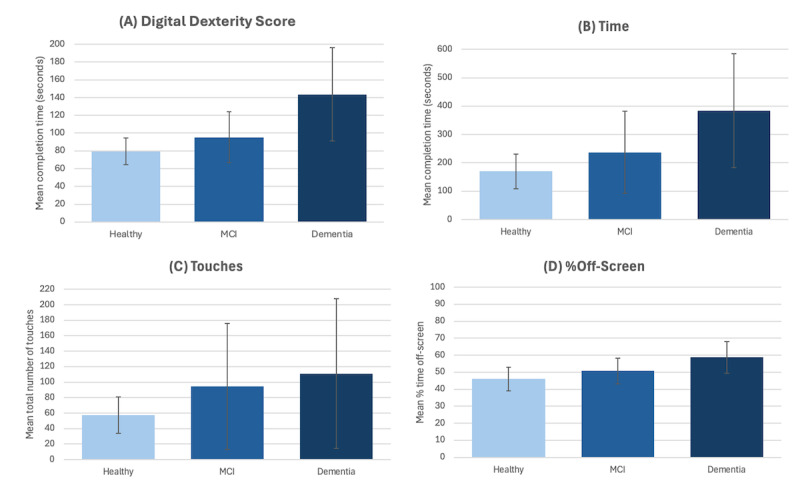 Figure 3
Peer Reviews
No public reviews on file for this paper yet. If you reviewed it on a platform where reviews are public (OpenReview, ICLR, NeurIPS, ICML), you can paste yours below so the community can read it here.
Videos
No videos yet. Explain this paper in a talk, walkthrough, or lecture? Add one.
Taxonomy
TopicsTechnology Use by Older Adults · Frailty in Older Adults · Balance, Gait, and Falls Prevention