Large Language Models in Patient Health Communication for Atherosclerotic Cardiovascular Disease: Pilot Cross-Sectional Comparative Analysis
Pengfei Li, Yinfei Xu, Xiang Liu, Zhean Shen, Yi Wang, Xinyi Lv, Ziyi Lu, Hui Wu, Jiaqi Zhuang, Yan Chen

TL;DR
This study compares three large language models in providing health information about heart disease in English and Chinese, finding one model performs best but all struggle with treatment guidelines.
Contribution
First comparative evaluation of LLMs for patient-centered ASCVD communication in multilingual settings with clinical validation.
Findings
DeepSeek R1 outperformed ChatGPT-4o and Gemini in accuracy and completeness for ASCVD information in both English and Chinese.
All models performed poorly in providing guideline-concordant treatment regimens for ASCVD.
Comprehensibility was highest for DeepSeek R1 and ChatGPT-4o in English but not significantly different in Chinese.
Abstract
Large language models (LLMs) have emerged as promising tools for enhancing public access to medical information, particularly for chronic diseases such as atherosclerotic cardiovascular disease (ASCVD). However, their effectiveness in patient-centered health communication remains underexplored, especially in multilingual contexts. Our study aimed to conduct a comparative evaluation of 3 advanced LLMs—DeepSeek R1, ChatGPT-4o, and Gemini—in generating responses to ASCVD-related patient queries in both English and Chinese, assessing their performance across the domains of accuracy, completeness, and comprehensibility. We conducted a cross-sectional evaluation based on 25 clinically validated ASCVD questions spanning 5 domains—definitions, diagnosis, treatment, prevention, and lifestyle. Each question was submitted 5 times to each of the 3 LLMs in both English and Chinese, yielding 750…
Genes, proteins, chemicals, diseases, species, mutations and cell lines named across the full text — each resolved to its canonical identifier and authoritative record.
Click any figure to enlarge with its caption.
 Figure 1
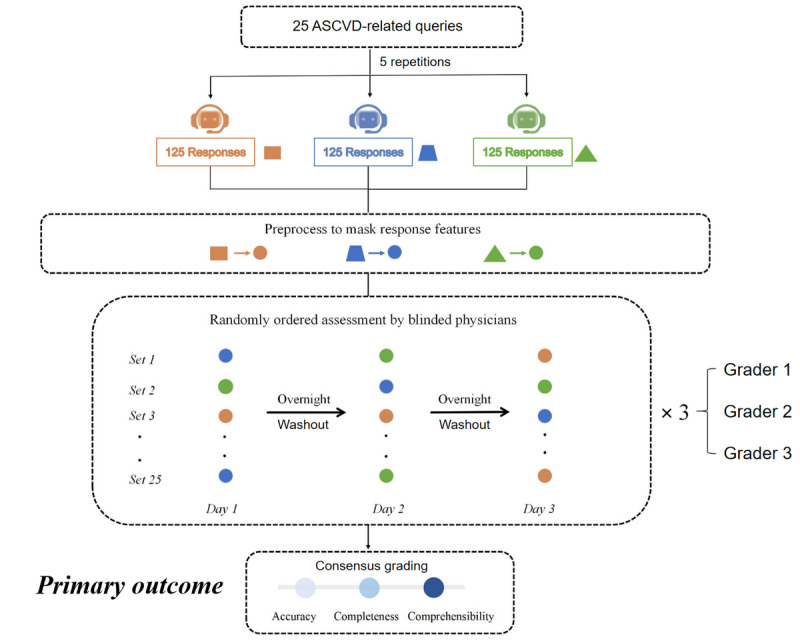 Figure 2
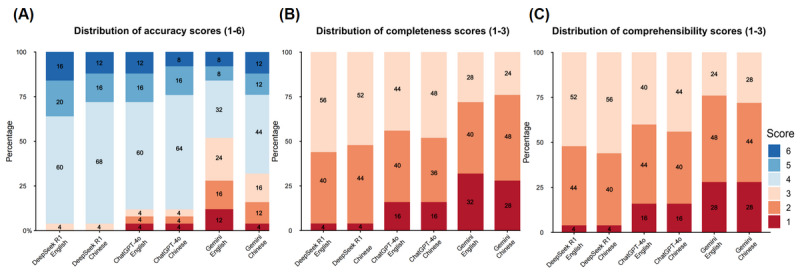 Figure 3
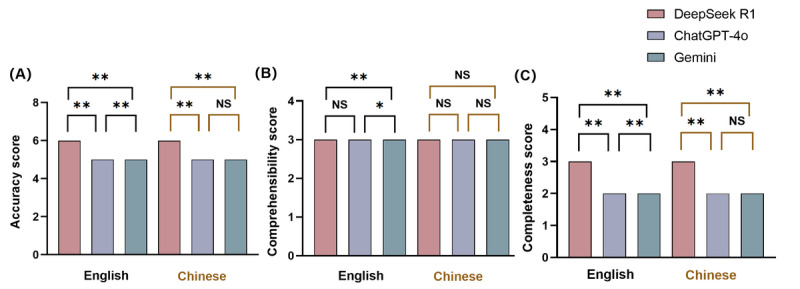 Figure 4
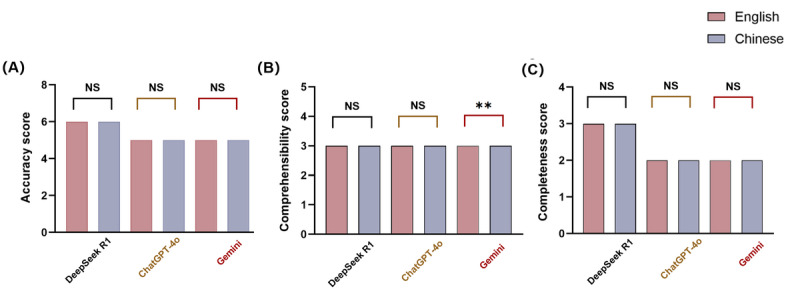 Figure 5
Peer Reviews
No public reviews on file for this paper yet. If you reviewed it on a platform where reviews are public (OpenReview, ICLR, NeurIPS, ICML), you can paste yours below so the community can read it here.
Videos
No videos yet. Explain this paper in a talk, walkthrough, or lecture? Add one.
Taxonomy
TopicsArtificial Intelligence in Healthcare and Education · Machine Learning in Healthcare · Health Literacy and Information Accessibility