Demographic and Clinical Characteristics Influencing Ecological Momentary Assessment Compliance in Individuals With Bipolar Disorder: Observational Study
Linru Yin, Minghui Li, Jinhao Li, Xiaofei Hou, Jianan Song, Xinyan Li, Yue Tong, Xinyue Zhou, Lidan Yuan, Huifang Yin, Guangming Xu

TL;DR
This study examines how well Chinese individuals with bipolar disorder follow a 14-day mood monitoring program using a WeChat app and identifies factors that influence their compliance.
Contribution
The study identifies clinical factors influencing EMA compliance in bipolar disorder patients in China, offering insights for improving monitoring protocols.
Findings
The median compliance rate for EMA monitoring was 75% over 14 days.
Higher mania scores and lower functional impairment were linked to better compliance.
Compliance did not vary significantly across different mood states.
Abstract
Bipolar disorder requires immediate and frequent daily symptom monitoring due to its extreme mood fluctuations. Ecological momentary assessment (EMA) technology uses high-frequency data collection to achieve ecologically valid capture of patient symptoms. Investigating EMA compliance among Chinese patients with bipolar disorder and its influencing factors is essential for developing more feasible daily symptom monitoring protocols. This study aimed to investigate the 14-day compliance rate of EMA among Chinese individuals with bipolar disorder and to examine the demographic and clinical characteristics associated with that compliance. A total of 100 adults (63 female individuals) with bipolar disorder across mood states (depressive episode, n=29, 29%; hypomanic or manic episode, n=17, 17%; euthymic state, n=54, 54%) completed self-monitoring via the WeChat Mini Program “Xunkang…
Genes, proteins, chemicals, diseases, species, mutations and cell lines named across the full text — each resolved to its canonical identifier and authoritative record.
Click any figure to enlarge with its caption.
 Figure 1
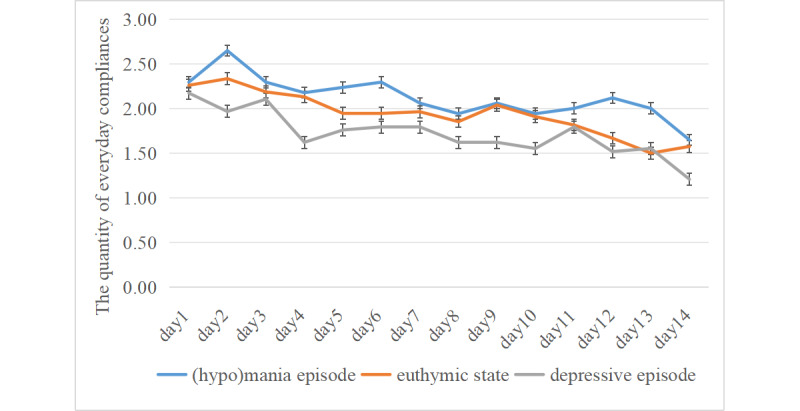 Figure 2
Peer Reviews
No public reviews on file for this paper yet. If you reviewed it on a platform where reviews are public (OpenReview, ICLR, NeurIPS, ICML), you can paste yours below so the community can read it here.
Videos
No videos yet. Explain this paper in a talk, walkthrough, or lecture? Add one.
Taxonomy
TopicsBipolar Disorder and Treatment · Mental Health Research Topics · Digital Mental Health Interventions