Chemosensory response to Pt-based chemotherapeutics via bitter taste receptors in vitro reveals a new mechanism for bitter taste disorders
Sofie Zehentner, Agnes Mistlberger-Reiner, Philip Pirkwieser, Noreen Orth, Valerie Boger, Kristin Kahlenberg, Johanna Kreißl, Christoph Grimm, Jakob Peter Ley, Veronika Somoza

TL;DR
This study shows that platinum-based chemotherapy drugs trigger bitter taste responses through specific receptors, and a compound can reduce this effect, offering a potential treatment for bitter taste disorders in cancer patients.
Contribution
The study identifies bitter taste receptors TAS2R4 and TAS2R5 as mediators of Pt-based drug-induced bitterness and shows that Na-HED can counteract this effect.
Findings
Carboplatin and cisplatin induce dose-dependent bitter responses via TAS2R4 and TAS2R5.
Na-HED significantly reduces the bitter response to both drugs in vitro.
TAS2Rs modulate the cellular uptake of Pt-based chemotherapeutics.
Abstract
Chemotherapeutics like platinum (Pt)-based drugs cause bitter taste disorders, which impair patients’ food intake and quality of life. However, the role of bitter taste receptors (TAS2Rs) remains unexplored, limiting the development of targeted treatments for this clinically impactful side effect. By performing a TAS2R-sensitive bitterness assay based on human gastric parietal cells (HGT-1), we evaluated the bitterness of Pt-based agents and the counteracting potential of the bitter-masking sodium salt of the flavanone homoeriodictyol (Na-HED). Here, we report that carboplatin (50–750 µM) and cisplatin (5–50 µM) elicited dose-dependent cellular bitter responses, with cisplatin evoking a stronger effect. Functional involvement of TAS2R4 and TAS2R5 was confirmed by CRISPR-Cas9 knockout- and siRNA knockdown-experiments. Na-HED reduced the cellular bitter response of 200 µM carboplatin (−…
Genes, proteins, chemicals, diseases, species, mutations and cell lines named across the full text — each resolved to its canonical identifier and authoritative record.
Click any figure to enlarge with its caption.
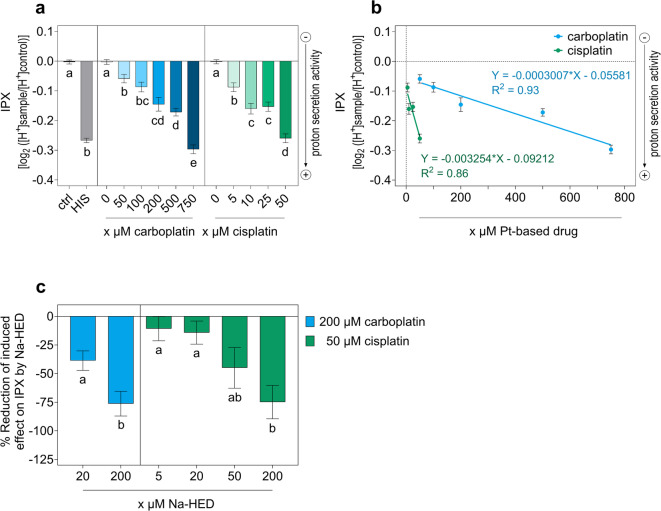 Figure 1
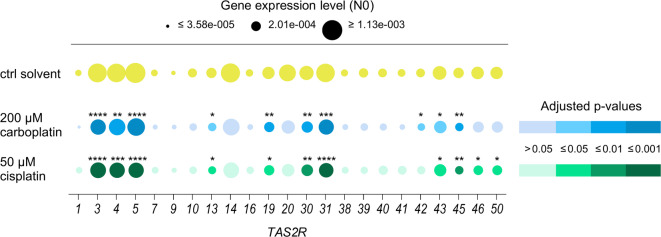 Figure 2
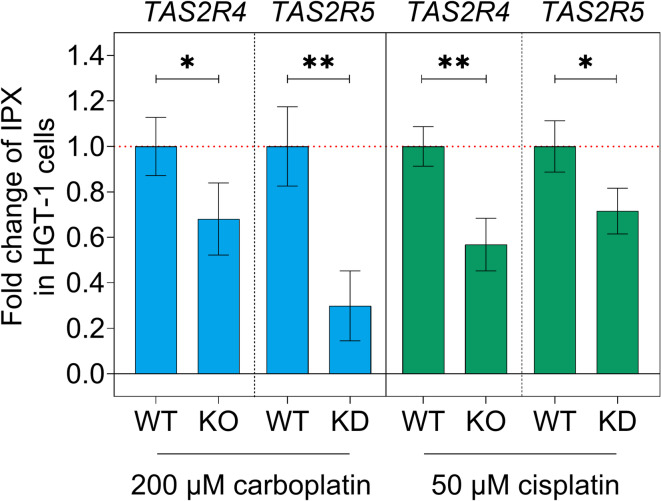 Figure 3
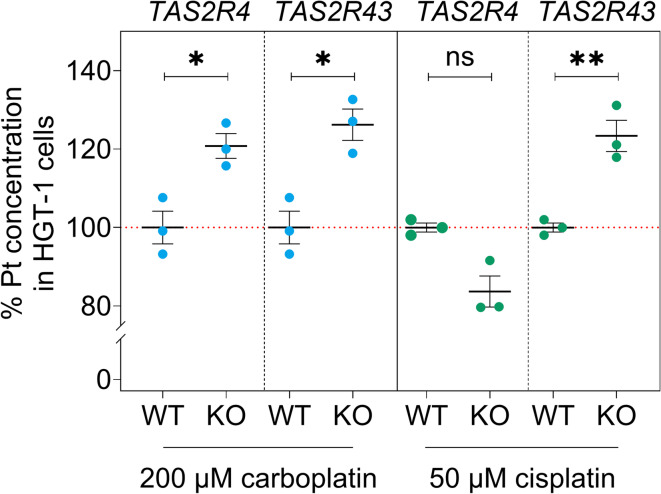 Figure 4
Peer Reviews
No public reviews on file for this paper yet. If you reviewed it on a platform where reviews are public (OpenReview, ICLR, NeurIPS, ICML), you can paste yours below so the community can read it here.
Videos
No videos yet. Explain this paper in a talk, walkthrough, or lecture? Add one.
Taxonomy
TopicsBiochemical Analysis and Sensing Techniques · Advanced Chemical Sensor Technologies · Olfactory and Sensory Function Studies