Southern hemisphere ceratosaurs evolved feeding mechanics paralleling those of Northern hemisphere tyrannosaurids
Andre J. Rowe, Mauricio A. Cerroni, Emily J. Rayfield

TL;DR
Southern hemisphere ceratosaurs evolved skull structures similar to Northern hemisphere tyrannosaurids, suggesting parallel ecological roles despite different physical traits.
Contribution
This study uses 3D modeling and finite element analysis to test ceratosaur skull mechanics, revealing new insights into their feeding adaptations.
Findings
Large abelisaurs do not exhibit low stress under bite loading despite compact skull shapes.
Cranial ornamentation in ceratosaurs does not act as a structural buttress.
Masiakasaurus likely specialized in grasping small prey, indicating niche partitioning with Majungasaurus.
Abstract
Ceratosaurs (Ceratosauria), including Ceratosaurus and derived abelisaurids such as Carnotaurus, were the dominant large-bodied predators in Cretaceous ecosystems of the Southern Hemisphere, paralleling the ecological role of tyrannosaurids in the Cretaceous Northern Hemisphere. They are known for their short, deep skulls and prominent cranial ornamentation. These traits have often been interpreted as potential adaptations for intraspecific combat, sexual display, and as a buttress during feeding-induced mechanical stresses. While these adaptations have often been discussed, they have been subject to little mechanical testing, particularly using 3D models due to previous limitations in software. Here we used a mixture of computed tomography (CT) scanning and surface scanning to create accurate 3D models of four ceratosaurian skulls: Ceratosaurus, Masiakasaurus, Carnotaurus, and…
Genes, proteins, chemicals, diseases, species, mutations and cell lines named across the full text — each resolved to its canonical identifier and authoritative record.
Click any figure to enlarge with its caption.
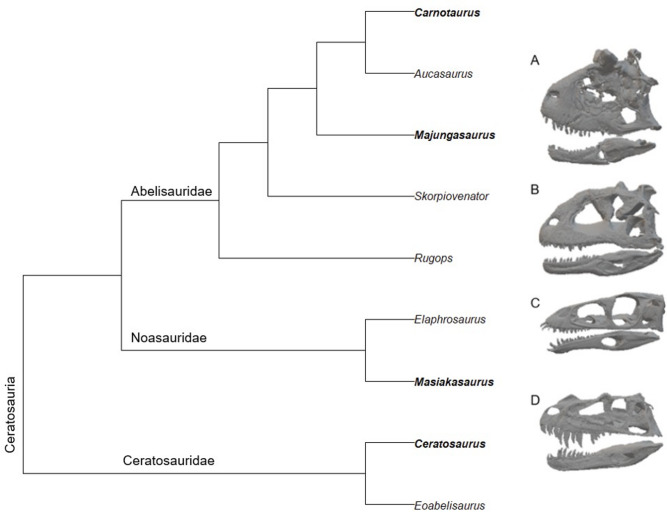 Figure 1
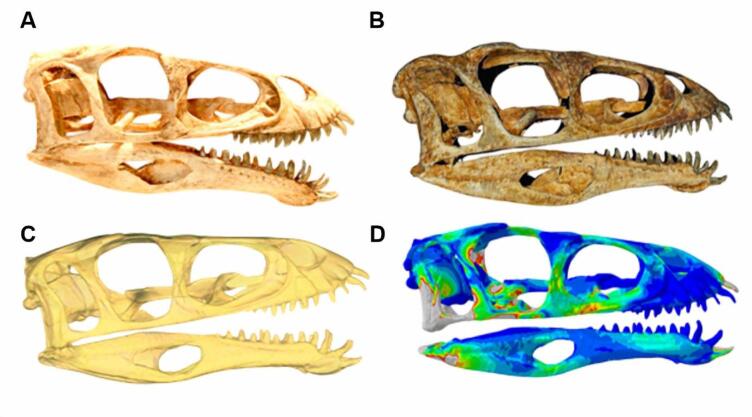 Figure 2
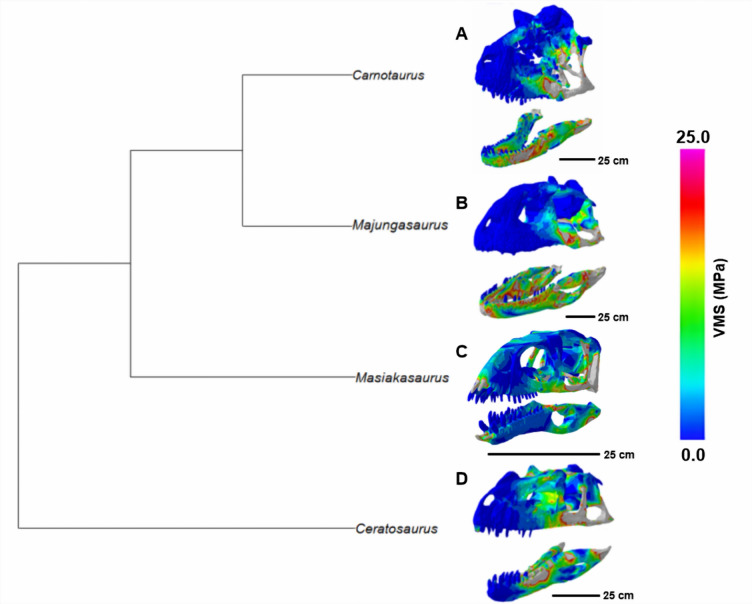 Figure 3
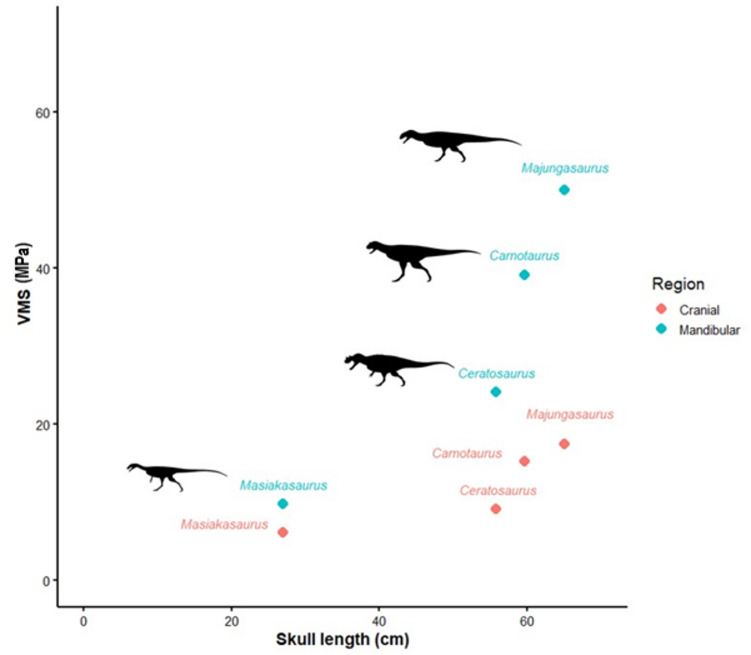 Figure 4
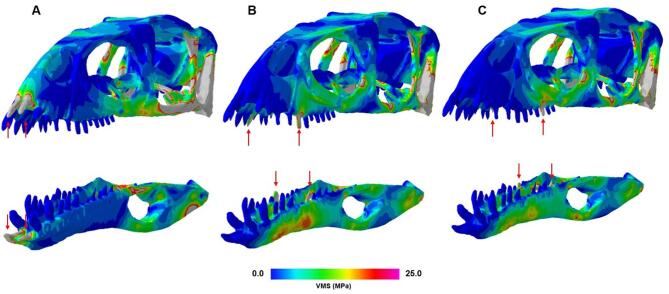 Figure 5
Peer Reviews
No public reviews on file for this paper yet. If you reviewed it on a platform where reviews are public (OpenReview, ICLR, NeurIPS, ICML), you can paste yours below so the community can read it here.
Videos
No videos yet. Explain this paper in a talk, walkthrough, or lecture? Add one.
Taxonomy
TopicsPaleontology and Evolutionary Biology · Evolution and Paleontology Studies · Paleontology and Stratigraphy of Fossils