Professional perspectives on recurrent characteristics of dogs with separation-related problems: a qualitative study in three nordic countries
Emma Almquist, Iben Meyer, Peter Sandøe, Karoline Måseide Thomassen, Ruth C. Newberry, Therese Rehn

TL;DR
This study explores professional insights into separation-related problems in dogs, identifying recurring themes that may help improve understanding and treatment.
Contribution
The study introduces professionally situated knowledge from Nordic dog professionals to better understand separation-related problems in dogs.
Findings
Six central themes were identified, such as co-occurring behavioral difficulties and changes to routine.
Some themes align with existing research, while others highlight underexplored areas like owner stress and adolescence effects.
The findings support a context-aware approach to understanding and managing separation-related problems in dogs.
Abstract
Separation related problems (SRPs) are common in companion dogs and give rise to serious problems for both dog welfare and owner quality of life. However, they are not well understood, making them difficult to prevent and treat. A so far underutilised source of knowledge is experience from professional behaviour practice. In this qualitative study, we explored professionally situated knowledge to identify factors that may contribute to the development of SRPs in dogs. The study is based on 15 semi-structured interviews with a diverse group of dog professionals (veterinarians, animal behaviourists, dog trainers) involved in the treatment of SRPs in Denmark, Sweden, and Norway. The transcripts were analysed using reflexive thematic analysis. Six central themes emerged from this analysis, which were labelled “co-occurring behavioural difficulties”, “a body in flux”, “dog training gone…
Genes, proteins, chemicals, diseases, species, mutations and cell lines named across the full text — each resolved to its canonical identifier and authoritative record.
Click any figure to enlarge with its caption.
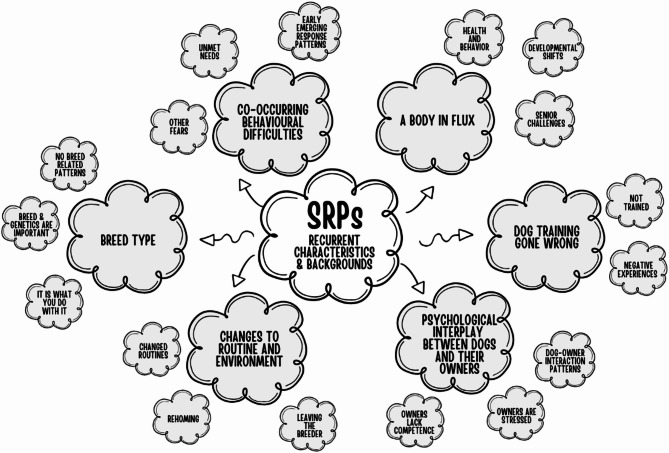 Figure 1
Peer Reviews
No public reviews on file for this paper yet. If you reviewed it on a platform where reviews are public (OpenReview, ICLR, NeurIPS, ICML), you can paste yours below so the community can read it here.
Videos
No videos yet. Explain this paper in a talk, walkthrough, or lecture? Add one.
Taxonomy
TopicsHuman-Animal Interaction Studies · Veterinary Orthopedics and Neurology · Veterinary Practice and Education Studies