Self-aligned and self-limiting van der Waals epitaxy of monolayer MoS2 for scalable 2D electronics
Yoshiki Sakuma, Keisuke Atsumi, Takanobu Hiroto, Jun Nara, Akihiro Ohtake, Yuki Ono, Takashi Matsumoto, Yukihiro Muta, Kai Takeda, Emi Kano, Toshiki Yasuno, Xu Yang, Nobuyuki Ikarashi, Asato Suzuki, Michio Ikezawa, Shuhong Li, Tomonori Nishimura, Kaito Kanahashi, Kosuke Nagashio

TL;DR
The paper introduces a new method for growing high-quality monolayer MoS2 on sapphire, using self-alignment and self-limiting growth to achieve better electronic properties.
Contribution
A novel self-alignment and self-limiting growth mechanism for MoS2 on sapphire using MOCVD is introduced.
Findings
Misoriented domains self-align and merge into a single-crystal MoS2 film during growth.
The use of MoO2Cl2 enables self-limiting growth of MoS2.
Achieved carrier mobilities of 66 cm²/Vs at room temperature and 749 cm²/Vs at low temperatures.
Abstract
Unidirectional nucleation followed by seamless stitching has emerged as a promising strategy for the scalable epitaxial growth of single-crystalline monolayer transition metal dichalcogenides on sapphire substrates, which holds potential for post-silicon electronics. In contrast, here we present a different growth mechanism for single-crystalline MoS2 on c-plane sapphire via metal-organic chemical vapor deposition (MOCVD). We show that the initial nucleation generates not only 0° and antiparallel 60° domains but also low-angle twisted domains, consistent with the coincidence site lattice framework. However, these rotationally misoriented domains are observed to deterministically self-align and merge into energetically preferred 0° domain during coalescence, yielding a continuous, unidirectional single-crystal. Additionally, by employing MoO2Cl2 as a molybdenum precursor, we demonstrate…
Genes, proteins, chemicals, diseases, species, mutations and cell lines named across the full text — each resolved to its canonical identifier and authoritative record.
Click any figure to enlarge with its caption.
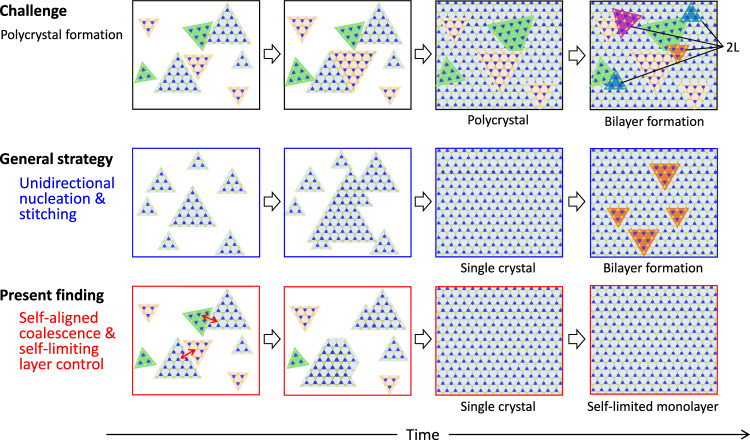 Figure 1
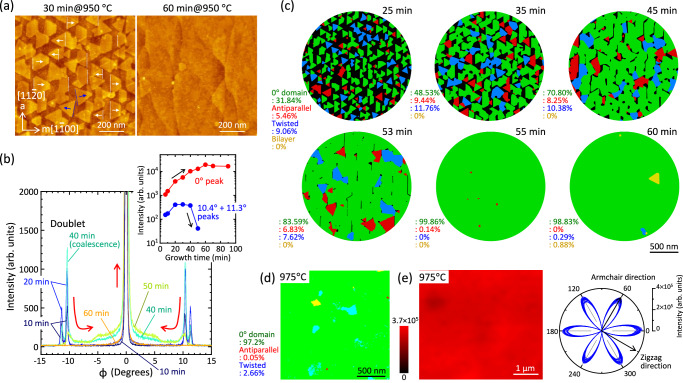 Figure 2
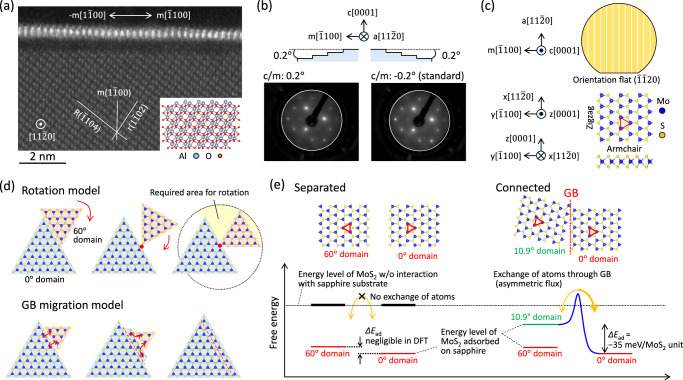 Figure 3
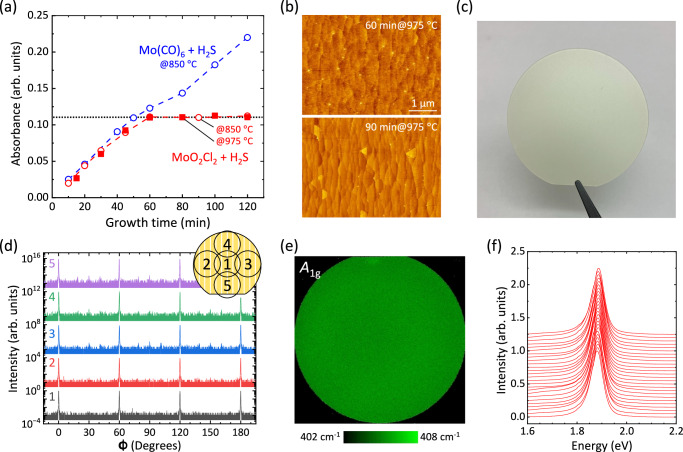 Figure 4
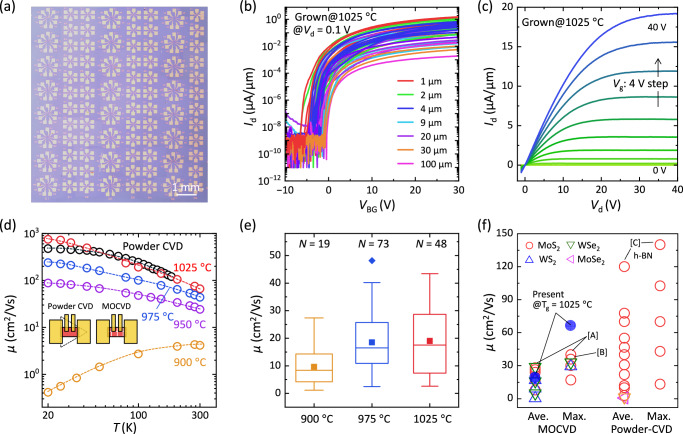 Figure 5
Peer Reviews
No public reviews on file for this paper yet. If you reviewed it on a platform where reviews are public (OpenReview, ICLR, NeurIPS, ICML), you can paste yours below so the community can read it here.
Videos
No videos yet. Explain this paper in a talk, walkthrough, or lecture? Add one.
Taxonomy
Topics2D Materials and Applications · Graphene research and applications · Solar-Powered Water Purification Methods