Assessment of phylogenetic informativeness in mitochondrial and nuclear genes for mammalian systematics using sparse learning
Carlos G. Schrago, Beatriz Mello

TL;DR
This study compares the usefulness of mitochondrial and nuclear genes for understanding mammalian evolutionary relationships using a new statistical method.
Contribution
The first large-scale, quantitative comparison of phylogenetic information content in mammalian mitochondrial and nuclear genes using sparse learning.
Findings
Mitochondrial genes like ND5, COX1, and CYTB contain the most phylogenetically informative sites.
Nuclear genes on average have more informative sites, but mitochondrial genes also resolve species relationships well.
Phylogenetic informativeness is positively correlated with gene length in both mitochondrial and nuclear markers.
Abstract
Despite the growing availability of nuclear genomic data, mitochondrial genes remain the most widely used molecular markers in mammalian systematics. However, a quantitative assessment of the phylogenetic information content of mitochondrial loci compared to nuclear loci has never been carried out. Here, we apply a sparse learning approach based on Lasso regression to evaluate the contribution of alignment sites to phylogenetic likelihoods, providing the first estimates of phylogenetically effective lengths for markers commonly used in mammalian systematics. Analyzing more than 30,000 complete mammalian mitochondrial genomes and nuclear panels composed of either 100 randomly selected complete coding sequences or of partial gene segments from conventional markers, we examined phylogenetic informativeness at two taxonomic levels: within-species and among-species. On average, ∼32% of…
Genes, proteins, chemicals, diseases, species, mutations and cell lines named across the full text — each resolved to its canonical identifier and authoritative record.
Click any figure to enlarge with its caption.
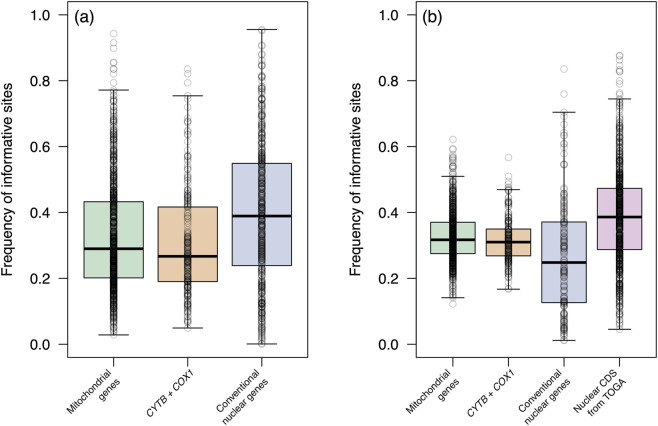 Figure 1
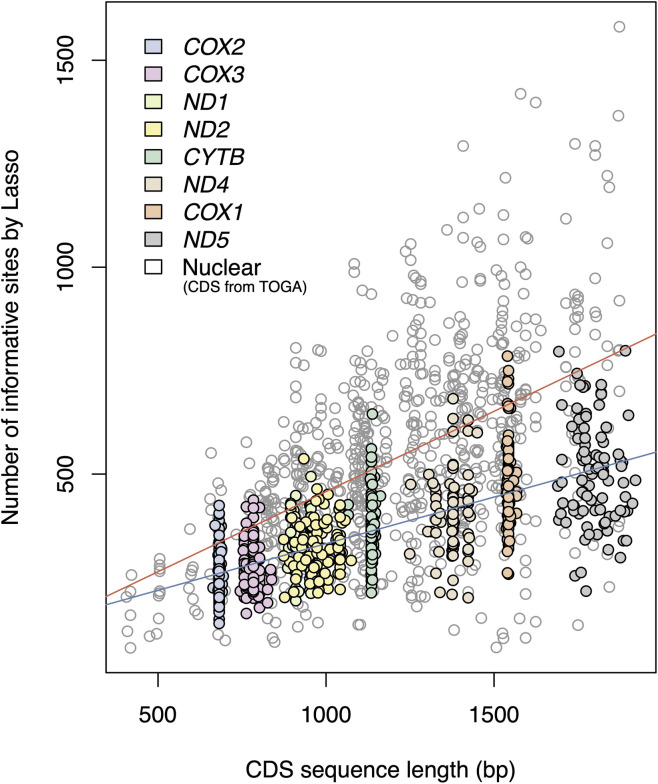 Figure 2
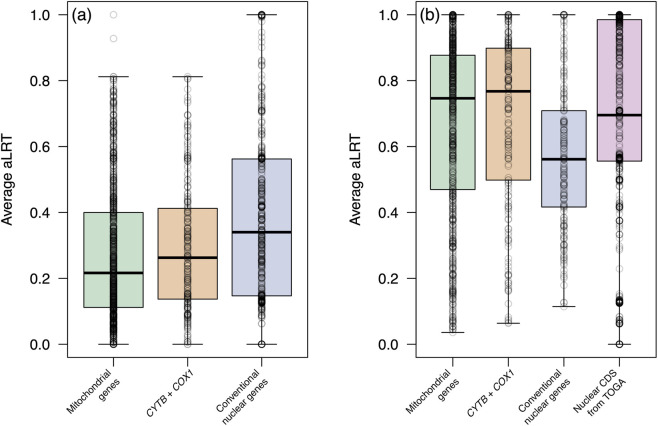 Figure 3
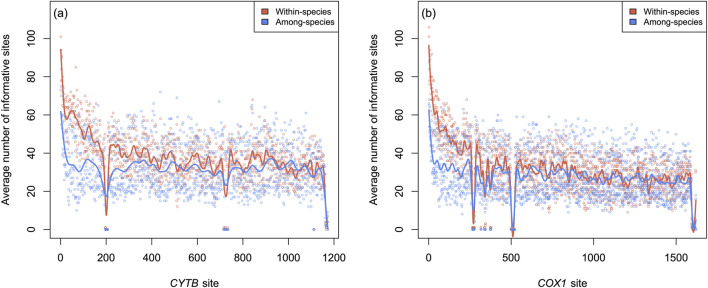 Figure 4
Peer Reviews
No public reviews on file for this paper yet. If you reviewed it on a platform where reviews are public (OpenReview, ICLR, NeurIPS, ICML), you can paste yours below so the community can read it here.
Videos
No videos yet. Explain this paper in a talk, walkthrough, or lecture? Add one.
Taxonomy
TopicsGenomics and Phylogenetic Studies · Evolution and Paleontology Studies · Genetic diversity and population structure