Neonatal Dandy–Walker syndrome: a case report
Ying Yang

TL;DR
A newborn with Dandy–Walker syndrome was diagnosed after being admitted for unrelated symptoms, highlighting the importance of revisiting prenatal imaging.
Contribution
This case emphasizes the value of postnatal MRI in confirming prenatal DWS diagnosis and guiding early management.
Findings
Classic DWS was confirmed in a neonate through postnatal MRI despite prenatal imaging suggesting vermian agenesis.
The infant's unrelated symptoms resolved quickly, allowing discharge with normal feeding.
Early confirmation of DWS enabled timely counseling and follow-up planning.
Abstract
Dandy–Walker syndrome (DWS) is usually identified prenatally or after hydrocephalus-related symptoms emerge. We report a term male neonate in whom classic DWS was incidentally discovered during admission for purpura and mild tachypnea. Although fetal magnetic resonance imaging (MRI) had suggested vermian agenesis, definitive postnatal brain MRI on day 6 confirmed complete vermian absence, left cerebellar hypoplasia, and a large posterior-fossa cyst communicating with the fourth ventricle. The purpura and respiratory symptoms resolved rapidly with supportive care, and the infant was discharged with full oral feeding at 7 days. This case highlights the need to revisit prenatal imaging when neonates present with seemingly unrelated problems; early postnatal confirmation enables timely family counseling, developmental surveillance, and multidisciplinary follow-up.
Genes, proteins, chemicals, diseases, species, mutations and cell lines named across the full text — each resolved to its canonical identifier and authoritative record.
Click any figure to enlarge with its caption.
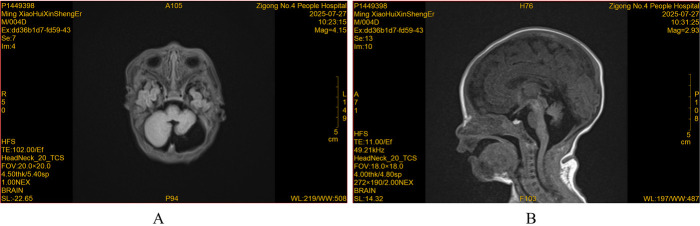 Figure 1
Peer Reviews
No public reviews on file for this paper yet. If you reviewed it on a platform where reviews are public (OpenReview, ICLR, NeurIPS, ICML), you can paste yours below so the community can read it here.
Videos
No videos yet. Explain this paper in a talk, walkthrough, or lecture? Add one.
Taxonomy
TopicsFetal and Pediatric Neurological Disorders · Pediatric Urology and Nephrology Studies · Cerebrospinal fluid and hydrocephalus