Saphenous vein graft and nitric oxide: strategies to prevent graft failure and enhance patency in coronary artery bypass grafting
Michele Dell’Aquila, Sotirios Prapas, Giorgia Falco, Shadi Abdalla, Branden Tejada, Meher Challagalla, Ignazio Condello, Joshua Newman, Omar Jarral, Stevan Pupovac, Ameerah Ali, Konstantinos Katsavrias, Augusto D’Onofrio, Carlo Zebele, Antonio Totaro, Vincenzo Labriola

TL;DR
This paper explores how nitric oxide helps improve the success of vein grafts used in heart surgery and how surgical techniques and drugs can enhance graft performance.
Contribution
The paper introduces a unifying strategy to enhance saphenous vein graft outcomes by targeting nitric oxide through surgical, pharmacologic, and graft configuration approaches.
Findings
Preservation of perivascular adipose tissue during vein harvesting improves nitric oxide availability and reduces inflammation.
Internal thoracic artery grafts provide long-term patency and nitric oxide-mediated protection for vein grafts.
Optimal graft configuration and secondary prevention strategies enhance arterialization and reduce SVG failure.
Abstract
Nitric oxide (NO) is a central regulator of vascular homeostasis and a key determinant of saphenous vein graft (SVG) outcomes in coronary artery bypass grafting (CABG). Endothelial dysfunction, driven by altered shear stress, oxidative stress, and cardiovascular risk factors, impairs NO production and release, contributing to SVG thrombosis, intimal hyperplasia, and atherosclerosis. SVG harvesting technique, storage, and intraoperative handling affects endothelial integrity, inflammatory response, and vascular remodeling, influencing arterialization, long-term patency, and clinical outcomes. Preservation of perivascular adipose tissue (PVAT) during vein harvesting enhances NO bioavailability, reduces inflammation and oxidative stress, and supports graft adaptation. Internal thoracic artery (ITA) grafts provide durable patency, survival benefit, and NO-mediated vasoprotection, improving…
Genes, proteins, chemicals, diseases, species, mutations and cell lines named across the full text — each resolved to its canonical identifier and authoritative record.
Click any figure to enlarge with its caption.
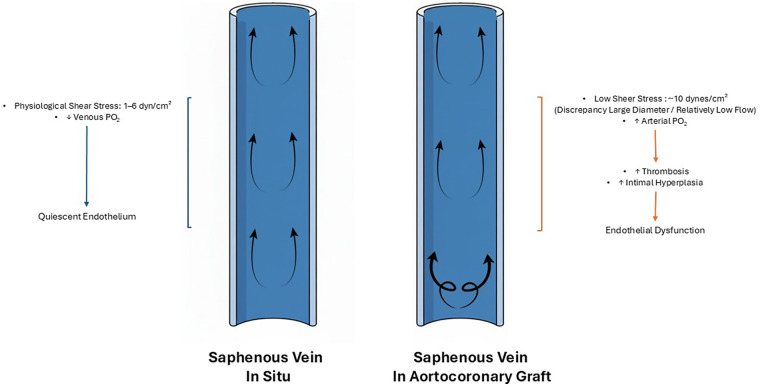 Figure 1
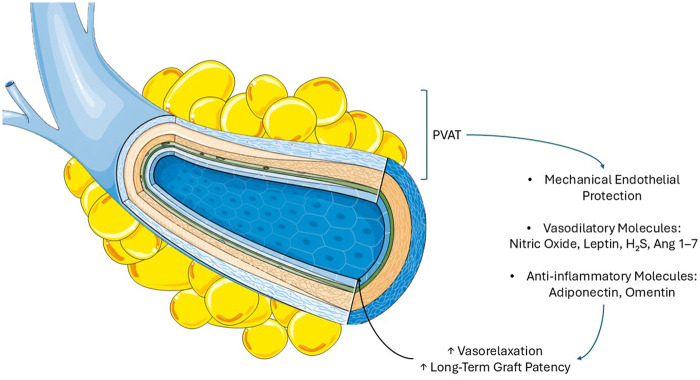 Figure 2
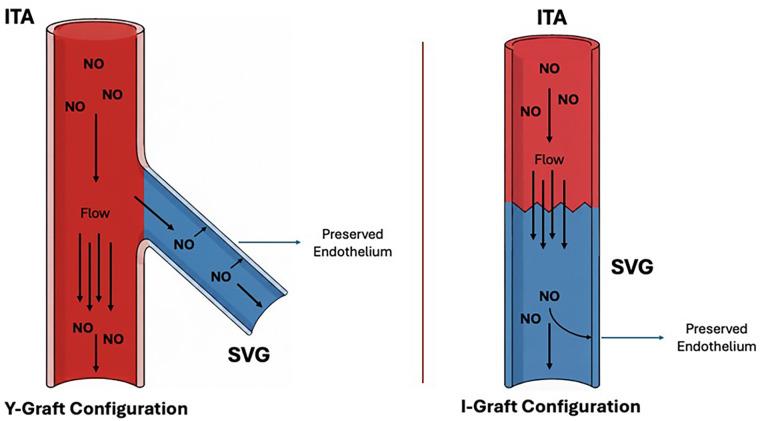 Figure 3
Peer Reviews
No public reviews on file for this paper yet. If you reviewed it on a platform where reviews are public (OpenReview, ICLR, NeurIPS, ICML), you can paste yours below so the community can read it here.
Videos
No videos yet. Explain this paper in a talk, walkthrough, or lecture? Add one.
Taxonomy
TopicsCardiac and Coronary Surgery Techniques · Cardiovascular Disease and Adiposity · Coronary Interventions and Diagnostics