Applications of synergetics in psychology: interpersonal synchrony in social systems
Wolfgang Tschacher

TL;DR
This paper explores how interpersonal synchrony, a phenomenon where people's movements or behaviors align, reflects self-organization in social systems and impacts cognition and emotion.
Contribution
The paper highlights how interpersonal synchrony generalizes synergetic principles and reveals novel qualities in social systems.
Findings
Interpersonal synchrony is a common feature in social systems and occurs spontaneously.
Synchrony is linked to cognitive and emotional variables, supporting embodied cognition.
Synchrony illustrates circular causality and the synergetic slaving principle in psychology.
Abstract
The Haken-Kelso-Bunz paradigm of motor coordination has instigated experimental research on pattern formation with a focus on body movement in intra- as well as interpersonal contexts. The current research on interpersonal synchrony in psychology can be seen to generalize on this initial synergetic approach. A large body of evidence has been aggregated to date showing that synchrony is a common signature of social systems as studied in psychotherapy research, in social psychology and in the dynamics of large groups. Interestingly, such synchronization processes occur spontaneously, generally outside the awareness of the individuals involved in them. Novel qualities arise due to interpersonal synchrony, which is reminiscent of self-organization as conceived by Haken’s Synergetics. The degree of synchrony of physiological and behavioral processes was often found associated with cognitive…
Click any figure to enlarge with its caption.
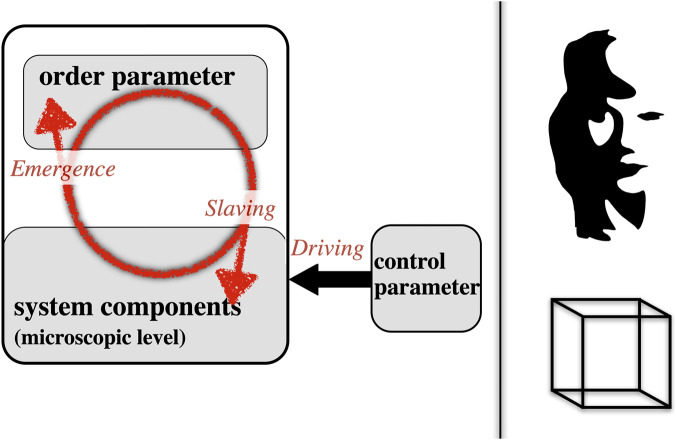 Figure 1
Peer Reviews
No public reviews on file for this paper yet. If you reviewed it on a platform where reviews are public (OpenReview, ICLR, NeurIPS, ICML), you can paste yours below so the community can read it here.
Videos
No videos yet. Explain this paper in a talk, walkthrough, or lecture? Add one.
Taxonomy
TopicsAction Observation and Synchronization · Embodied and Extended Cognition · Chaos, Complexity, and Education