The Usefulness of Short‐Type Single Balloon Enteroscope for Successful Pancreato‐Biliary Cannulation During Endoscopic Retrograde Cholangiopancreatography in Patients With Roux‐en‐Y Gastrectomy: A Comparative Study With Short‐Type Double‐balloon Enteroscope
Hiroya Terabe, Takahiko Sakaue, Takumi Kawaguchi, Kyoyoshi Saito, Yohei Hara, Yutaka Shimamatsu, Sohei Yoshimura, Shingo Hirai, Yu Sasaki, Suketo So, Hidetoshi Takedatsu, Yoshinobu Okabe

TL;DR
This study compares the effectiveness of two types of endoscopes in achieving a crucial position for successful bile duct access in patients who had stomach surgery.
Contribution
The study is the first to show that short-type single-balloon enteroscopes are more effective than double-balloon ones for forming a key position during ERCP in Roux-en-Y gastrectomy patients.
Findings
The retroflex position was the strongest predictor of successful bile duct cannulation in Roux-en-Y gastrectomy patients.
Short-type single-balloon enteroscopes were significantly better than double-balloon ones at forming the retroflex position.
The retroflex position rate was 81.5% with single-balloon and 42.9% with double-balloon enteroscopes.
Abstract
The retroflex position is crucial for the success of pancreato‐biliary cannulation in patients with Roux‐en‐Y gastrectomy (RYG). We aimed to investigate the factors associated with forming the retroflex position in patients with RYG, including short‐type single‐balloon enteroscope (sSBE) and short‐type double‐balloon enteroscope (sDBE). 119 consecutive patients who underwent endoscopic retrograde cholangiopancreatography (ERCP) after RYG were enrolled. All the procedures were performed using sSBE (SIF‐H290S; Olympus Medical Systems, Tokyo, Japan) or sDBE (EI‐580BT; Fujifilm, Tokyo, Japan). The clinical outcomes of ERCP were compared between patients undergoing ERCP with sSBE (n = 65) and sDBE (n = 54). A logistic regression model was used to identify the independent factors associated with retroflex position. The overall cannulation success rate was 76.7% in patients with RYG.…
Genes, proteins, chemicals, diseases, species, mutations and cell lines named across the full text — each resolved to its canonical identifier and authoritative record.
Click any figure to enlarge with its caption.
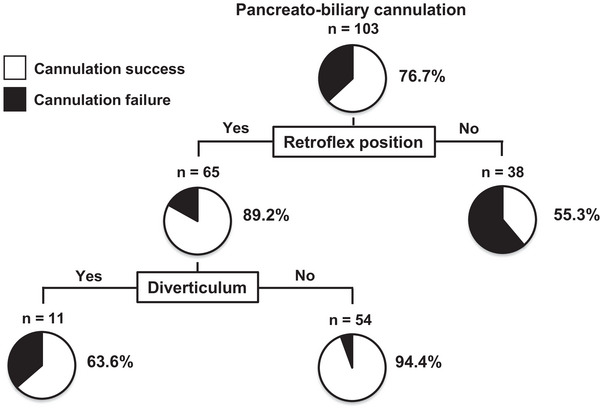 Figure 1
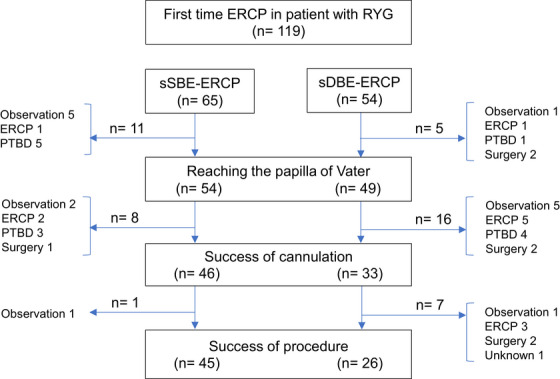 Figure 2
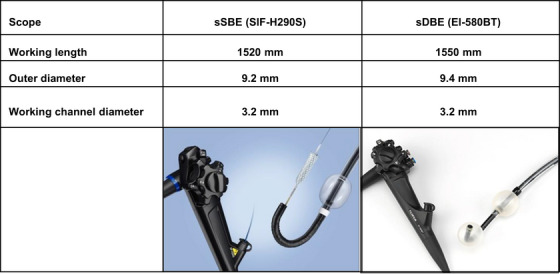 Figure 3
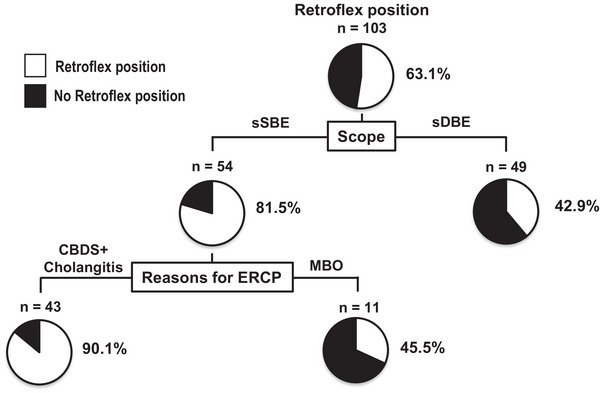 Figure 4
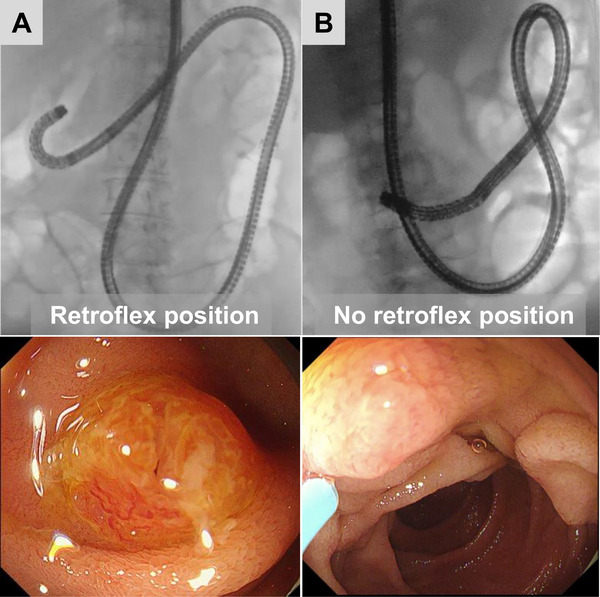 Figure 5
Peer Reviews
No public reviews on file for this paper yet. If you reviewed it on a platform where reviews are public (OpenReview, ICLR, NeurIPS, ICML), you can paste yours below so the community can read it here.
Videos
No videos yet. Explain this paper in a talk, walkthrough, or lecture? Add one.
Taxonomy
TopicsGallbladder and Bile Duct Disorders · Medical Device Sterilization and Disinfection · Gastrointestinal Bleeding Diagnosis and Treatment