Impacts of Herbal Medicine Use on Lipid Profiles in Type 2 Diabetic Patients in Northwest Ethiopia: A Comparative Cross‐Sectional Study
Assefa Belay Asrie, Tafere Mulaw Belete, Tezera Jemere Aragaw, Melshew Fenta Misker, Alemante Tafese Beyna, Habtamu Semagne Ayele, Kidist Goshime Tekle, Yonas Zewdu Milikit, Ephrem Adane Andargie, Hiwot Tesfaselassie Afework, Yenatfanta Gezu Lenjiso, Gebrehiwot Lema Legese

TL;DR
This study found that using herbal medicine in addition to conventional treatments helps improve lipid profiles in Type 2 diabetes patients in Ethiopia, potentially reducing cardiovascular risks.
Contribution
The study provides new evidence on the beneficial impact of herbal medicine on lipid profiles in Type 2 diabetic patients in Ethiopia.
Findings
Herbal medicine users had significantly lower total cholesterol, triglycerides, and LDL-C levels compared to nonusers.
Users also showed higher HDL-C levels and reduced atherogenic indices, suggesting improved cardiovascular health.
Linear regression confirmed the positive association between herbal medicine use and better lipid profiles.
Abstract
Blood lipid abnormalities are common among Type 2 diabetes mellitus (T2DM) patients, and achieving better glycemic control may help improve their lipid profiles. Concomitant use of herbal medicines with conventional antidiabetic medications is a common practice among T2DM patients in Ethiopia. This study was conducted to evaluate the impacts of herbal medicine use on lipid profiles among T2DM patients. This is a cross‐sectional study and was conducted from May 01 to July 30, 2024. A sample of 416 participants was approached for the study. The sample size was calculated using a single population proportion formula. A systematic random sampling method was used to select the participants. The data were collected through interviewer‐administered questionnaire and patient medical record reviews. Patients were randomly selected, and their corresponding medical records, retrieved from the…
Genes, proteins, chemicals, diseases, species, mutations and cell lines named across the full text — each resolved to its canonical identifier and authoritative record.
Click any figure to enlarge with its caption.
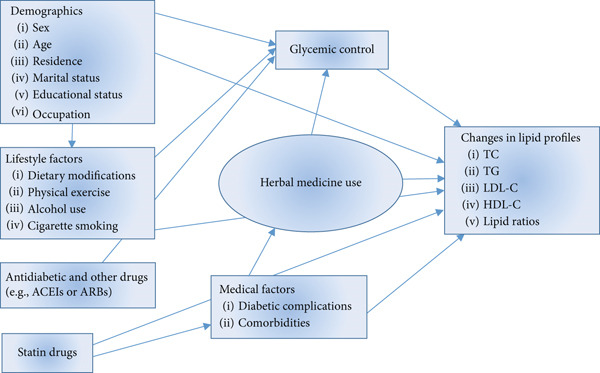 Figure 1
Peer Reviews
No public reviews on file for this paper yet. If you reviewed it on a platform where reviews are public (OpenReview, ICLR, NeurIPS, ICML), you can paste yours below so the community can read it here.
Videos
No videos yet. Explain this paper in a talk, walkthrough, or lecture? Add one.
Taxonomy
TopicsNatural Antidiabetic Agents Studies · Diabetes, Cardiovascular Risks, and Lipoproteins · Ethnobotanical and Medicinal Plants Studies