Evaluating pneumoperitoneum pressure in robotic liver surgery: a propensity-score matched analysis in a high-volume center in Scandinavia
Daisuke Fukumori, Christoph Tschuor, Takashi Hamada, Paul Suno Krohn, Stefan Burgdorf, Øivind Jans, Hans-Jørgen Frederiksen, Jens Hillingsø, Peter Nørgaard Larsen

TL;DR
This study compares low versus standard pneumoperitoneum pressure in robotic liver surgery and finds no significant differences in outcomes.
Contribution
The study evaluates the safety and efficacy of using 10 mmHg pneumoperitoneum pressure in robotic liver surgery without central venous pressure management.
Findings
No significant differences in blood loss, operating time, or complications between low and standard pneumoperitoneum pressure groups.
Low pneumoperitoneum pressure (10 mmHg) was found to be feasible and safe for robotic liver surgery.
Gas embolism was not observed in either group during the study.
Abstract
Minimally invasive liver surgery usually involves the use of standard pneumoperitoneal pressure (12–15 mmHg) and low central venous pressure (CVP) management to reduce intraoperative bleeding while hereby possibly increasing the risk for gas embolism. The purpose of this study is to evaluate the efficacy and safety of low pneumoperitoneum pressure (Low-PP: 10 mmHg) compared to standard pneumoperitoneum pressure (Standard-PP: 12 mmHg) in patients undergoing robotic liver surgery (RLS) without active CVP management. A single-center retrospective cohort study was conducted from June 2019 to February 2024. Propensity-score matching analysis (1:1) was performed based on age, sex, BMI, ASA classification, diagnosis, and extent of resection (minor or major) for Low-PP group to Standard-PP group. The primary outcome were estimated blood loss (EBL), operating time (OT), length of stay (LOS),…
Genes, proteins, chemicals, diseases, species, mutations and cell lines named across the full text — each resolved to its canonical identifier and authoritative record.
Click any figure to enlarge with its caption.
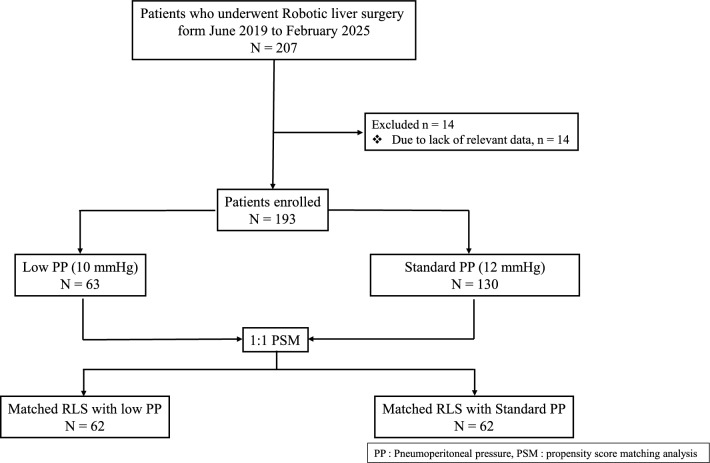 Figure 1
Peer Reviews
No public reviews on file for this paper yet. If you reviewed it on a platform where reviews are public (OpenReview, ICLR, NeurIPS, ICML), you can paste yours below so the community can read it here.
Videos
No videos yet. Explain this paper in a talk, walkthrough, or lecture? Add one.
Taxonomy
TopicsHepatocellular Carcinoma Treatment and Prognosis · Abdominal Surgery and Complications · Liver Disease and Transplantation