Towards causal inference-based antidepressant selection with brain and blood biomarkers
Milica Barac, Caroline W. Grant, Russell Toll, Thomas Carmody, Abu Minhajuddin, Cherise Chin Fatt, Jane A. Foster, Paul E. Croarkin, William V. Bobo, Manish K. Jha, Arjun P. Athreya, Madhukar H. Trivedi

TL;DR
This study uses brain and blood biomarkers to predict which antidepressants will work best for individuals with depression.
Contribution
The study introduces a causal inference approach combining brain and blood biomarkers for personalized antidepressant selection.
Findings
A model using 15 multi-modal features predicted remission with an AUC of 0.74 for sertraline, 0.71 for bupropion, and 0.73 for placebo.
Propensity score-matching and counterfactual prediction models showed 82% accuracy for observed outcomes.
The selected biomarkers are highly sensitive for guiding antidepressant treatment decisions.
Abstract
This report sought to employ multi-modal integration of pre-treatment brain (electroencephalogram, resting-state functional magnetic resonance imaging) and blood (immune and metabolic) biomarkers to facilitate causal inference-based treatment selection by virtue of establishing predictability of remission to multi-stage antidepressant treatment. Data from two stages of pharmacotherapy in the ‘Establishing Moderators and Biosignatures of Antidepressant Response for Clinical Care for Depression’ (EMBARC) study from participants with both brain and blood biomarkers were included (N = 197). Participants were initially randomized to sertraline or placebo (Stage 1), and depending on clinical response at week-8, their therapy in Stage 2 was either maintained or switched (to sertraline, if a non-responder to placebo, or to bupropion, if a non-responder to sertraline). Three readily accessible…
Genes, proteins, chemicals, diseases, species, mutations and cell lines named across the full text — each resolved to its canonical identifier and authoritative record.
Click any figure to enlarge with its caption.
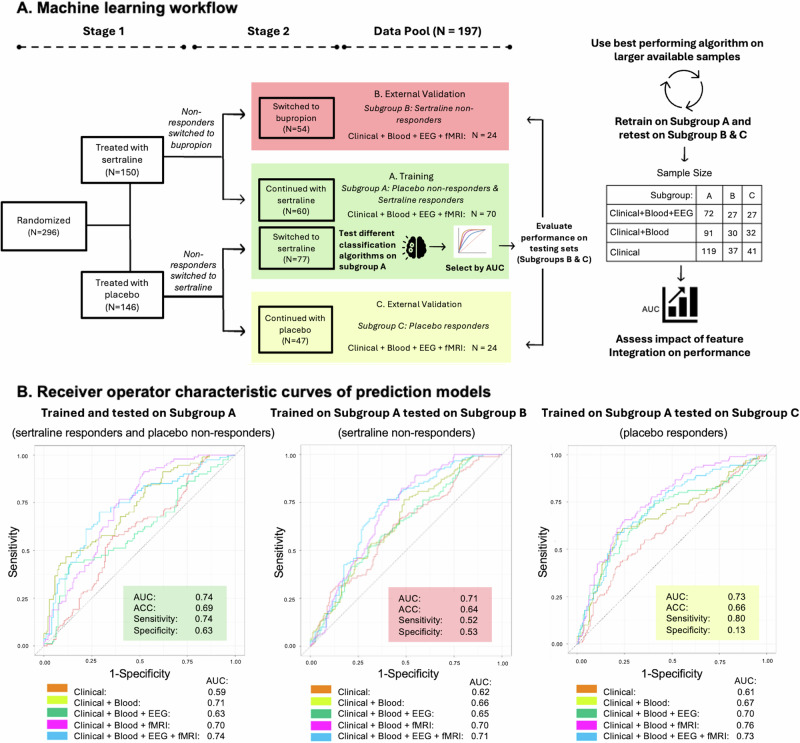 Figure 1
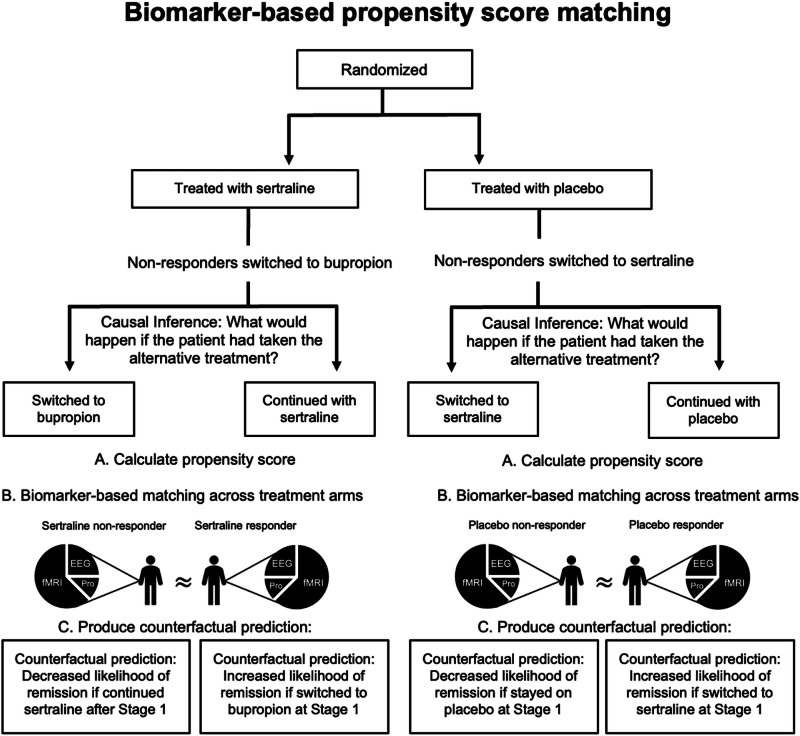 Figure 2
Peer Reviews
No public reviews on file for this paper yet. If you reviewed it on a platform where reviews are public (OpenReview, ICLR, NeurIPS, ICML), you can paste yours below so the community can read it here.
Videos
No videos yet. Explain this paper in a talk, walkthrough, or lecture? Add one.
Taxonomy
TopicsFunctional Brain Connectivity Studies · Mental Health Research Topics · Treatment of Major Depression