Advanced chronic kidney disease increases the odds of ERCP adverse events but not post-ERCP pancreatitis: a propensity-matched analysis of the US Collaborative Network
Hussein Baydoun, Azizullah Beran, Daryl Ramai, Vikram R. Rajagopalan, Aladdin Said Dahbour, Mina Batarseh, Ujwala Pamidimukkala, Eugene Nwankwo, Islam Mohamed, Clive Jude Miranda, Hisham Wehbe, Oluwafisayo Adebiyi, Indira Bhavsar-Burke, John J. Guardiola, Itegbemie Obaitan

TL;DR
Advanced chronic kidney disease increases the risk of certain ERCP complications but not post-ERCP pancreatitis, challenging previous assumptions.
Contribution
This study identifies that advanced CKD patients face higher odds of ERCP-related adverse events except for post-ERCP pancreatitis.
Findings
Advanced CKD patients had higher odds of bleeding, cholangitis, ICU admissions, intubation, and mortality after ERCP.
Post-ERCP pancreatitis and perforation odds were similar between advanced CKD and control groups.
ESRD patients specifically had increased odds of ICU admissions.
Abstract
Patients with chronic kidney disease (CKD) are at an increased risk choledocholithiasis, requiring intervention with endoscopic retrograde cholangiopancreatography (ERCP). Data on ERCP-related adverse events in this population is limited, hence this study. This retrospective cohort study utilized the TriNetX database to assess the odds of ERCP-related adverse events in patients with stages 4 and 5 chronic kidney disease, as well as end-stage renal disease (ESRD) on dialysis. Primary outcomes were ERCP-related pancreatitis (PEP), bleeding, cholangitis, and perforation. Secondary outcomes were failure to extubate/new post-procedure intubation, intensive care unit (ICU) admissions, and all-cause mortality. After propensity score matching, our study included 4450 patients in the aCKD cohort and 4450 patients in the matched control cohort who underwent ERCP. Patients with aCKD had an…
Genes, proteins, chemicals, diseases, species, mutations and cell lines named across the full text — each resolved to its canonical identifier and authoritative record.
Click any figure to enlarge with its caption.
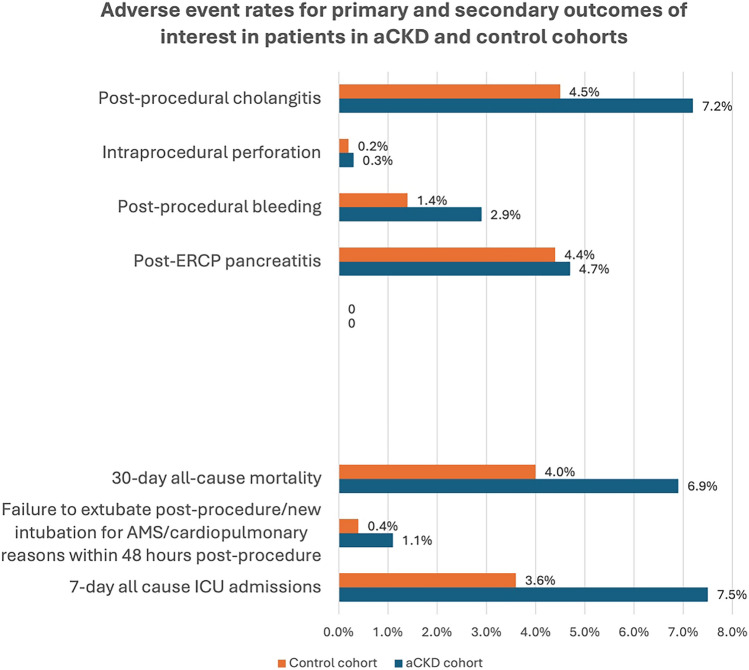 Figure 1
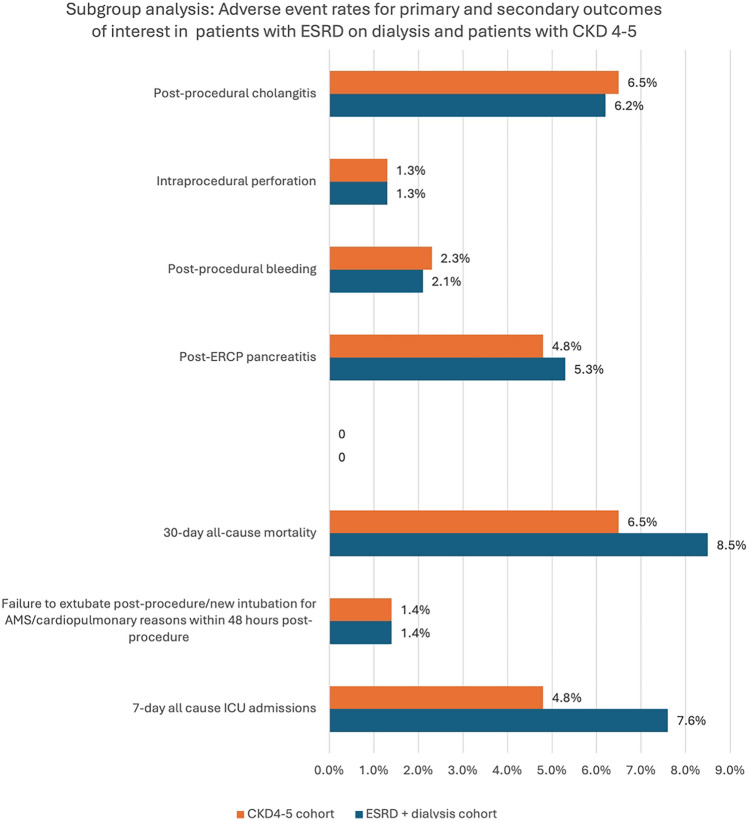 Figure 2
Peer Reviews
No public reviews on file for this paper yet. If you reviewed it on a platform where reviews are public (OpenReview, ICLR, NeurIPS, ICML), you can paste yours below so the community can read it here.
Videos
No videos yet. Explain this paper in a talk, walkthrough, or lecture? Add one.
Taxonomy
TopicsGallbladder and Bile Duct Disorders · Esophageal and GI Pathology · Pancreatic and Hepatic Oncology Research