Three years later: tracking bothersome symptoms and impacts for people with early Parkinson’s disease
Jennifer R. Mammen, Varun Reddy, Aaron Lerner, Nami Shah, Jocelyn Silva, Mirinda Tyo, Kristin Magan, Nguyen Thimaikhue, Dang Thao-Uyen, Tatiana Solodova, Tim McWilliams, Mathew Stephen, Peggy Auinger, Melissa Kostrzebski, Yuge Xiao, Diane Stephenson, Jamie L. Adams

TL;DR
This study tracked how symptoms and their impacts changed over three years in people with early Parkinson’s disease, finding that while motor symptoms remained stable, functional and psychosocial impacts worsened over time.
Contribution
The study provides longitudinal insights into symptom progression and coping strategies in early Parkinson’s disease over three years.
Findings
Motor symptoms like tremor and gait remained consistently bothersome over three years.
Functional impacts, such as increased effort to perform daily activities, worsened significantly over time.
Participants reported improved coping strategies that mitigated symptom bothersomeness despite disease progression.
Abstract
Understanding how meaningful symptoms and impacts of Parkinson’s change with time is necessary to select endpoints for clinical trials and to support clinical practice. This study aimed to longitudinally evaluate the prevalence, bothersomeness, and functional impacts of early Parkinson’s symptoms on daily life over a three-year study duration. 32 participants with early Parkinson’s completed qualitative interviews to map symptoms and impacts of disease annually for three years. Symptom maps were content coded for frequency and bothersomeness of symptoms and presence of related impacts. Non-parametric generalized linear mixed models (GLMM) were used to evaluate change over time. The most bothersome motor symptoms were tremor, gait difficulties, balance, fine motor, slow movements, and stiffness at all years. Top non-motor symptoms were fatigue, sleep, mood changes, difficulty…
Genes, proteins, chemicals, diseases, species, mutations and cell lines named across the full text — each resolved to its canonical identifier and authoritative record.
Click any figure to enlarge with its caption.
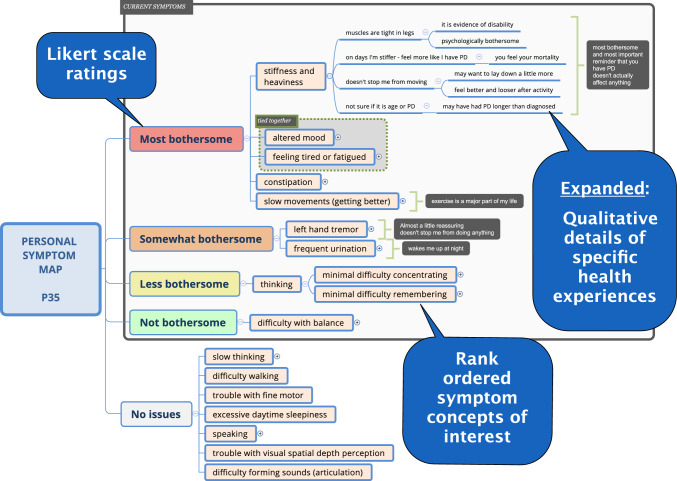 Figure 1
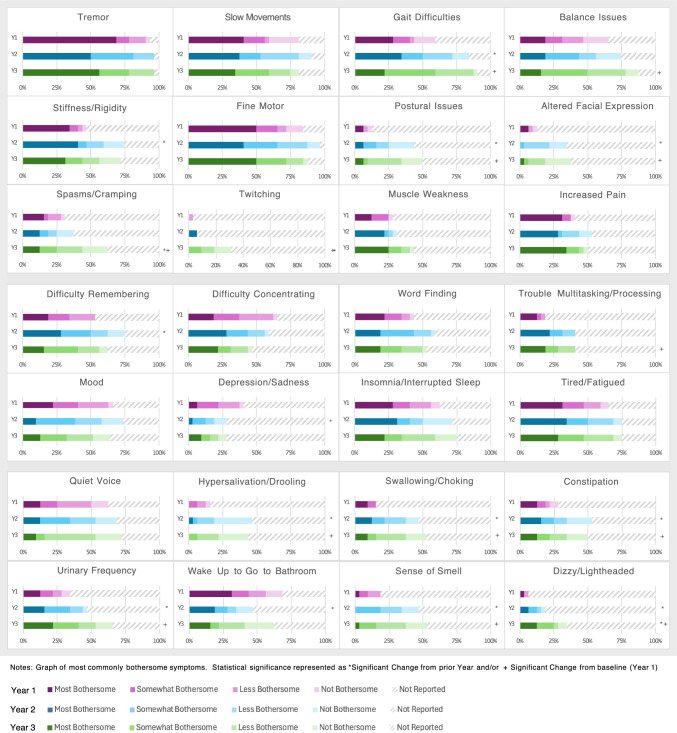 Figure 2
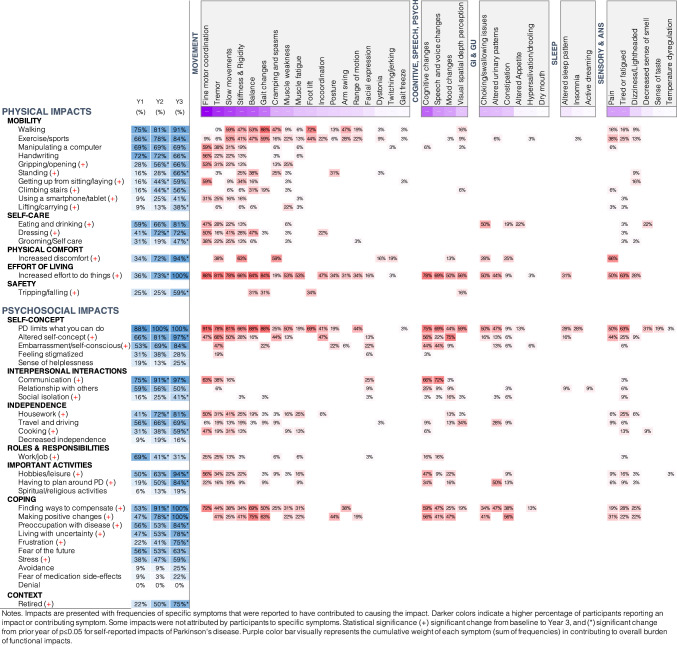 Figure 3
Peer Reviews
No public reviews on file for this paper yet. If you reviewed it on a platform where reviews are public (OpenReview, ICLR, NeurIPS, ICML), you can paste yours below so the community can read it here.
Videos
No videos yet. Explain this paper in a talk, walkthrough, or lecture? Add one.
Taxonomy
TopicsParkinson's Disease Mechanisms and Treatments · Voice and Speech Disorders · Neurological disorders and treatments