Relationship between bone mineral density and strength derived from 3D-shaper and HR-pQCT in patients with X-linked osteoporosis related to PLS3
Z. Zervou, R. Mabrouk, E. F. S. van Velsen, M. S. A. M. Bevers, E. Alizadeh, J. P. van den Bergh, M. C. Zillikens

TL;DR
This study compares bone density and strength measurements in patients with a rare genetic bone disease using two imaging techniques, finding that trabecular bone is more affected than cortical bone.
Contribution
The study is the first to compare HR-pQCT and 3D-DXA in X-linked osteoporosis caused by PLS3 variants.
Findings
3D-DXA and HR-pQCT both showed greater trabecular than cortical bone deficits in PLS3 patients.
3D-DXA parameters were highly correlated with each other and with aBMD, but not with HR-pQCT parameters.
Lumbar spine aBMD was lower than total hip aBMD in PLS3 patients.
Abstract
In individuals with PLS3 genetic variants, HR-pQCT and 3D-DXA analysis indicate a larger trabecular than cortical deficit. This is consistent with the lower aBMD from DXA at the lumbar spine than at the total hip. X-linked osteoporosis due to PLS3 genetic variants is a rare disease, clinically affecting men more than women. This study aimed to explore relationships between parameters obtained from DXA, high-resolution peripheral quantitative computed tomography (HR-pQCT), and 3D-DXA in thirteen adults with PLS3 variants. The parameters were for 3D-DXA: trabecular volumetric bone mineral density (Tb.BMD), cortical surface BMD (Ct.sBMD), and bone strength at the total hip using 3D-DXA-based finite element models (3D Shaper® software, v2.14.0), and for HR-pQCT: Tb.BMD, cortical volumetric BMD (Ct.BMD), and bone strength at the distal radius and tibia using micro-finite element analysis.…
Genes, proteins, chemicals, diseases, species, mutations and cell lines named across the full text — each resolved to its canonical identifier and authoritative record.
Click any figure to enlarge with its caption.
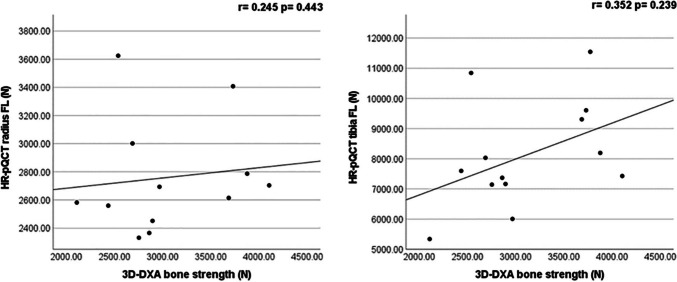 Figure 1
Peer Reviews
No public reviews on file for this paper yet. If you reviewed it on a platform where reviews are public (OpenReview, ICLR, NeurIPS, ICML), you can paste yours below so the community can read it here.
Videos
No videos yet. Explain this paper in a talk, walkthrough, or lecture? Add one.
Taxonomy
TopicsBone health and osteoporosis research · Bone Metabolism and Diseases · Parathyroid Disorders and Treatments