Genome Sequence of Actinobacteriophage LilTerminator, Isolated From Microbacterium foliorum on Jekyll Island, Georgia
Kristen Darley, Noah English, John Barron, Ellie Brooks, Kamilah Brown, Annale Claxton, Chrishai Cummings, Piper Davidson, Ally Gibson, Jessi Griffin, Amanda Hixson, Faith Holt, Klaire Murray, Phanice Osundwa, Gracie Pilkinton, Lauren Ray, Mikaya Walker, Holly Nance

TL;DR
This paper reports the genome sequence of a new actinobacteriophage called LilTerminator, isolated from soil in Georgia.
Contribution
The novel contribution is the isolation and genome sequencing of a new phage, LilTerminator, and its classification into subcluster EA5.
Findings
LilTerminator's genome is 39,963 bp, circularly permuted, and contains 62 predicted genes.
The phage is classified into subcluster EA5 based on gene content similarity to other actinobacteriophages.
Abstract
Actinobacteriophage LilTerminator was isolated from soil collected from Jekyll Island, Georgia, using Microbacterium foliorum NRRL B-24224 as the host. The genome of this phage is 39,963 bp, circularly permuted, and contains 62 predicted genes, including one tRNA gene. Based on gene content similarity of at least 35% to actinobacteriophages, LilTerminator is grouped into subcluster EA5.
Genes, proteins, chemicals, diseases, species, mutations and cell lines named across the full text — each resolved to its canonical identifier and authoritative record.
Click any figure to enlarge with its caption.
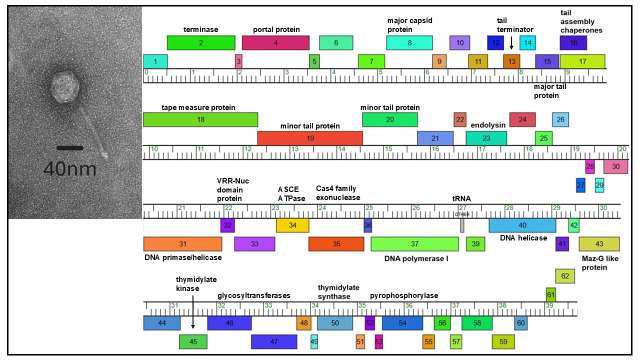 Figure 1
Peer Reviews
No public reviews on file for this paper yet. If you reviewed it on a platform where reviews are public (OpenReview, ICLR, NeurIPS, ICML), you can paste yours below so the community can read it here.
Videos
No videos yet. Explain this paper in a talk, walkthrough, or lecture? Add one.
Taxonomy
TopicsBacteriophages and microbial interactions · Genomics and Phylogenetic Studies · Microbial Community Ecology and Physiology
Description
The global rise in antiobiotic-resistant bacteria has led to increased focus on bacteriophage, viruses that infect and kill their bacterial host via lysis, as an alternative treatment for infections (Cui et al., 2024). The discovery of new bacteriophages and characterization of their genomes can further increase our understanding of phage biology and their use in medicine. A total of 679 phages isolated using the bacterium Microbacterium foliorum as a host have been sequenced and deposited into the Actinobacteriophage database, PhagesDB (Russell and Hatfull 2016). *Microbacterium foliorum * is a rod-shaped, gram-positive bacterium occurring naturally in plant ecosystems but has also been found in wounds and around catheters of immunocompromised patients (Kim et al., 2022). Here, we describe the isolation and characterization of a new actinobacteriophage, LilTerminator, capable of infecting M. foliorum .
A soil sample collected from the marshlands of Jekyll Island, Georgia (GPS coordinates: 31.10528 N, 81.40653 W) was incubated in a peptone-yeast-calcium (PYCa) liquid medium at 30°C with shaking for 2 hours. The sample was centrifuged at 2,000 x g for 10 minutes, and the resulting supernatant was filtered through a 0.22 µm pore size. The filtrate was plated with M. foliorum and incubated at 30°C on a PYCa plate for 48 hours with soft agar overlay, resulting in the direct isolation of LilTerminator, which produced clear, circular plaques measuring 2-8 mm in diameter (n=15).
LilTerminator was purified through four successive rounds of picking isolated plaques and plating in top agar with M. foliorum . A high titer lysate (4.5 x 10 ^9 ^ pfu/ml) was prepared and used for transmission electron microscopy (FEI Tecnai G2 Spirit BioTWIN) using a 200–400 mesh carbon–formvar-coated copper grid and 1% uranyl acetate for negative staining, revealing that LilTerminator exhibits a siphovirus morphology with a tail length of 187.5 nm +/- 2nm (n=4) and a capsid diameter of 75 nm +/- 2nm (n=4) (Figure 1).
To isolate phage DNA, bacterial DNA/RNA in thelysate was first degraded with a 10-minute 37℃ incubation with DNase I and RNase A, followed by phage capsid denaturation and phage DNA extraction using the Promega Wizard DNA Cleanup System. DNA was sequenced using an Illumina MiSeq 1000 (v3 reagents), with libraries prepped using the NEB Ultra II FS kit. The resulting 150 base raw reads were assembled using Newbler v2.9 (Miller et al., 2010) and genomic termini were assessed using Consed v29 (Gordon and Green, 2013) following Russell (2018). The genome of LilTerminator is 39,963 bp in length with 709-fold coverage. It is circularly permuted and has a G+C content of 63.8%, which is similar to that of its M. foliorum host (68.7%).
Initial auto-annotation was conducted using GLIMMER v3.0 (Delcher at al., 2007) and GeneMark v2.5 (Besemer and Boroditsky, 2005). The annotation was refined using Starterator v485 (https://seaphages.org/software/#Starterator), Phamerator (Cresawn et al., 2011) and DNA Master v5.23.6 (Pope and Jacobs-Sera, 2017). HHpred v3.2 searching against the PDB_mmCIF70, SCOPe70, Pfam-A, NCBI_Conserved_Domains databases (Södinget al., 2005), BLASTp searches against the NCBI nonredundant and actinobacteriophage databases (Altschulet al., 1990), and DeepTMHMM v1.0.24 (Hallgren et al., 2022) were used to determine gene functions. Aragorn (Laslett and Canback, 2004) and tRNAscan-SE v2.0 (Lowe and Eddy, 1997) were used to identify tRNA genes. Default settings were used for all software.
LilTerminator has a total of 62 predicted genes, including 61 protein-coding genes, 23 of which have putative functions, and one putative tRNA-Undet (NNN) gene. Approximately half of the genes are transcribed rightward, with the remaining transcribed leftward. LilTerminator was assigned to subcluster EA5 based on gene content similarity of at least 35% to phages in the Actinobacteriophage database, phagesDB (https://phageDB.org) (Russell and Hatfull, 2016; Pope et al., 2017). Like all EA5 phages with annotated genomes, LilTerminator encodes a pair of tail assembly chaperone proteins through a -1 translational frameshift, a DNA polymerase I, a Maz-G like protein and a thymidylate synthase. Also like most other annotated EA5 phages (8 out of 13), LilTerminator encodes an endolysin downstream of the minor tail proteins, although not all the endolysins are grouped into the same protein family. There is no identifiable capsid maturation protease, holin, integrase or immunity repressor function, the latter suggesting this phage is unlikely to establish lysogeny.
Nucleotide sequence accession numbers
GenBank Accession Number is PV876929. The Sequence Read Archive (SRA) number is SRX28150555 .
The reference list from the paper itself. Each links out to its DOI / PubMed record.
- 1Altschul Stephen F. Gish Warren Miller Webb Myers Eugene W. Lipman David J. 1990101 Basic local alignment search tool Journal of Molecular Biology 21530022-283640341010.1016/s 0022-2836(05)80360-22231712 · doi ↗ · pubmed ↗
- 2Besemer J. Borodovsky M. 200571 Gene Mark: web software for gene finding in prokaryotes, eukaryotes and viruses Nucleic Acids Research 33Web Server 0305-1048 W 451W 45410.1093/nar/gki 48715980510 PMC 1160247 · doi ↗ · pubmed ↗
- 3Cresawn Steven G Bogel Matt Day Nathan Jacobs-Sera Deborah Hendrix Roger W Hatfull Graham F 20111012 Phamerator: a bioinformatic tool for comparative bacteriophage genomics BMC Bioinformatics 1211471-210510.1186/1471-2105-12-395PMC 323361221991981 · doi ↗ · pubmed ↗
- 4Cui Longzhu Kiga Kotaro Kondabagil Kiran Węgrzyn Alicja 20241017 Current and future directions in bacteriophage research for developing therapeutic innovations Scientific Reports 1412045-232210.1038/s 41598-024-76427-5PMC 1148726639420115 · doi ↗ · pubmed ↗
- 5Delcher Arthur L. Bratke Kirsten A. Powers Edwin C. Salzberg Steven L. 2007119 Identifying bacterial genes and endosymbiont DNA with Glimmer Bioinformatics 2361367-481167367910.1093/bioinformatics/btm 00917237039 PMC 2387122 · doi ↗ · pubmed ↗
- 6Gordon David Green Phil 2013831 Consed: a graphical editor for next-generation sequencing Bioinformatics 29221367-48112936293710.1093/bioinformatics/btt 51523995391 PMC 3810858 · doi ↗ · pubmed ↗
- 7Hallgren Jeppe Tsirigos Konstantinos D. Pedersen Mads Damgaard Almagro Armenteros José Juan Marcatili Paolo Nielsen Henrik Krogh Anders Winther Ole 2022410 Deep TMHMM predicts alpha and beta transmembrane proteins using deep neural networks 10.1101/2022.04.08.487609 · doi ↗
- 8Kim Uylae Paul Elizabeth S. Diaz Arturo 2022614 Characterization of Phages Yuu Y, Kai Hai Dragon, and Oneina Gillian Isolated from Microbacterium foliorum International Journal of Molecular Sciences 23121422-00676609660910.3390/ijms 2312660935743053 PMC 9224216 · doi ↗ · pubmed ↗