Complete Genome Sequence of Gordonia phage RedRaider
Peyton Abraham, Princess Bola-Lawal, Mary Britten, Randi Childress, Abby Flannagan, Mallory Gramstad, Hayden Groos, Sharon Huffman, Korver Hupke, Corbin Kleis, Jenna Kluxdal, Ayda Maassen, Caden Meyer, Elsa Meyer, Logan Miller, Emma Steinhardt, Travis Sweeney, Alexa Trover

TL;DR
Scientists sequenced and described a new bacteriophage, RedRaider, that infects the bacterium Gordonia terrae.
Contribution
The paper presents the complete genome sequence and annotation of a novel phage, RedRaider, and identifies key genomic features.
Findings
RedRaider's genome has features typical of cluster CR3 phages.
The phage encodes putative lysin A in two gene products and lysin B in the left arm of the genome.
Abstract
We isolated and annotated a novel bacteriophage, RedRaider, on Gordonia terrae 3612. Annotation revealed genome features typical of cluster CR3 phages with the putative lysin A function encoded in two gene products, a protease C39 domain and a glycosyl hydrolase domain, and lysin B encoded distally in the left arm of the genome.
Genes, proteins, chemicals, diseases, species, mutations and cell lines named across the full text — each resolved to its canonical identifier and authoritative record.
Click any figure to enlarge with its caption.
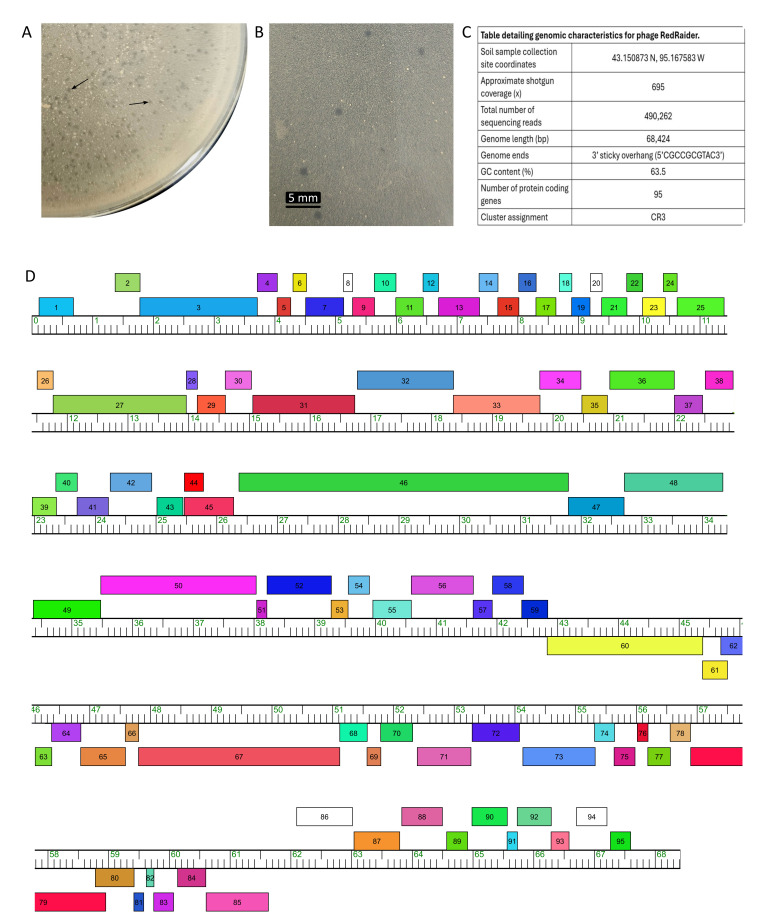 Figure 1
Peer Reviews
No public reviews on file for this paper yet. If you reviewed it on a platform where reviews are public (OpenReview, ICLR, NeurIPS, ICML), you can paste yours below so the community can read it here.
Videos
No videos yet. Explain this paper in a talk, walkthrough, or lecture? Add one.
Taxonomy
TopicsBacteriophages and microbial interactions · Genomics and Phylogenetic Studies · Diatoms and Algae Research
Description
Bacteriophages are a rapidly evolving group of infectious particles (Hendrix 2002). They are remarkably abundant, found in nearly every ecosystem investigated (Rohwer et al., 2014). In this paper, we report the genomic organization of RedRaider, a newly discovered member of this dynamic population.
We isolated RedRaider from 15 g of very dry, surface topsoil that was near a patch of grass clippings using standard methods (see Figure 1C for GPS coordinates) (Poxleitner et al, 2018). Briefly, the soil sample was washed with peptone-yeast extract-calcium (PYCa) liquid medium supplemented with 0.1% dextrose and the suspension was filtered (0.2-µm pore size). The filtrate was inoculated with Gordonia terrae 3512 and incubated, with shaking, at 30 ^o^ C for two days. The resulting culture was filtered (0.2- µm pore size) to remove bacteria and phages in the filtrate were plated in PYCa top agar with *G. terrae. * Plaques of RedRaider were observed after 24 hours and purified with three rounds of plating. RedRaider formed small plaques, 0.8 - 2.3 mm in diameter (n = 10), with slightly turbid, irregular edges after 24-48 hours at 30 ^o^ C ( Figure 1A, B).
We isolated phage DNA from high titer lysate using Wizard DNA Clean-Up System (Promega) then concentrated the DNA with a DNA Clean and Concentrator Kit (ZYMO Research). RedRaider DNA was pooled with DNA isolated from a mycobacteriophage and a microbacterium phage and then prepared for sequencing on an Illumina NextSeq 1000 sequencer using the NEB Ultra II Library kit. The resulting 100 base raw reads were trimmed with cutadapt 4.7 (using the option: –nextseq-trim 30) and filtered with skewer 0.2.2 (using the options: -q 20 -Q 30 -n -l 50) prior to assembly (Martin 2011; Jiang et al, 2014; Wick et al, 2017; Gordon et al, 1998). Genome ends were determined with Consed (v29.0) using default settings (Gordon and Green 2013; Russell 2018). The DNA sequences from each pooled sample were substantially different, which enabled the assembly of three distinct genomes, one of which was RedRaider (Russell 2018). RedRaider was assigned to cluster CR3 based on gene-content similarity (GCS) of 35% or higher to sequenced bacteriophages present in the Actinobacteriophage database, phagesDB (Russell and Hatfull 2017) using the phagesDB GCS tool and previously described criteria (Hatfull et al., 2010). Sequencing details and genome characteristics are reported in Figure 1C .
RedRaider's genome was autoannotated using DNA Master v5.23.2 (cobamide2.bio.pitt.edu) with embedded Glimmer v3.02 (Delcher et al., 2007) and Genemark v2.5 (Besemer and Borodovsky 2005). The autoannotation was manually refined using these tools along with several others. Start site conservation was analyzed using Starterator (hhtp://phages.wustl.edu/starterator/). BLAST, using the Actinobacteriophage and NCBI non-redundant database (Altschul et al., 1990), Phamerator using Actino draft database v578 (Cresawn et al., 2011), and HHPRED, using the PDB_mmCIF70, Pfam- v.36, NCBI Conserved Domains databases (Söding et al., 2005) were used to make putative functional calls. We used Aragorn v1.1 (Laslett et al., 2004) and tRNAscan-SE v2.0 (Lowe et al., 1997) to scan for tRNA genes and deepTMHMM to identify putative transmembrane proteins (Hallgren et al., 2022). Many of the programs we used embedded in PECAAN (discover.kbrinsgd.org) and we used default parameters for all software programs. Our annotation identified 95 putative protein-coding genes and no tRNA genes ( Figure 1C, D).
RedRaider's genome organization is typical of bacteriophages with structural genes located in the left arm of the genome while genes encoding transcription factors and nucleic acid modification enzymes are primarily located in the right arm of the genome (Hatfull and Hendrix 2011). Genes are transcribed in both directions in the genome with 69 genes transcribed in one direction and the remaining 26 transcribed in the opposite direction ( Figure 1D ). We annotated four orphams, which are genes for which no homologues exist within the Actinobacteriophage database: genes 8, 20, 86, and 94.
Like the other CR3 cluster phages, RedRaider has a non-canonical lysis cassette organization (Pimentel 2014). The putative lysin B gene (gp25) is located in the left arm of the genome, upstream of genes encoding putative structural proteins such as major capsid, tape measure, and minor tail proteins. The putative lysin A gene (gp 55 and gp 56) is located downstream of the putative structural genes, as expected, and is encoded by two gene products, one encoding the protease C39 domain and another the glycosyl hydrolase domain ( Figure 1D ). We were unable to identify a gene encoding holin function but noted three putative gene products (gp57, gp58, and gp59) with predicted transmembrane domains encoded immediately downstream of the two lysin A genes (Bavda et al., 2021).
RedRaider represents only the sixth cluster CR3 phage from the Actinobacteriophage database discovered making this work an important contribution to our growing understanding of phage diversity, genomic structure, and evolution (Dion et al., 2020).
Data Availability.
RedRaider is available at GenBank with Accession No. PV329801 and Sequence Read Archive (SRA) No. SRX28484027 .
**: **
The reference list from the paper itself. Each links out to its DOI / PubMed record.
- 1Altschul Stephen F. Gish Warren Miller Webb Myers Eugene W. Lipman David J. 1990101 Basic local alignment search tool Journal of Molecular Biology 21530022-283640341010.1016/s 0022-2836(05)80360-22231712 · doi ↗ · pubmed ↗
- 2Bavda VR Yadav A Jain V 2021224 Decoding the molecular properties of mycobacteriophage D 29 Holin provides insights into Holin engineering.J Virol 95100022-538X 10.1128/JVI.02173-2033627396 PMC 8139666 · doi ↗ · pubmed ↗
- 3Besemer J Borodovsky M 200571 Gene Mark: web software for gene finding in prokaryotes, eukaryotes and viruses.Nucleic Acids Res 33Web Server issue 0305-1048 W 451W 45410.1093/nar/gki 48715980510 PMC 1160247 · doi ↗ · pubmed ↗
- 4Cresawn SG Bogel M Day N Jacobs-Sera D Hendrix RW Hatfull GF 20111012 Phamerator: a bioinformatic tool for comparative bacteriophage genomics.BMC Bioinformatics 1239539510.1186/1471-2105-12-39521991981 PMC 3233612 · doi ↗ · pubmed ↗
- 5Delcher AL Bratke KA Powers EC Salzberg SL 2007119 Identifying bacterial genes and endosymbiont DNA with Glimmer.Bioinformatics 2361367-480367367910.1093/bioinformatics/btm 00917237039 PMC 2387122 · doi ↗ · pubmed ↗
- 6Dion MB Oechslin F Moineau S 202023 Phage diversity, genomics and phylogeny.Nat Rev Microbiol 1831740-152612513810.1038/s 41579-019-0311-532015529 · doi ↗ · pubmed ↗
- 7Gordon D Abajian C Green P 199831 Consed: a graphical tool for sequence finishing.Genome Res 831088-905119520210.1101/gr.8.3.1959521923 · doi ↗ · pubmed ↗
- 8Gordon D Green P 2013831 Consed: a graphical editor for next-generation sequencing.Bioinformatics 29221367-48032936293710.1093/bioinformatics/btt 51523995391 PMC 3810858 · doi ↗ · pubmed ↗