Introducing Two New Bacteriophages Isolated Using Arthrobacter globiformis : BlueShadow and Schaffner
Madeline Dojs, Christine Fleischacker, Celia Brekken, Ethan Emineth

TL;DR
This paper introduces two new bacteriophages, BlueShadow and Schaffner, isolated from soil using a specific bacterial host.
Contribution
The discovery and classification of two novel phages into distinct actinobacteriophage clusters.
Findings
BlueShadow belongs to actinobacteriophage cluster AY based on gene content similarity.
Schaffner is classified into cluster AZ1 and shares a conserved integrase with BlueShadow.
Both phages are likely temperate due to the presence of conserved integrase genes.
Abstract
Two newly discovered phages, BlueShadow and Schaffner, were isolated from soil in Bismarck, ND using the host Arthrobacter globiformis B-2979 . Based on gene content similarity, BlueShadow is assigned to actinobacteriophage cluster AY, while Schaffner is assigned to cluster AZ1. Both phages encode a putative integrase that is conserved within their respective clusters, implying a temperate lifestyle.
Genes, proteins, chemicals, diseases, species, mutations and cell lines named across the full text — each resolved to its canonical identifier and authoritative record.
Click any figure to enlarge with its caption.
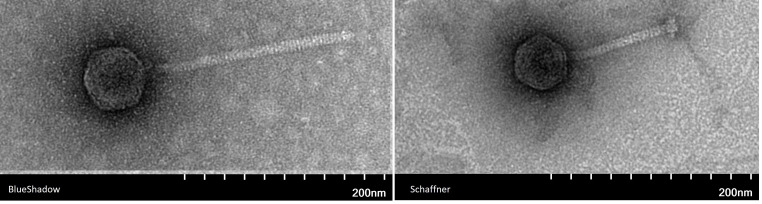 Figure 1
Peer Reviews
No public reviews on file for this paper yet. If you reviewed it on a platform where reviews are public (OpenReview, ICLR, NeurIPS, ICML), you can paste yours below so the community can read it here.
Videos
No videos yet. Explain this paper in a talk, walkthrough, or lecture? Add one.
Taxonomy
TopicsBacteriophages and microbial interactions · Genomics and Phylogenetic Studies · Cancer Research and Treatments
Description
Bacteriophages are viruses that exclusively infect bacteria. Since their discovery, several phages have been used to combat antibiotic-resistant bacterial infections (Hatful, 2022). Here, we detail the isolation and characteristics of two newly identified bacteriophages, BlueShadow and Schaffner, found to infect Arthrobacter globiformis B-2979, a widespread soil bacterium not known to be associated with human disease.
Phages BlueShadow and Schaffner were isolated from soil samples collected in Bismarck, ND. The soil sample for BlueShadow was dark and moist and collected next to a stone retaining wall (GPS: 46.72623 N, 100.75309 W), whereas Schaffner was extracted from a soil sample where perennials were unsuccessfully cultivated (GPS: 46.88773 N, 100.70426 W). Both soil samples were washed with peptone-yeast extract-calcium (PYCa) liquid medium, filtered through a 0.22-µm filter, and mixed with a soft agar containing A. globiformis B-2979, overlaid onto PYCa agar, and incubated at 30°C for 48 hours (Zorawik et al). After 48 hours, BlueShadow displayed an average plaque size of 3.06 mm +/- .05mm (n=3), and Schaffner displayed an average plaque size of 0.9 mm +/- .1mm (n=3). Both phages were purified through three rounds of plating. Transmission electron microscopy with negative staining (1% uranyl acetate) revealed that both phages exhibited siphovirus morphology (Figure 1).
DNA was isolated from BlueShadow and Schaffner using the Promega Wizard DNA cleanup kit. The genome was sequenced using an Illumina NextSeq 1000 (XLEAP-P1 kit), with libraries prepped using the NEB Ultra II FS kit yielding 4,697,068 single-end 100-bp reads for BlueShadow and 4,803,542 single-end 100-bp reads for Schaffner. Raw reads were trimmed with cutadapt 4.7 (using the option: –nextseq-trim 30) and filtered with skewer 0.2.2 (using the options: -q 20 -Q 30 -n -l 50) prior to assembly.(Martin, Jiang et al, Wick et al, Gordon et al) The resulting genome of BlueShadow was 52,454 bp long with a 3′ sticky overhang of 9bp and a G+C content of 62.7%: Whereas the genome of Schaffner is 43,610 bp long, with 3' sticky overhang of 11bp and a GC content of 68.1% as previously described (Russell DA). BlueShadow was assigned to cluster AY and Schaffner was assigned to cluster AZ1 based on gene content similarity of at least 35% to phages in the Actinobacteriophage Database, phagesdb (https://phageDB.org) (Pope et al., 2017; Russell and Hatfull, 2017).
Genome annotation was performed using DNA Master (cobamide2.bio.pitt.edu) and PECAAN (discover.kbrinsgd.org). Both programs use Glimmer-v3.02 (Delcher, 2007), Genemark-v3.25 (Besemer and Borodovsky, 2005), Phamerator (Cresawn, 2011), and Starterator (http://phages.wustl.edu/starterator/ref) for the prediction of potential open-reading frames (ORFs). ARAGORN v1.2.41 (Laslett, 2004) and tRNA scan-SE 2.0 (Lowe, 1997), were used to detect the presence of tRNAs. Gene functions were predicted using BLASTp (Altschul et al, 1990) searches against the Actinobacteriophage and NCBI non-redundant databases as well as HHPred v3.18 (Söding, 2005) searches against the PDB mmCIF70, Pfam-A, and NCBI Conserved Domain databases. All software was used with default parameters.
The genome of BlueShadow is composed of 93 proposed protein-coding genes, 49 of which have a known protein function. The genome of Schaffner contains 66 proposed protein-coding genes, 36 of which have a known protein function. Both phages encode for integrase functions suggesting a temperate life cycle; BlueShadow encodes two tyrosine integrases (37 & 40), whereas Schaffner encodes a serine integrase (50). BlueShadow encodes a large terminase across two ORFs (ATPase domain, BlueShadow 2; Nuclease domain, BlueShadow 3), as is characteristic of most AY phages (Gavin et al, 2024). Endolysins are well-conserved across cluster AZ1, but the location is not conserved. In Schaffner, this endolysin is found in the second half of the genome (Schaffner 57) similar to phage Yang (Dojs et al, 2024).
Nucleotide sequence accession numbers
The GenBank and Sequence Read Archive (SRA) accession numbers for BlueShadow are PV876918 and SRX27501634 , respectively. The GenBank and SRA accession numbers for Schaffner are PV876958 and SRX27501638 , respectively.
The reference list from the paper itself. Each links out to its DOI / PubMed record.
- 1Altschul Stephen F. Gish Warren Miller Webb Myers Eugene W. Lipman David J. 1990101 Basic local alignment search tool Journal of Molecular Biology 21530022-283640341010.1016/s 0022-2836(05)80360-22231712 · doi ↗ · pubmed ↗
- 2Besemer J. Borodovsky M. 200571 Gene Mark: web software for gene finding in prokaryotes, eukaryotes and viruses Nucleic Acids Research 33Web Server 0305-1048 W 451W 45410.1093/nar/gki 48715980510 PMC 1160247 · doi ↗ · pubmed ↗
- 3Delcher Arthur L. Bratke Kirsten A. Powers Edwin C. Salzberg Steven L. 2007119 Identifying bacterial genes and endosymbiont DNA with Glimmer Bioinformatics 2361367-481167367910.1093/bioinformatics/btm 00917237039 PMC 2387122 · doi ↗ · pubmed ↗
- 4Gordon D Abajian C Green P 199831 Consed: a graphical tool for sequence finishing.Genome Res 831088-905119520210.1101/gr.8.3.1959521923 · doi ↗ · pubmed ↗
- 5Hatfull Graham F. 202277 Mycobacteriophages: From Petri dish to patient PLOS Pathogens 1871553-7374 e 1010602 e 101060210.1371/journal.ppat.101060235797343 PMC 9262239 · doi ↗ · pubmed ↗
- 6Jiang H Lei R Ding SW Zhu S 2014612 Skewer: a fast and accurate adapter trimmer for next-generation sequencing paired-end reads.BMC Bioinformatics 1518218210.1186/1471-2105-15-18224925680 PMC 4074385 · doi ↗ · pubmed ↗
- 7Jones, D. & Keddie, R. M. (2006). The genus arthrobacter. The prokaryotes , 3 , 945-960.
- 8Kapinos Andrew Aghamalian Pauline Capehart Erika Alag Anya Angel Heather Briseno Eddie Corado Perez Byron Farag Emily Foster Hilory Hakim Abbas Hernandez-Casas Daisy Huang Calvin Lam Derek Mendez Maya Min Ashley Nguyen Nikki Omholt Alexa L. Ortiz Emily Saldivar Lizbeth Shelly Shannon Jack Arthur Smith Rachel Sridhar Mihika V. Ta An Theophilus Malavika C. Ngo Ryan Torres Canela Reddi Krisanavane Freise Amanda C. Moberg Parker Jordan 2022113 Novel Cluster AZ Arthrobacter phages Powerpuff, Lego, and Yes Chef exhibit close functi · doi ↗ · pubmed ↗