Evaluation of risk factors for ocular morbidities and its impact on the lives of medical students: An academic collateral
Haneen Haneen, Jarina Begum, Syed Irfan Ali, Abhishek Kumar, Swati Shikha, Khushboo Juneja, Samudyatha U chandrashekara, Jarina Begum, Raya Khudhair Mohsin, Jarina Begum, Akinsola S Aina, Jarina Begum

TL;DR
This study finds that many medical students suffer from eye problems, mainly myopia, which affects their lifestyle and studies.
Contribution
The study identifies key risk factors and lifestyle impacts of ocular morbidities among medical students.
Findings
64.7% of medical students suffer from ocular morbidities, with myopia being the most common.
Ocular issues have impacted students' ability to participate in activities or apply for jobs.
Risk factors include family history, screen time, and poor lighting.
Abstract
One billion people worldwide have preventable vision impairment. Ocular morbidities are a significant problem in the public health sector, especially among medical students. The study objectives were to identify the prevailing ocular morbidities and evaluate the risk factors and their impact on students’ lifestyles and academics. A cross-sectional study was conducted among 312 undergraduate medical students over 6 months. Data were collected through a structured questionnaire and analysed to identify the prevalence, associated risk factors, and consequences of ocular morbidities. 64.7% were suffering from ocular morbidities. Headache was a predominant symptom in students with (51.7%) and without (39.1%) ocular morbidities. The most common ocular morbidity was myopia (84.3%). 18.7% of students perceived that ocular morbidity had restricted them from participating in activities or…
Genes, proteins, chemicals, diseases, species, mutations and cell lines named across the full text — each resolved to its canonical identifier and authoritative record.
Click any figure to enlarge with its caption.
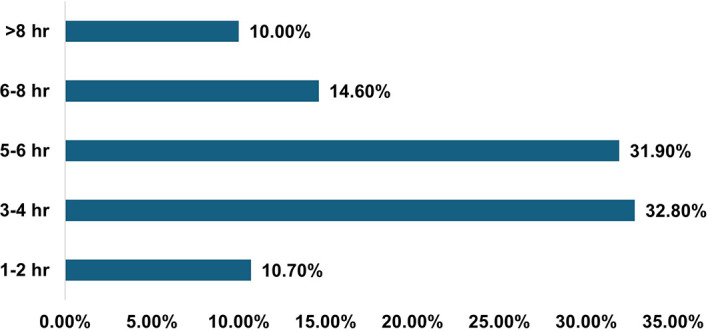 Figure 1
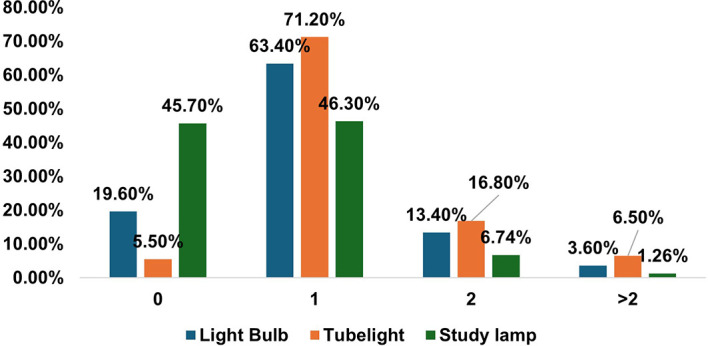 Figure 2
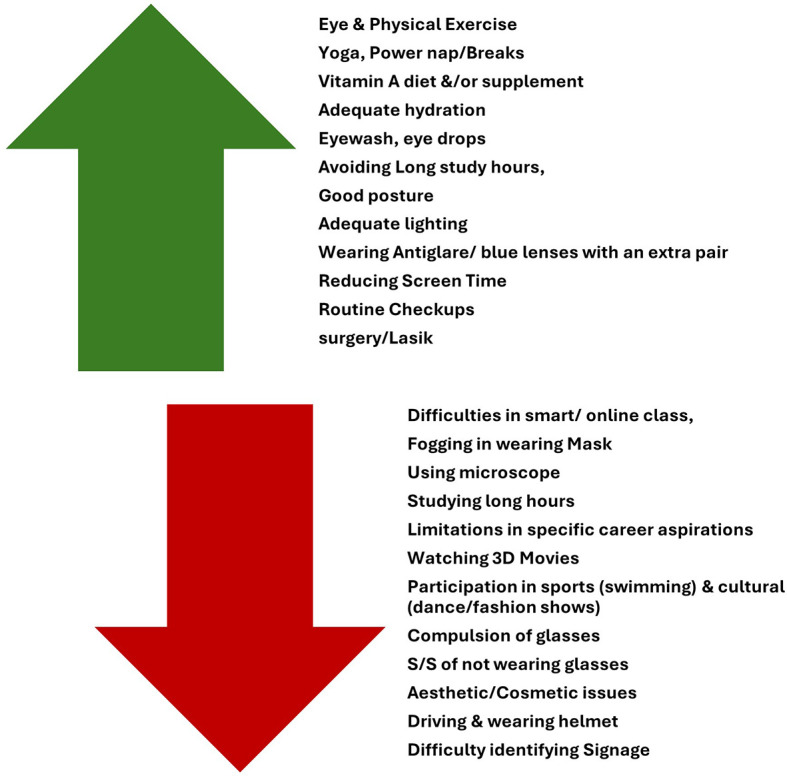 Figure 3
| SL. No | Frequency of vitamin A rich food intake | Percentage |
|---|---|---|
| 1 | Once a week | 43.30% |
| 2 | 2 or more times a week | 30.60% |
| 3 | Rarely | 13.50% |
| 4 | Never | 12.60% |
| Sl. No | Posture while reading | Percentage |
|---|---|---|
| 1 | Sitting on a Chair and table | 61.20% |
| 2 | Sitting/lying on a couch | 22.80% |
| 3 | Lying down | 9.40% |
| 4 | Sitting on floor | 4.60% |
| 5 | Others | 2% |
| Risk factors | Yes | No | P value | |
|---|---|---|---|---|
|
|
| 192 | 93 | p < 0.0001 |
|
| 10 | 17 | ||
|
| >5 hr | 144 | 33 | p < 0.0001 |
| <5-hr | 58 | 77 | ||
|
| Present | 142 | 44 | p < 0.0001 |
| Absent | 60 | 66 | ||
|
| Female | 162 | 63 | p < 0.0001 |
| Male | 40 | 47 | ||
|
| Adequate | 155 | 86 | P = 0.7705 |
| Inadequate | 47 | 24 | ||
|
| Right | 104 | 86 | p < 0.0001 |
| Wrong | 98 | 24 | ||
|
| Present | 24 | 70 | p < 0.0001 |
| Absent | 178 | 40 | ||
|
|
| |||
|
| During school (<_15 yr) | 61 | 66 | p < 0.0001 |
| After school (>15 Years) | 59 | 16 | ||
|
| <6 months | 102 | 47 | p < 0.0001 |
| >6 months | 18 | 35 |
- —Manipal Academy of Higher Education
Peer Reviews
No public reviews on file for this paper yet. If you reviewed it on a platform where reviews are public (OpenReview, ICLR, NeurIPS, ICML), you can paste yours below so the community can read it here.
Videos
No videos yet. Explain this paper in a talk, walkthrough, or lecture? Add one.
Taxonomy
TopicsOphthalmology and Visual Impairment Studies · Ophthalmology and Visual Health Research · Traumatic Ocular and Foreign Body Injuries
Introduction
At least 2.2 billion people have vision impairment worldwide, and among these, 1 billion vision impairments are preventable. ^ 1 ^ Avoidable ocular morbidities are a significant public health problem in India. ^ 2 ^ Vision is an important and special sense of living beings. These days, it is common to find an increasing number of younger people and even children complaining about several vision problems apart from the age-onset eye conditions. The prevalence of myopia was attributed to urban lifestyle, family history, longer time spent on near-work activities, and fewer outdoor activities. Few surveys have explored the role of high exposure in developing cell phone vision syndrome among college students. ^ 3 ^ Environmental factors, such as dryness, potentially contribute to ocular discomfort and alteration of the tear film. ^ 4 ^ Ocular morbidities are common among medical students, although many areas in this field require good near and far vision. ^ 5 ^ Sleep disorders and underlying diseases are also major concerns pertaining to the onset of vision-related tiredness. ^ 6 ^ There is a need for standard vision testing in the young population to diagnose such problems at the earliest. ^ 7 ^ The current study aimed to identify the risk factors for various vision problems among medical students that affect their lifestyles.
Medical students are prone to excessive device usage due to recent shifts to online mode during the pandemic, followed by a hybrid mode of study as well as a heavy load of academic involvement. We intend to identify the risk factors for vision problems among such students and their effect on the lifestyle of the students so that the issue of increasing ocular morbidities can be addressed.
Objectives
- 1.To identify the ocular morbidities prevailing in medical students.
- 2.To evaluate the risk factors causing the ocular morbidities.
- 3.To discuss its impact on the lifestyle & academics of medical students.
Methodology
Study design
A cross-sectional study was conducted among 312 undergraduate medical students over six months.
Sample size
- The study sample was calculated by using a population proportion of ocular morbidity of 50%, confidence interval (CI) of 95%, population size around 800, and an error of 5%, which is estimated as 260. Assuming a non-response rate of 20%, the sample size was calculated as 312. A sampling method of complete enumeration was used with the inclusion of medical students with ocular morbidities (vision problems) in the age group 18-26 years, currently pursuing their professional course, and who consented to participate in the study. Those lacking any prescription or knowledge of ocular morbidity or those submitting incomplete forms were excluded from the study.
Study tools
A semi-structured questionnaire was circulated through an online Google survey form, which was developed and validated by a panel of public health experts. The questionnaire comprised five sections of socio-demographic profile, status of ocular morbidity, impact on lifestyle, impact on academics, and open-ended questions discussing the difficulties faced due to ocular morbidity and suggestions to overcome them.
Ethical approval statement
The study was reviewed and approved by the Manipal Tata Medical College Institutional Ethics Committee (DHR Registration: EC/NEW/INST/2022/2810) with approval number MTMC/IEC/2023/31. All procedures performed involving human participants were in accordance with the ethical standards of the institutional committee and with the 1964 Declaration of Helsinki and its later amendments.
Data collection
Data were collected using an online Google survey form administered to MBBS students across all phases of study in two medical colleges within the region. Written informed consent was obtained electronically through the survey platform, and only participants who provided consent were permitted to complete the questionnaire. No minors were enrolled in the study. In accordance with the inclusion and exclusion criteria, morbidity details were further gathered through structured telephonic interviews and subsequently verified by subject experts prior to inclusion in the analysis.
Statistical analysis
Descriptive statistics for quantitative data in the form of percentages and proportions, along with the chi-square test for categorical data, were used. Thematic analysis was performed on qualitative data obtained through open-ended questions.
Results
Out of 312 majority were females (72.4%) and currently living in hostels (84.4%). Around 83.4% belonged to general caste and high socioeconomic status (86.5%).
202 students (64.7%) were suffering from ocular morbidities currently. Rest of the 110 students (35.3%) had ocular morbidities in the past. However, the students were having ocular symptoms (headache, strain in the eyes, itchiness, watery eyes, eye fatigue, dark circles, dry eye, etc.), among which headaches were the predominant symptom (39.1%). The majority revealed that there were no interventional procedures performed for their past ocular morbidities, except a few (4.3%), which were minor interventions such as chalazion cyst removal, Lasik, trauma, and foreign body in the eye, etc.
Out of 202 students who were suffering from one or other forms of ocular morbidity, the majority had myopia (84.3%), followed by astigmatism (6.4%), hypermetropia (3.3%), strabismus (1.9%), and others (4.1%), including glaucoma, color blindness, retinal thinning, granular corneal dystrophy, and the predominant symptom was headache (51.7%).
The age of onset of the ocular morbidity was ≤15 years in 62.8% of students. The most common presentation was headache (56%), followed by blurred vision (32%) where they were not inability to see the blackboard, red, dry, and watery eyes (8.2%), and regular checkup (3.8%). As perceived by the students, ocular morbidities have been managed; however, the conditions had variable outcomes in terms of 38.9% improvement, 37% not change, 22.7% worsened, and 1.4% were unsure of their conditions.
Likewise, (12.8%) few students had claimed the reason for their development of ocular morbidity after joining medical colleges.
Currently, 89.1% students were using spectacles and rest of them were either contact lenses or both. Amongst them, 88.2% were using it regularly and rest who were not using it regularly. The reasons stated were ignorance, not fashionable, not required for other than academics, non compliance due to unawareness, uncomfortable.
The mean power of right eye and left eye were -1.24 with a lowest of -0.5 to highest of – 8.5 & -1.21 with a lowest of -0.5 to the highest of -6.25 respectively. The majority had the last eye check-up for an average 6.8 months back.
Very few had any interventional procedures (3.8%) or had history (2.9%) majority (91.6%) had a family history of ocular morbidities in their family members. There were no associated co morbidities, except for few (8.6%) such as diabetes, hypertension, thyroid disorder, asthma, migraine, PCOS, epilepsy, bronchitis, and tuberculosis. Only 6% students had mentioned the presence of addiction in their families.
94 students were taking vitamin and mineral supplements attributed to doctors (62.4%) or parent’s (37.6%), including various forms such as Multivitamin, Vitamin B complex, Vitamin D, Iron or IFA, Calcium, Biotin, Omega 3, Vitamin B12, Zinc etc. When asked about the intake of vitamin A-rich food, almost all were eating it consciously or unconsciously in various forms; however, the frequency varied, as shown in Table 1.
Out of the 312, the majority, 84.4% preferred physical books to read, although virtual PDF books were available. Likewise, the majority (67.2%) used tables and chairs while reading, followed by other means, such as bed, couch, floor, and others [ Table 2].
Students had various forms of entertainment, either virtually via electronic devices (59.8%) or physically by interacting with friends and family (58%), followed by outdoor/indoor games (38%), video games, and various other social media interactions. The students were using devices for multiple purposes, but for varied periods of time, as per their needs [ Figure 1].
Average screen time of participants (N = 312 Medical Students).
When asked about adequate lighting, the majority (77.3%) said yes. However, the average number of windows and doors in the reading room was 1.5 and one, respectively, indicating that there was a lack of natural light in the room. Similarly, the average study hours during daylight were less than 3 h compared to study hours without daylight (i.e., 5 h). The majority had a mean sleep hour of 7.3 in the night and a total of 8.6 hours during the 24hours of the day and night. The sources of artificial lights were either light bulbs, tube lights, study lamps, or a combination of them [ Figure 2].
Sources of Artificial Light used by Participants (N = 312 Medical Students).
Early age of onset (<15 years of age) and regular eye check-ups (at least once in 6 months) were associated with improved outcomes (P < 0.0001) with respect to ocular morbid conditions. Inappropriate posture, more than five hours of screen time, and device intimacy were significantly associated (P < 0.0001) with ocular morbidities. The association between perceived adequacy of lighting and the occurrence of morbid ocular conditions was found to be insignificant. (P = 0.7705). Female sex and family history were also associated with ocular morbidities (P < 0.0001). Multivitamin supplementation was associated with a lower incidence of any form of ocular morbidity (P < 0.0001) [ Table 3].
18.7% of students confessed that ocular morbidity had restricted them from participating in activities or applying for a post, such as swimming, military/army/air force post, dance, a few sports, basketball, badminton, cricket, driving at night, watching 3D movies, continuous screen use, and seeing through microscopes, etc.
The students mentioned various challenges encountered with ocular morbidity and suggested solutions to overcome them through open-ended questions, which were presented as themes [ Figure 3].
Challenges and suggested solutions for ocular morbidities.
Discussion
The majority (57.4%) had myopia in the current study followed by other conditions. Studies has stated Refractive error is the most common ocular morbid condition among children. ^ 8 ^ Likewise the most common presentation of ocular symptoms at onset was blurred vision, followed by headache. However, another study found that headache (50%) and dry eyes (45%) were the common ocular complaints, and myopia was common as well among the students. ^ 9 ^
The students were concerned about the challenges encountered when dealing with ocular morbidities, such as the inability to study long hours and engaging with devices. Likewise, an observational study was conducted among 200 medical students who are using smart phone, laptops, and computers to determine the relationship between eye strain and related risk factors, which showed that most of the students had more than one symptom, such as headache (56.77%), eye strain (50.52%), blurring of vision (40.62%), and redness (23.95%). 85% of patients used electronic devices for longer duration of 4-10 hours, had more asthenopia or eye strain. ^ 10 ^
Although inappropriate posture, more than five hours of screen time, and device intimacy had a significant association, the perceived adequacy of lighting had no statistically significant association with the occurrence of ocular morbid conditions. Another study on the prevalence of eye strain and other ocular morbidities among students inferred that low levels of lighting in the classroom may be an contributing factor for ocular morbidity. ^ 11 ^
The current study observed that female students and those with a family history of ocular morbidity were more vulnerable to ocular morbidity. Another study showed similar results, with a higher prevalence of ocular morbidity among females. ^ 8 ^
The students suggested solutions to the perceived challenges pertaining to ocular morbidities, such as a vitamin A-rich diet, reduced screen time, yoga, hydration, and regular eye check-ups. Similarly, age <17years was found to be another factor responsible for the high prevalence of ocular morbidities, to which the suggested reasonable services were early screening and health education. Another study among medical students observed common ocular morbidities, such as refractive errors, dry eyes, and color blindness, directing frequent eye checkups. ^ 12, 13 ^
As discussed in the study, students were predominantly myopic and using spectacles; they also perceived limitations in playing outdoor games and sports due to their ocular morbidity. Studies have found similar findings where myopia was the common ocular morbidity among medical students as a huge portion of their time was spent on near –work and doing indoor activities while very less in doing outdoor activities, which was indicated as a risk factor for myopia. ^ 14, 15 ^
Conclusion
The study concluded that the most prevalent ocular morbidity among medical students was refractive error, with myopia being the most prevalent. Evaluation of various risk factors inferred that ocular morbidity in students was associated with familial history, female sex, appropriate posture while reading, screen time, device intimacy, and multivitamin supplementation. Ocular morbid conditions have adversely affected the students’ lifestyles and academics in terms of their inability to participate in sports and games, career aspirations, such as in the Army or Air Force, Navy, etc. Likewise, the inability to study long hours is another negative effect of ocular morbidity as perceived by the students, underscoring the need for early detection, preventive strategies, and health education interventions.
Limitations
A small sample size and an online questionnaire were used for data collection. There is scope for a larger study in the future to explore ocular morbidity among healthcare professionals.
The reference list from the paper itself. Each links out to its DOI / PubMed record.
- 1World report on vision: Who.int. [cited 2023 Mar 28]. Reference Source
- 2Sadagopan AP Manivel R Marimuthu A : Prevalence of Smart Phone Users at Risk for Developing Cell Phone Vision Syndrome among College Students. Journal of Psychology & Psychotherapy. 2017;07:299. [accessed Jan 06 2025]. (PDF) Prevalence of Smart Phone Users at Risk for Developing Cell Phone Vision Syndrome among College Students. 10.4172/2161-0487.1000299 Reference Source · doi ↗
- 3Berhane MA Demilew KZ Assem AS : Myopia: An Increasing Problem for Medical Students at the University of Gondar. Clinical ophthalmology (Auckland, N.Z.). 2022;16:1529–1539. 10.2147/OPTH.S 365618 35615078 PMC 9126289 · doi ↗ · pubmed ↗
- 4Tabernero J Garcia-Porta N Artal P : Intraocular Scattering, Blinking Rate, and Tear Film Osmolarity After Exposure to Environmental Stress. Transl. Vis. Sci. Technol. 2021;10(9):12. 10.1167/tvst.10.9.12 34379094 PMC 8362624 · doi ↗ · pubmed ↗
- 5Abuallut II Alhulaibi AA Alyamani AA : Prevalence of Refractive Errors and its Associated Risk Factors among Medical Students of Jazan University, Saudi Arabia: A Cross-sectional Study. Middle East Afr. J. Ophthalmol. 2021;27(4):210–217. 10.4103/meajo.MEAJO_240_20 33814817 PMC 7993047 · doi ↗ · pubmed ↗
- 6Schakel W Bode C Ven P Mvan de : Understanding fatigue in adults with visual impairment: A path analysis study of sociodemographic, psychological and health-related factors. Plo S one. 2019;14(10):e 0224340. 10.1371/journal.pone.0224340 31652298 PMC 6814229 · doi ↗ · pubmed ↗
- 7Alrashidi SH : Pattern of refractive errors in Buraydah. How serious is the problem? Int. J. Health Sci. 2018;12(4):39–41. 30022902 PMC 6040848 · pubmed ↗
- 8Sarkar A Medhi GK Bhattacharyya H : Pattern of ocular morbidities: A cross-sectional study on school-going children in Shillong city. J. Family Med. Prim. Care. 2019;8(6):2124–2128. 10.4103/jfmpc.jfmpc_268_19 31334191 PMC 6618186 · doi ↗ · pubmed ↗