The nutrition toolbox permits in silico generation, analysis, and optimization of personalized diets through metabolic modelling
Bram Nap, Bronson Weston, Annette Brandt, Maximilian F Wodak, Ina Bergheim, Ines Thiele

TL;DR
The Nutrition Toolbox helps create and optimize personalized diets by modeling their effects on human and gut microbiome metabolism.
Contribution
The Nutrition Toolbox converts food items into metabolic compositions for use in whole-body metabolic models.
Findings
The toolbox uses open-source databases to translate food items into metabolite-level diets.
It enables minimal dietary changes to achieve desired metabolic shifts in humans and microbiomes.
The tool is implemented in MATLAB and is publicly available for further use and development.
Abstract
Nutrition is an important factor in human health, used to alleviate or prevent symptoms of various diseases. However, the effects of nutrition on the gut microbiome and human metabolism are not well understood. Whole-body metabolic models (WBMs) have been applied to study relationships between regional diets and human/microbiome metabolism. This method requires diets to be defined at the metabolite level, rather than the food item level, which has gated the application of personalized diets to WBMs. We developed the Nutrition Toolbox, which leverages open-source databases containing metabolite composition for over ten thousand food items to convert food items into their metabolic composition to create in silico diets. Additionally, when used with a previously published nutrition algorithm, minimal changes to a diet can be identified to achieve desirable shifts in human and microbiome…
Genes, proteins, chemicals, diseases, species, mutations and cell lines named across the full text — each resolved to its canonical identifier and authoritative record.
Click any figure to enlarge with its caption.
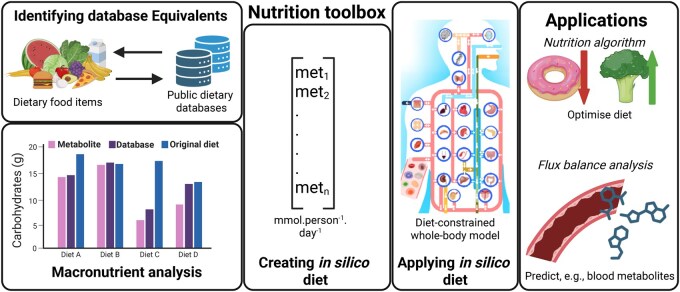 Figure 1
| OriginalFood | KeyWords | ReferenceWeight(g) | Energy (kcal) | Lipid (g) | Protein (g) | Sugars (g) |
|---|---|---|---|---|---|---|
| Red apple | Apple; Red | 150 | 91.4 | 0.1 | 0.4 | 15.5 |
| FoodName | databaseID | databaseOrigin | diet1 (g) | diet2 (g) |
|---|---|---|---|---|
| Dried date | 168191 | usda | 50 | 80 |
| Red apple | 1105430 | usda | 100 | 0 |
| Cream cheese | 1215 | frida | 25 | 35 |
- —European Union’s Horizon 2020 Research
- —Science Foundation Ireland funded by the Irish Government under the BlueBio ERA-NET Co-fund
- —European Research Council (ERC) under the European Union’s Horizon 2020 Research and Innovation Programme
Peer Reviews
No public reviews on file for this paper yet. If you reviewed it on a platform where reviews are public (OpenReview, ICLR, NeurIPS, ICML), you can paste yours below so the community can read it here.
Videos
No videos yet. Explain this paper in a talk, walkthrough, or lecture? Add one.
Taxonomy
TopicsMicrobial Metabolic Engineering and Bioproduction · Nutrition, Genetics, and Disease · Metabolomics and Mass Spectrometry Studies
1 Introduction
Nutrition has long been an important area of study, particularly to maintain human health and supply nutrients (Melzer et al. 2021). Diet is also frequently targeted to alleviate symptoms or prevent diseases (Xiao et al. 2024). However, the effects of nutrients on human metabolism are not well understood (Johnson et al. 2020, Melzer et al. 2021). Studying nutrition-human metabolism is difficult due to the high variability of dietary habits and gut microbiome composition between people. The gut microbiome is a complex ecosystem that converts human and dietary metabolites. Thus, the gut microbiome from different people will consume and produce different metabolites, even if they eat the same diet (Johnson et al. 2020).
A method to investigate human-microbiome co-metabolism is the constraint-based reconstruction and analysis (COBRA) framework (Heirendt et al. 2019), in which an organism’s genome and experimental data are used to describe in a stoichiometrically accurate, mass- and charge-balanced manner the metabolic capabilities of the organism. COBRA assumes the system to be at a steady state, meaning concentrations do not change over time. The metabolic reactions can be further constrained through the addition of context-specific data, such as the uptake and excretion rates of metabolites. These additional constraints lead to the conversion from a metabolic reconstruction to a genome-scale metabolic model, which can be investigated using, for example, flux balance analysis (Orth et al. 2010). The COBRA framework has been applied to develop sex-specific, organ-resolved whole-body metabolic models (WBMs) that can be used to simulate human metabolism (Thiele et al. 2020). The WBMs can be personalized with physiological and metabolomic data. Additionally, metagenomics can be used to create community microbiome models, which can be integrated within the lumen of the large intestine in the WBMs. The high level of personalization of WBMs enables modelling nutrition-microbiome-human metabolism. However, to model the diet influence on the WBMs, the diets need to be defined on the metabolite level. Only a few metabolite-resolved diet formulations are currently available (Noronha et al. 2019) and thus, hamper the accurate modelling of nutrition effects on human metabolism and of nutritional interventions.
At present, several open-access food databases, including the U.S. Department of Agriculture’s FoodData Central (USDA) (U.S. Department of Agriculture Agricultural Research Service, Beltsville Human Nutrition Research Center 2024) and the National Food Institute, Technical University of Denmark (FRIDA) (National Food Institute, Technical University of Denmark 2024) database, contain metabolite-resolved information with mass measurements, e.g. grams, for a large number of food items. We define here a database food equivalent as a food item in either the USDA or FRIDA database, which could potentially be used to represent a food item consumed in the diet. Manually identifying food items in a database that match specific dietary food items, e.g. from food frequency questionnaires, is time-consuming. Additionally, converting the metabolite composition to be compatible with the WBMs requires knowledge of the virtual metabolic human (VMH) database (Noronha et al. 2019) and modelling conventions.
Here, we present the nutrition toolbox (Fig. 1), a MATLAB-based codebase within the COBRA Toolbox (Heirendt et al. 2019). The Nutrition Toolbox (i) aids in identifying database food equivalents in the USDA or FRIDA databases, (ii) can convert diets with database food equivalents into in silico diets, (iii) performs macronutrient analyses on in silico diets, (iv) sets in silico diets as constraints on WBMs, and (v) connects to the nutrition algorithm (Weston and Thiele 2023) to predict dietary changes. We also provide a tutorial (Supplementary Tutorial, available as supplementary data at Bioinformatics Advances online) explaining the various functions and a demonstration dataset in the COBRA toolbox https://opencobra.github.io/cobratoolbox/stable/tutorials/tutorial_Tutorial_nutritionToolbox.html, which are automatically downloaded during installation of the COBRA toolbox.
Schematic overview of the nutrition toolbox and its applications. Public dietary databases, i.e. USDA U.S. Department of Agriculture, 2024 or FRIDA National Food Institute, 2024, are used to identify database food equivalents from dietary food items based on description and macronutrient composition. The in silico diets are then calculated from the database food equivalents. Carbohydrate (shown), lipid, protein, sugar, and caloric contents of the in silico diets are compared to the original diet. To accurately compare the in silico diet, macronutrients as reported from the database (database in the figure) and macronutrients as calculated from measured metabolites (metabolites in the figure) are shown. The in silico diet can be set on the WBMs (Thiele et al. 2020) and be used with either flux balance analysis (Orth et al. 2010) to investigate human metabolism or with the nutrition algorithm (Weston and Thiele 2023) to optimize the in silico diet. The whole-body model figure was adapted from Thiele et al. (2020). Created with BioRender.
2 Methods
The nutrition toolbox is written in MATLAB (Mathworks, Inc.) and can be found in the COBRA toolbox (Heirendt et al. 2019). Certain parts of the nutrition toolbox perform linear optimizations, and it is recommended to use, e.g. gurobi (Gurobi Optimization, Inc.) as linear programming solver. Information on installing the COBRA toolbox, linear programming solver compatibility, and solver installation can be found at https://opencobra.github.io/cobratoolbox/stable/installation.html. The tutorial location in the cobratoolbox is cobratoolbox/tutorial/analysis/nutritionToolbox.
2.1 Construction of food item databases
The USDA and FRIDA databases were downloaded from https://fdc.nal.usda.gov/download-datasets and https://frida.fooddata.dk/data? lang=en, respectively. The contents of the USDA and FRIDA databases were processed for compatibility with WBMs utilizing the createUSDAdatabase.m and createFridaDatabase.m functions, respectively (available in the Nutrition Toolbox), yielding almost 14.000 food items from the USDA database and almost 1400 food items from the Frida database that could be used to formulate in silico diets. These functions also translate metabolites with mass measurements, i.e. variations of grams, into their respective VMH identifiers and convert these values to mmol/100g of database food equivalent.
2.2 Preparing dietary information to search food databases
The first step in using the Nutrition Toolbox is to prepare the dietary food items to find database food equivalents in the altered USDA/FRIDA databases. We provide a template file for users to populate with their dietary data, ensuring the correct formatting (Table 1, available as supplementary data at Bioinformatics Advances online). We will refer to this file throughout the manuscript as the foodDescription file. Additionally, we define a dietary food item as the food item, for which the user wants to find database food equivalents. Information required to describe dietary food items is: the dietary food item name, descriptive keywords, reference weight, and macronutrient composition (Table 1). Macronutrients are a set of nutrients that the body requires in substantial amounts. They can generally be divided into 1. carbohydrates, which can be subdivided into sugar, starch, and fibre, 2. lipids or fats, and 3. protein. The reference weight is the weight of the dietary food item for which the macronutrient composition is given, e.g. 100 g on food labels.
Keywords should be single words separated by semicolons (;), which describe the dietary food item. A quick method for generating keywords is to separate each word from the original food name with a semicolon. The first keyword is usually the most descriptive. For example, in the case of ‘red apple’, the most descriptive term is ‘apple’, and should be the first keyword (Table 1).
The reference weight and macronutrient composition are used to assess the similarity between the dietary food items and database food equivalents. Macronutrient values can be obtained from the packaging of the dietary food item, online from distributors or general databases. Users do not have to input all available macronutrients. However, the more values are given, the more accurate and comprehensive the comparison with the database food equivalents will be. The expected units for each macronutrient are provided in the column names. When creating multiple diets, one foodDescription file can be used with all the unique dietary food items.
2.3 Identifying suitable database food equivalents
The function vmhFoodFinder.m uses the keywords and a string matching search strategy to identify potential database food equivalents. Two search strategies can be employed: sequential or cumulative. More details on the search strategies can be found in the tutorial (Supplementary Tutorial, available as supplementary data at Bioinformatics Advances online). Dietary food items, for which no database food equivalents are found during the keyword search, are logged in the noDatabaseHits.txt file. In contrast, a dietary food item may return many database food equivalents, which increases runtime. Therefore, dietary food items yielding database food equivalents exceeding a user-defined threshold (default: 50) are stored in the tooManyDatabaseHits.xlsx file. All database food equivalents found for dietary food items are listed and can be used for keyword refinement. For both cases, the foodDescription file will need to be updated to obtain new database food equivalents. Tips on how to handle dietary food items yielding no or too many database food equivalents, can be found in the tutorial (Supplementary Tutorial, available as supplementary data at Bioinformatics Advances online and in the COBRA toolbox https://opencobra.github.io/cobratoolbox/stable/tutorials/tutorial_Tutorial_nutritionToolbox.html).
The resulting database food equivalents are then passed to the collectFoodItemInfo.m function, where the macronutrients and metabolites for each database food equivalent are collected. The macronutrient composition extracted from the database food equivalent (database macronutrient) is subsequently compared to the user-provided macronutrient composition by calculating the Euclidean distance in the calculateFoodScore.m. Besides the Euclidean distance, the percentage of the measured macronutrients as metabolites is also reported. The measured metabolites are grouped into macronutrient groups and give an indication of how well the macronutrients are represented in the measured metabolite content. Database food equivalents less similar to dietary food items might be chosen if they have a higher measured metabolite representation. Carbohydrates are excluded from the macronutrient comparison due to inconsistency in definitions across databases and on food labels of dietary food items, specifically, whether fibre is included in the total carbohydrate count. Instead, individual carbohydrate components (i.e. sugars, fibre, and starch) are used, where available.
The final comparison table is saved as fullComparison FoodItems.xlsx. A shorter version with only the top ten hits per dietary food item is saved as topResultsComparisonFoodItems.xlsx.
2.4 Creating in silico diets
The most appropriate database food equivalents, chosen from the comparison files as explained in the previous section, must be linked to their consumed weights per diet. A template file is provided (Table 2, available as supplementary data at Bioinformatics Advances online), which requires, at a minimum, four entries (Table 2): the name of the dietary food item, the ID of the database food equivalent, the name of the database, from which the database food equivalent was selected, and the consumed weight. The file containing the consumed database food equivalents will be referred to as the equivalentsConsumed file throughout the paper. The name of the dietary food item serves as a secondary check to ensure that the correct information has been entered. The database name and ID can be found in the comparison files, from which the database food equivalents were selected. Each column following the database name represents a separate diet, where the value corresponds to the consumed weight in grams (Table 2). If a dietary food item is not consumed in a particular diet, the consumed weight should be set to zero.
To create and analyse in silico diets, the function generateInSilicoDiet.m is used. For each consumed food in the equivalentsConsumed file, the metabolites in mmol/100g of database food equivalent are extracted, divided by 100, and multiplied by the consumed weight of the dietary food item to arrive at a unit of mmol/day/person, which can be used as constraints after summing all dietary food items. From the database food equivalents, both the database and metabolite-derived database macronutrients are visualized as bar charts. The function also calculates the fractional contribution of various macronutrients to the total energy content of the diet. If the user provides the macronutrient composition of the original diet, this info is also included in the analysis. A template is provided (Table 3, available as supplementary data at Bioinformatics Advances online).
To easily apply the diet to WBMs, the setInSilicoDiet.m function can be used. This function also uses the foodsConsumed file and offers two methods to apply the diet. The first is the conventional approach, in which the available dietary metabolites are calculated in mmol/human/day (as in generateInSilicoDiet.m) and directly applied to the WBMs. Alternatively, database food equivalents themselves can be used as constraints. As WBMs are not natively able to ’consume’ foods, additional reactions must be added to the WBMs. Two types of reactions are included for each database food equivalent in the selected database(s). The first is an exchange reaction, allowing for ’consumption’ of the database food equivalent, defined as:
where [f] is a new compartment denoting the food source. The second is a breakdown reaction, representing the conversion of the database food equivalents into its constituent metabolites and macronutrients. These reactions are defined as:
where n is the total number of product metabolites and [d] the dietary compartment. Note that macronutrients (e.g. energy, lipids) are treated as metabolites in this approach for modelling purposes, but do not interact with the metabolic network of the WBMs and are not broken down into specific molecules. They are only used to calculate the macronutrient composition of the ’ingested’ diet in the WBMs and to enable control over dietary composition when working with the nutrition algorithm. Finally, exchange reactions are added for these newly defined macronutrients to ensure mass balance within the WBM and to allow the macronutrients to be removed from the WBM, now called food item-constrained WBMs, formulated as:
It is recommended to use the food item-constrained WBMs primarily when the objective is to adjust the diet itself. For standard analyses of diet impact on WBMs, the use of metabolite-constrained WBMs is advised, as the inclusion of numerous exchange and breakdown reactions can significantly increase model size and complexity. Lastly, the function includes a feasibility check for the resulting WBMs. If essential metabolites are missing, the diet is automatically adjusted to restore model feasibility. Feasibility for WBMs is defined as the WBM capability to satisfy the whole-body maintenance objective. For community microbiome WBMs, the production of community microbiome biomass is added as an additional feasibility check. More information on ensuring feasibility can be found in the tutorial (Supplementary Tutorial, available as supplementary data at Bioinformatics Advances online).
2.5 Integration with the nutrition algorithm
To further leverage the information contained within food databases, the previously published nutrition algorithm (Weston and Thiele 2023) was adapted to work with the WBMs and the nutrition toolbox. The nutrition algorithm can use metabolite-constrained and food item-constrained WBMs to determine the minimal dietary change required to achieve the greatest increase or decrease in specific metabolic fluxes of interest (e.g. decrease of blood cholesterol levels). Dietary modifications can be calculated at the metabolite or database food equivalent level. Applications of the nutrition algorithm at the metabolite level may be most helpful for the identification of novel food supplements, while applications at the database food equivalent level could be useful for creating a personalized diet or identifying optimal diets to target various diseases.
When utilizing food-item optimization, constraints can be specified to limit how much specific macronutrients vary. For example, a user can request the minimal changes to a given diet to maximally increase dopamine storage in the brain while maintaining lipid intake and allowing a maximum addition or removal of 200 grams of food. Additionally, the user can specify the caloric range (in kcal) of the consumed diet. These additional constraints on macronutrients enable precise control over dietary modifications compared to those produced without macronutrient constraints.
2.6 Limitations
WBMs do not take into account enzyme kinetics or bioavailability of nutrients, which is important to consider when interpreting the simulation results, as the modelled intake of nutrients through the gastrointestinal tract might not accurately reflect in vivo uptake. Secondly, the predictive capability of an in silico diet generated by the nutrition toolbox is limited by the number of metabolites measured for a database food equivalent, which can vary between databases and between food equivalents in the same database. Any predicted changes in metabolism or diet, through the nutrition algorithm, are thus hypotheses and need to be validated through literature research or experiments.
Although the Nutrition Toolbox was designed for the WBMs, only setInSilicoDiet.m is specifically formulated for the WBMs. The generated in silico diets can be applied to any metabolic model, given that they have the VMH namespace. Alternatively, metabolite IDs need to be renamed to fit the namespace of the chosen metabolic model.
3 Conclusion
The Nutrition Toolbox provides a workflow to integrate publicly available food databases with the power of WBMs to enable researchers in the fields of metabolic modelling and nutrition to investigate the effects of diet composition on human metabolism. Potential research questions that could be investigated with the Nutrition Toolbox could be how the metabolic activity of an individual’s microbiomes changes with a specific diet, dietary intervention, or the effect of personalized nutrition on disease metabolism modulation. In conjunction with the nutrition algorithm, minimal dietary alterations can be calculated to achieve a targeted change in flux through specific metabolic reactions, which can be used to suggest novel prebiotics or dietary solutions to improve human health. The Nutrition Toolbox and the nutrition algorithm represent a step towards the efficient and user-friendly metabolic understanding of nutrition and the development of personalized nutrition strategies.
Supplementary Material
vbaf325_Supplementary_Data
The reference list from the paper itself. Each links out to its DOI / PubMed record.
- 1Heirendt L , Arreckx S, Pfau T et al Creation and analysis of biochemical constraint-based models using the COBRA toolbox v.3.0. Nat Protoc 2019;14:639–702.30787451 10.1038/s 41596-018-0098-2PMC 6635304 · doi ↗ · pubmed ↗
- 2Johnson AJ , Zheng JJ, Kang JW et al A guide to diet-microbiome study design. Front Nutr 2020;7:79.32596250 10.3389/fnut.2020.00079 PMC 7303276 · doi ↗ · pubmed ↗
- 3Melzer TM , Manosso LM, Yau S-Y et al In pursuit of healthy aging: effects of nutrition on brain function. Int J Mol Sci 2021;22:5026.
- 4National Food Institute, Technical University of Denmark. Food Data (frida.fooddata.dk), version 5.3, 2024. 2024. https://frida.fooddata.dk/?lang=en (15 December 2024, date last accessed).
- 5Noronha A , Modamio J, Jarosz Y et al The virtual metabolic human database: integrating human and gut microbiome metabolism with nutrition and disease. Nucleic Acids Res 2019;47:D 614–24.30371894 10.1093/nar/gky 992PMC 6323901 · doi ↗ · pubmed ↗
- 6Orth JD , Thiele I, Palsson BØ. What is flux balance analysis? Nat Biotechnol 2010;28:245–8.20212490 10.1038/nbt.1614 PMC 3108565 · doi ↗ · pubmed ↗
- 7Thiele I , Sahoo S, Heinken A et al Personalized whole-body models integrate metabolism, physiology, and the gut microbiome. Mol Syst Biol 2020;16:e 8982.32463598 10.15252/msb.20198982 PMC 7285886 · doi ↗ · pubmed ↗
- 8U.S. Department of Agriculture Agricultural Research Service, Beltsville Human Nutrition Research Center. Food Data Central. 2024. https://fdc.nal.usda.gov/ (15 December 2024, date last accessed).