E-liquid flavor alters nicotine exposure, puff topography, and subjective effects under ad libitum use conditions
Arit M. Harvanko, Conor A. Ruzycki, Jacob McDonald, Eric D. Claus, Megan Schroeder, Carolina Ramôa

TL;DR
This study found that e-liquids with tobacco flavor result in lower nicotine exposure and less liking compared to fruit or menthol flavors, which may make them less addictive.
Contribution
The study is the first to compare abuse liability of tobacco, fruit, and menthol e-liquids under ad libitum use conditions.
Findings
Tobacco-flavored e-liquids led to lower plasma nicotine levels and fewer puffs compared to other flavors.
Zero-nicotine fruit e-liquids did not reduce withdrawal symptoms and were associated with greater puff duration.
Tobacco flavor was rated lower on liking and may have lower abuse liability than non-tobacco flavors.
Abstract
•Tobacco flavor had lower liking and nicotine exposure than other e-liquids.•Tobacco flavor eased withdrawal less than menthol or fruit flavor e-liquids.•A zero-nicotine fruit e-liquid did not ease withdrawal symptoms.•Tobacco flavor e-liquids may have lower abuse liability than non-tobacco flavors.•E-liquids with lower liking and nicotine exposure may substitute for cigarettes. Tobacco flavor had lower liking and nicotine exposure than other e-liquids. Tobacco flavor eased withdrawal less than menthol or fruit flavor e-liquids. A zero-nicotine fruit e-liquid did not ease withdrawal symptoms. Tobacco flavor e-liquids may have lower abuse liability than non-tobacco flavors. E-liquids with lower liking and nicotine exposure may substitute for cigarettes. Electronic nicotine delivery systems (ENDS) are most often used with e-liquids having fruit, and menthol or mint flavor, with…
Genes, proteins, chemicals, diseases, species, mutations and cell lines named across the full text — each resolved to its canonical identifier and authoritative record.
Click any figure to enlarge with its caption.
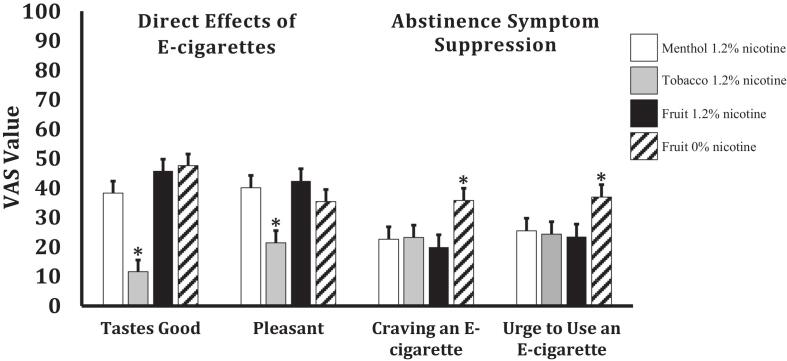 Figure 1
Peer Reviews
No public reviews on file for this paper yet. If you reviewed it on a platform where reviews are public (OpenReview, ICLR, NeurIPS, ICML), you can paste yours below so the community can read it here.
Videos
No videos yet. Explain this paper in a talk, walkthrough, or lecture? Add one.
Taxonomy
TopicsSensory Analysis and Statistical Methods · Biochemical Analysis and Sensing Techniques · Olfactory and Sensory Function Studies
Introduction
1
Electronic nicotine delivery systems (ENDS) are typically used with fruit, menthol, or mint flavored e-liquids, with tobacco flavor being least common (Bansal-Travers et al., 2024). Widespread availability and popularity of non-tobacco ENDS flavors raise questions about their impact on abuse liability and potential for switching from or reducing combusted cigarette (CC) use. ENDS flavor could alter user behavior (i.e., puffing topography), also affecting nicotine exposure and abuse liability. and alter subjective effects like satisfaction and craving relief, which could affect the likelihood of switching from CCs to ENDS and of ENDS addiction.
Previous research on the abuse liability of ENDS flavors has yielded mixed findings and some methodological limitations. While some studies have demonstrated that sweet or fruit flavors can increase nicotine exposure compared to tobacco flavors (St Helen, Dempsey, Havel, Jacob, & Benowitz, 2017) and enhance subjective appeal and reinforcing value (Audrain-McGovern et al., 2016, Goldenson et al., 2016), these studies have been limited by small sample sizes (n = 14–32), and lack of nicotine-free control conditions. Additionally, results have been inconsistent regarding subjective effects, with some studies finding no significant differences in satisfaction between flavors despite differences in nicotine exposure (St Helen et al., 2017). These methodological limitations and mixed findings highlight the need for more rigorous experimental designs to understand how flavors influence ENDS use patterns and abuse liability.
The current study addresses these gaps by incorporating a larger sample size, a nicotine-free control condition, and a randomized, double-blinded, crossover design to assess effects of ENDS flavor on nicotine exposure, puffing behavior, and subjective liking and withdrawal symptoms following ad libitum use. Study findings enhance understanding of how ENDS flavors affect abuse liability under controlled conditions within a clinical setting, providing important evidence for the potential role of ENDS in switching from CCs given the substantial public health implications with current U.S. adult CC and ENDS use rates of approximately 8 % and 4.1 %, respectively (Arrazola, Husten, Cornelius, & Armour, 2025).
Methods
2
Participants
2.1
Recruitment criteria included: age 18–55, regular nicotine-containing ENDS use (≥ 25 days in the past month), CC use ≤ 1 day/week in the past 30 days, no current smoking cessation treatment, and exhaled carbon monoxide < 6 ppm. Participants were excluded if they reported illicit drug use in the past 30 days but could report currently using other tobacco products. During 2018–2020, 307 participants were screened by telephone, 89 completed an in-person screening visit and 61, 52, 49, and 46 completed one, two, three, and all four study days, respectively. Participants were compensated up to 75 for screening and $200 per exposure visit). All participants provided informed consent. Only those who completed at least two study visits were included in the final dataset. This study was approved by an external institutional review board (Advarra: #Pro00036406).
Study products
2.2
Participants used a KangerTech CUPTI™ ENDS at 35 W, with a 5 mL tank and 0.5 O 316 L coil. This ENDS type was popular when this study began (2018).
E-liquids were selected based on manufacturer-reported popularity in tobacco, menthol, and fruit flavor categories and purchased from Avail Vapor, LLC. Five e-liquids were used: one for the initial screening/practice day (Tobacco Row [tobacco flavor] with 1.2 % nicotine concentration), and four for exposure days (Jamestown Tobacco [tobacco flavor], Arctic Blast [menthol flavor], Mardi Gras [fruit flavor] with 1.2 % nicotine concentration, and Mardi Gras with 0.0 % nicotine concentration). All e-liquids contained 70:30 propylene glycol:vegetable glycerin.
General procedures
2.3
The study included an initial screening/practice day and four exposure days separated by 48 h to 10 business days. At the screening/practice day, participants provided informed consent and completed a demographics and tobacco use history questionnaire and measures of nicotine dependence, including modified versions of the Fagerström Test for Nicotine Dependence (Heatherton, Kozlowski, Frecker, & Fagerstrom, 1991) and Penn State Electronic Cigarette Dependence Index (Foulds et al., 2015). Past 30-day tobacco use was assessed using the Timeline Follow-back method (Sobell & Sobell, 1992) and confirmed via urinary cotinine of ≥ 100 ng/mL. At the screening/practice day, participants completed a prescribed puffing session with Tobacco Row 1.2 % e-liquid to familiarize themselves with the study ENDS and procedures.
Exposure days were randomized according to a Williams Design generated with SAS v. 9.4 (SAS Institute Inc., Cary, NC). Participants were asked to abstain from ENDS for 12 h and all other tobacco products for 72 h, prior to each exposure day (verified post-hoc using plasma nicotine levels). Each exposure day included a prescribed and ad libitum use session. During the prescribed use session participants took 10 directed puffs with 30 s inter-puff intervals, followed by a 115-minute observation period. Only ad libitum use is included in this report.
During the ad libitum session (121 min following initiation of prescribed use), participants used the study ENDS for 1 h. One participant stopped using the study ENDS before the ad libitum session completed; they remained in the facility and remaining measures were taken and blood samples collected. Blood samples were collected, and heart rate and blood pressure were measured at the beginning, end, and 1 h following the ad libitum session. Within 5 min following the end of the ad libitum session, blood pressure and heart rate were measured and participants completed the Direct Effect of Nicotine Scale, Direct Effects of E-cigarettes Scale, Drug Effect Scale, and Abstinence Symptom Suppression Scale. Within 30 min following the ad libitum session, participants completed the Minnesota Nicotine Withdrawal Scale (MNWS) and Questionnaire of Smoking Urges – Brief (QSU-B). Where appropriate, questionnaires were adapted for ENDS by replacing the word “cigarette(s)” with “e-cigarette(s).”.
Study measures
2.4
Plasma nicotine
2.4.1
Plasma nicotine concentrations were measured with gas chromatography–tandem mass spectrometry/mass spectrometry. The limit of quantitation for plasma nicotine concentration was 2.0 ng/mL.
Puff topography
2.4.2
The Clinical Research Support System (CReSS Pocket, Version 3, Borgwaldt, KC) measured puff topography (i.e., puff number, duration, and volume, average flow rate, and inter-puff interval).
Subjective effects
2.4.3
Six subjective effects measures were administered. The following were 100-point visual analog scales (0=“not at all”, 100=“extremely”): Direct Effect of Nicotine Scale (10-item scale that measures nicotine effects), Direct Effects of E-cigarettes Scale (10-item scale that measures ENDS effects), and Abstinence Symptom Suppression Scale (11-item scale that measures nicotine or ENDS abstinence symptoms). The Drug Effect Scale includes five-items related to product liking rated on a 5-point Likert scale ranging from “not at all” to “extremely.” Differences in MNWS (Hughes & Hatsukami, 1986) and QSU-B (Tiffany & Drobes, 1991) total scores were examined from preceding to following the ad libitum session.
Statistical analysis
2.5
Plasma nicotine concentration values were baseline corrected using the elimination rate constant (Kel) calculated from the participant’s own data: , where t is the time point, 0 is the baseline time point, C(t)adjusted is the adjusted concentration at a time point, and C(t)observed is the observed concentration at a time point. Two participants had quantifiable plasma nicotine concentrations at Mardi Gras 0.0 % ENDS sessions and were removed from analyses for that session.
Statistical comparisons of plasma nicotine parameters included area under the plasma nicotine concentration–time curve (AUC_0-60_) and maximum plasma nicotine concentration (C_max_). Comparisons were conducted with a linear mixed model to include data from participants with fewer than four exposure visits. Sequence, visit number, and product were fixed effects, and participants were a random effect. Nicotine exposure parameters were log-transformed for analysis. Analyses were performed using SAS v. 9.4 and α = 0.05.
Results
3
Participant (n = 52) demographics and tobacco use are reported in Supplementary Table 1. Participants reported using ENDS an average of 3.1 times per day (SD = 1.6) for an average of 3.7 years (SD = 2.4), typically using e-liquids with a nicotine concentration of 14.1 mg/mL (SD = 28.6) and nearly all participants (98 %) used rechargeable ENDS. Other tobacco product use was minimal; two reported current cigar use (< 2x/month) and three reported hookah use (≤ 4x/month).
Nicotine exposure
3.1
Table 1 presents nicotine exposure parameters. Jamestown Tobacco 1.2 % was associated with significantly lower plasma nicotine C_max_ and AUC_(0-60)_ relative to other nicotine-containing ENDS (p’s < 0.001).Table 1. Plasma nicotine exposure parameters.Mardi gras(0 %)Arctic blast (1.2 %)Jamestown (1.2 %)Mardi gras (1.2 %)Main effectPost-hoc comparisonsC_max_, ng/mLBLQ4.58 (2.83)2.65 (2.99)5.09 (2.84)F = 54.34^^Arctic Blast & Mardi Gras 1.2 % > Jamestown^^All 1.2 % > Mardi Gras 0 %^^AUC, ng/mL minBLQ494343509F = 40.49**^^Arctic Blast & Mardi Gras 1.2 % > Jamestown^^All 1.2 % > Mardi Gras 0 %^**^Values are geometric mean (SD of geometric mean) of baseline adjusted plasma nicotine exposure parameters and time to max concentration. BLQ = below limit of quantitation. AUC = area under the plasma nicotine concentration–time curve. ***=p < 0.001, **=p < 0.01, *=p < 0.05.
Puff topography
3.2
Supplementary Table 2 lists puff topography variables. Significantly fewer puffs were taken from Jamestown Tobacco 1.2 % relative to all other e-liquids (p’s < 0.05). Mardi Gras 0 % was associated with greater puff duration and puff volumes compared to all other ENDS (p's < 0.001).
Subjective effects
3.3
Subjective effects results are listed in Supplementary Table 3. Notably, Jamestown Tobacco 1.2 % was rated lower than all other ENDS on several desirable subjective effects, including Pleasant and Tastes Good on the Direct Effects of E-cigarettes Scale (p's < 0.02; Fig. 1) and Enjoy, Taste, Like, and Pleasure on the Drug Effects Scale (p’s < 0.001). Mardi Gras 0 %, however, demonstrated less withdrawal symptom alleviation compared to all other ENDS with higher ratings on Use an E-cigarette Right Now on Direct Effects of E-cigarettes (p's < 0.001), lower ratings on Craving an E-cigarette (Fig. 1), Impatient, and Urge to Use an E-cigarette on Abstinence Symptom Suppression Rating (p’s < 0.05), and less reduction in urges compared to all other ENDS on the QSU-B (p’s < 0.02).Fig. 1. Menthol = Arctic Blast e-liquid, Tobacco = Jamestown Tobacco e-liquid, Fruit = Mardi Gras e-liquid. Visual Analog Scale (VAS) Values are 0–100 from a scale anchored with “Not at all” at 0 and “Extremely” at 100. All values are means with standard errors derived from the linear mixed models. * = Significantly different than all other conditions with p’s < 0.05.
Discussion
4
Results showed that e-liquid flavor affected nicotine exposure, puffing topography, and ratings of desirable subjective effects (e.g., product liking and satisfaction), but not reports of withdrawal symptom alleviation. The tobacco flavor was associated with fewer puffs and subsequent lower nicotine exposure, perhaps because of lower desirable subjective effects. This suggests flavor-related subjective effects can influence behavioral patterns and resulting pharmacological outcomes. Despite reduced nicotine exposure from the tobacco flavor, and regardless of flavor, the presence of nicotine was the primary driver of withdrawal symptom relief. This suggests that, while flavor affects appeal and use patterns, nicotine content remains the key factor for addressing tobacco dependence symptoms.
These results are consistent with previous research demonstrating that a fruit flavor e-liquid was associated with greater nicotine exposure than a tobacco flavor e-liquid, while ratings of tobacco withdrawal symptoms were not significantly different (St Helen et al., 2017). Although participants in that study (St Helen et al., 2017) did not rate a tobacco flavor significantly lower than a fruit flavor (i.e., strawberry) on measures of subjective liking, participants in the current study rated the tobacco flavor lower on measures of taste and liking; nonetheless, ratings of withdrawal symptoms were not significantly different. Our results are partially consistent with another study that found a tobacco flavor e-liquid, relative to a preferred non-tobacco flavor e-liquid, was rated lower on subjective liking, though it did not significantly differ on measures of nicotine exposure (Vargas-Rivera et al., 2020). The current study demonstrates that, even if nicotine exposure and subjective ratings of desirable effects (e.g., liking) are lower for a tobacco flavored e-liquid, management of tobacco withdrawal symptoms appears driven by presence of nicotine in the e-liquid, and not associated with subjective liking. These results suggest tobacco flavored e-liquids may be useful for switching from CCs because they address withdrawal symptoms; however, lower desirable subjective effects from tobacco flavors could limit complete switching as CC users may choose fruit or menthol flavored ENDS for greater desirable subjective effects. Therefore, non-tobacco flavors could facilitate greater switching but potentially increase ENDS dependence risk from greater use.
Limitations of this study include: 1) this study only tested popular examples of flavors from three categories (i.e., tobacco, menthol, fruit) and although data on participants’ preferred e-liquid was captured, many e-liquids could not be grouped into these categories given labelling and naming that did not provide clear categorization; as a result personal preference for certain types of flavors was not accounted for in this study, 2) although the study ENDS had a nicotine concentration consistent with participants’ usual e-liquids (i.e., 14.1 mg/mL) the study ENDS with 1.2 % nicotine concentration may not generalize to higher nicotine concentrations and other types, 3) the predominantly white male sample and adult age range (ages 18–55) may limit generalizability to people of other races, female users, and adolescents (who are more likely to use flavored ENDS products), and 4) use in a controlled laboratory environment offers good experimental control but may not reflect real-world use.
Author statement
All authors have seen and approved the final version of the manuscript being submitted. This article is the authors' original work, hasn't received prior publication, and isn't under consideration for publication elsewhere.
Data availability
Data from this study are available at: https://doi.org/10.6084/m9.figshare.30757928.
CRediT authorship contribution statement
Arit M. Harvanko: Writing – review & editing, Writing – original draft. Conor A. Ruzycki: Writing – review & editing, Methodology, Investigation. Jacob McDonald: Writing – review & editing, Supervision, Project administration, Conceptualization. Eric D. Claus: Writing – review & editing, Methodology, Formal analysis. Megan Schroeder: Writing – review & editing, Writing – original draft, Supervision, Conceptualization. Carolina Ramôa: Writing – review & editing, Writing – original draft, Supervision, Conceptualization.
Funding
This study was funded by the United States Food and Drug Administration, Center for Tobacco Products (HHSF223201310033I).
Declaration of competing interest
The authors declare that they have no known competing financial interests or personal relationships that could have appeared to influence the work reported in this paper.
The reference list from the paper itself. Each links out to its DOI / PubMed record.
- 1Arrazola R.A.Husten C.G.Cornelius M.E.Armour B.S.Notes from the field: Tobacco product use among adults - United States, 2017-2023 Morbidity and Mortality Weekly Report 747202511812110.15585/mmwr.mm 7407 a 340048400 PMC 11956159 · doi ↗ · pubmed ↗
- 2Audrain-Mc Govern J.Strasser A.A.Wileyto E.P.The impact of flavoring on the rewarding and reinforcing value of e-cigarettes with nicotine among young adult smokers Drug and Alcohol Dependence 166201626326710.1016/j.drugalcdep.2016.06.03027426010 PMC 4995771 · doi ↗ · pubmed ↗
- 3Bansal-Travers M.Rivard C.Delnevo C.D.Gross A.Anesetti-Rothermel A.Merson B.Xiao H.Cheng Y.C.Creamer M.R.Kimmel H.L.Stanton C.A.Sharma E.Taylor K.Lauten K.Goniewicz M.Hyland A.Flavor and Device Choices Among People Who Use ENDS: Results From the PATH Study American journal of preventive medicine 682202523624410.1016/j.amepre.2024.09.02039362615 PMC 11757064 · doi ↗ · pubmed ↗
- 4Foulds J.Veldheer S.Yingst J.Hrabovsky S.Wilson S.J.Nichols T.T.Eissenberg T.Development of a questionnaire for assessing dependence on electronic cigarettes among a large sample of ex-smoking E-cigarette users Nicotine & Tobacco Research 172201518619210.1093/ntr/ntu 20425332459 PMC 4838001 · doi ↗ · pubmed ↗
- 5Goldenson N.I.Kirkpatrick M.G.Barrington-Trimis J.L.Pang R.D.Mc Beth J.F.Pentz M.A.Leventhal A.M.Effects of sweet flavorings and nicotine on the appeal and sensory properties of E-cigarettes among young adult vapers: Application of a novel methodology Drug and Alcohol Dependence 168201617618010.1016/j.drugalcdep.2016.09.01427676583 PMC 5086287 · doi ↗ · pubmed ↗
- 6Heatherton T.F.Kozlowski L.T.Frecker R.C.Fagerstrom K.O.The Fagerstrom test for nicotine dependence: A revision of the Fagerstrom tolerance questionnaire British Journal of Addiction 86919911119112710.1111/j.1360-0443.1991.tb 01879.x 1932883 · doi ↗ · pubmed ↗
- 7Hughes J.R.Hatsukami D.Signs and symptoms of tobacco withdrawal Archives of General Psychiatry 433198628929410.1001/archpsyc.1986.018000301070133954551 · doi ↗ · pubmed ↗
- 8Sobell L.C.Sobell M.B.Timeline follow-back Measuring alcohol consumption 1992 Springer 4172