A simplified strategy for stent fixation using a defect-closure system in refractory esophageal stricture
Marco Spadaccini, Davide Massimi, Giacomo Marcozzi, Matteo Colombo, Alessandro Fugazza, Roberto De Sire, Alessandro Repici

Abstract
Genes, proteins, chemicals, diseases, species, mutations and cell lines named across the full text — each resolved to its canonical identifier and authoritative record.
Click any figure to enlarge with its caption.
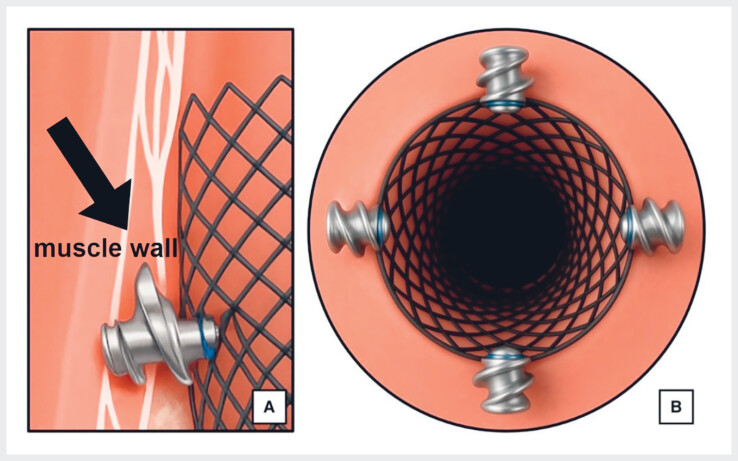 Fig. 1
- —Italian Ministry of Health’s “Ricerca Corrente”
Peer Reviews
No public reviews on file for this paper yet. If you reviewed it on a platform where reviews are public (OpenReview, ICLR, NeurIPS, ICML), you can paste yours below so the community can read it here.
Videos
No videos yet. Explain this paper in a talk, walkthrough, or lecture? Add one.
Taxonomy
TopicsEsophageal and GI Pathology · Esophageal Cancer Research and Treatment · Aortic aneurysm repair treatments
Refractory esophageal strictures due to benign conditions (such as post-radiation therapy, endoscopic resection, or caustic ingestion) are often managed with endoscopic stenting. Despite its effectiveness, stent migration remains a major limitation, with studies reporting rates of up to 40% 1 . To address this, stent fixation strategies have been developed 2 . An X-Tack defect closure system (Boston Scientific, Marlborough, MA, USA), originally designed for closure of gastrointestinal defects, has also been used for stent anchoring 3 4 . Conventionally, the device utilizes four helical tacks, a running suture, and a cinch. We describe a simplified approach using tack-only fixation, omitting the suture to make the procedure more straightforward.
A 19-year-old patient with caustic-induced esophageal strictures, refractory to multiple dilations, underwent placement of a fully covered stent. Unfortunately, the stent migrated after 2 days and was removed. A second stent was placed and secured using the X-Tack system. After confirming correct positioning by free contrast flow into the stomach, the polypropylene suture was cut and each tack was loaded individually onto the tack-driver catheter. The first tack was advanced through the stent mesh into healthy apposing esophageal tissues ( Fig. 1 ). Secure fixation was verified by the gentle traction of the device prior to release. Additional tacks were deployed in distinct areas along the proximal stent edge, ensuring stable anchorage ( Video 1 ).
Tacks were advanced through the stent mesh into the healthy apposing esophageal tissue.
A simplified tack-only approach was adopted for stent fixation in a caustic-induced esophageal stricture. Tack placement along the proximal stent edge achieved secure and stable anchoring.Video 1
Four weeks later, the stent was removed, with endoscopy showing significant improvement of the stricture. The patient has since tolerated a soft diet without further intervention.
This tack-only fixation technique stabilized the stent effectively, prevented migration and simplified the procedure. By eliminating the suture component, the method offers a user-friendly and reproducible approach, potentially extending the use of the X-Tack system even to endoscopists less familiar with defect closure applications.
Endoscopy_UCTN_Code_TTT_1AO_2AZ
The reference list from the paper itself. Each links out to its DOI / PubMed record.
- 1Coelho-Prabhu N Forbes N Thosani NC Adverse events associated with EGD and EGD-related techniques Gastrointest Endosc 202296389401035843754 10.1016/j.gie.2022.04.024 · doi ↗ · pubmed ↗
- 2Papaefthymiou A Gkolfakis P Basiliya K Success rates of fixation techniques on prevention of esophageal stent migration: a systematic review and meta-analysis Endoscopy 202456223010.1055/a-2147-829437536365 · doi ↗ · pubmed ↗
- 3Krishnan A Shah-Khan SM Hadi Y Endoscopic management of gastrointestinal wall defects, fistula closure, and stent fixation using through-the-scope tack and suture system Endoscopy 20235576677210.1055/a-2019-365236693419 · doi ↗ · pubmed ↗
- 4Mahmoud T Wong Kee Song LM Stavropoulos SN Initial multicenter experience using a novel endoscopic tack and suture system for challenging GI defect closure and stent fixation (with video)Gastrointest Endosc 20229537338234695421 10.1016/j.gie.2021.10.018 · doi ↗ · pubmed ↗