Ongoing reepithelialization after keratopigmentation
Giovanni Garottii, Nicole Bulgarão Maricondi de Almeida, Newton Kara-Junior

Abstract
Genes, proteins, chemicals, diseases, species, mutations and cell lines named across the full text — each resolved to its canonical identifier and authoritative record.
Click any figure to enlarge with its caption.
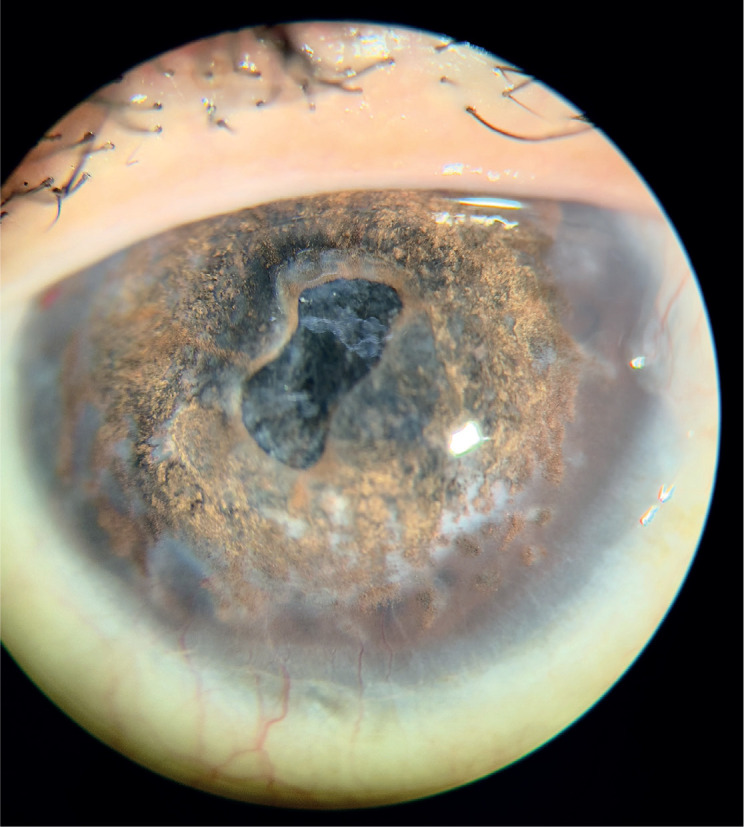 Figure 1
Peer Reviews
No public reviews on file for this paper yet. If you reviewed it on a platform where reviews are public (OpenReview, ICLR, NeurIPS, ICML), you can paste yours below so the community can read it here.
Videos
No videos yet. Explain this paper in a talk, walkthrough, or lecture? Add one.
Taxonomy
TopicsScience and Science Education · Environmental Sustainability and Education · Rural and Ethnic Education
Keratopigmentation (Figure), also referred to as corneal tattooing, is a procedure involving the insertion of pigment into the corneal stroma^(1)^. It can be used to improve the cosmetic appearance of blind eyes^(2)^, thereby positively influencing patient self-esteem^(3)^.Reported complications include pigment fading, uveitis, and corneal neovascularization^(1^,^2)^.
Figure 1. Slit lamp view of blind eye reepithelialization post Keratopigmentation procedure
The reference list from the paper itself. Each links out to its DOI / PubMed record.
- 1Žiak P KapitánováK Halička J MojžišP Keratopigmentation (Corneal Tattoo) - our first experience Cesk Slov Oftalmol.20197441404 English 3091388910.31348/2018/1/3-4-2018 · doi ↗ · pubmed ↗
- 2Hasani H Es’haghi A Rafatnia S Alilou S Abolmaali M Keratopigmentation: a comprehensive review Eye (Lond)20203461039463189680110.1038/s 41433-019-0750-2PMC 7253443 · doi ↗ · pubmed ↗
- 3Trindade BL Coelho IB Magalhães LL Crepaldi LA Man Fu FM Da Glória LM Cosmetic therapeutic keratopigmentation Clin Ophthalmol.202519527343996778410.2147/OPTH.S 507490 PMC 11832349 · doi ↗ · pubmed ↗