Body Composition Analysis Methods in Adolescent Athletes: A Systematic Review
Sogand Poureghbali, Tilman Engel, Areeba Raja, Dominik Sonnenburg, Frank Mayer

TL;DR
This paper reviews methods for measuring body composition in adolescent athletes and finds that more accurate four-compartment models are preferable due to limitations in other techniques.
Contribution
The paper systematically evaluates the reliability and validity of body composition methods in adolescent athletes and recommends four-compartment models for better accuracy.
Findings
Dual-energy X-ray absorptiometry is considered the criterion standard for validating other methods.
Two- and three-compartment models have reduced accuracy in adolescent athletes.
Field methods like bioelectrical impedance analysis and skinfolds need further validation.
Abstract
Body composition analysis in adolescent athletes is critical for assessing fat mass percentage and fat-free mass. However, measurement inaccuracies can compromise results. Additionally, there is a lack of reliable reference methods to evaluate the accuracy of field measurement techniques. This review evaluates the reliability and validity of methods in adolescent athletes and provides evidence-based recommendations for best practice. The search (Pubmed and Scopus) followed Preferred Reporting Items for Systematic reviews and Meta-Analyses guidelines and PICO criteria related to adolescent athletes in bioelectrical impedance analysis, dual-energy X-ray absorptiometry, air displacement plethysmography and skinfold thickness measurements. Thirty-one studies out of 4,408 records met the eligibility criteria. Estimating fat mass percentage and fat-free mass in adolescent athletes is…
Genes, proteins, chemicals, diseases, species, mutations and cell lines named across the full text — each resolved to its canonical identifier and authoritative record.
Click any figure to enlarge with its caption.
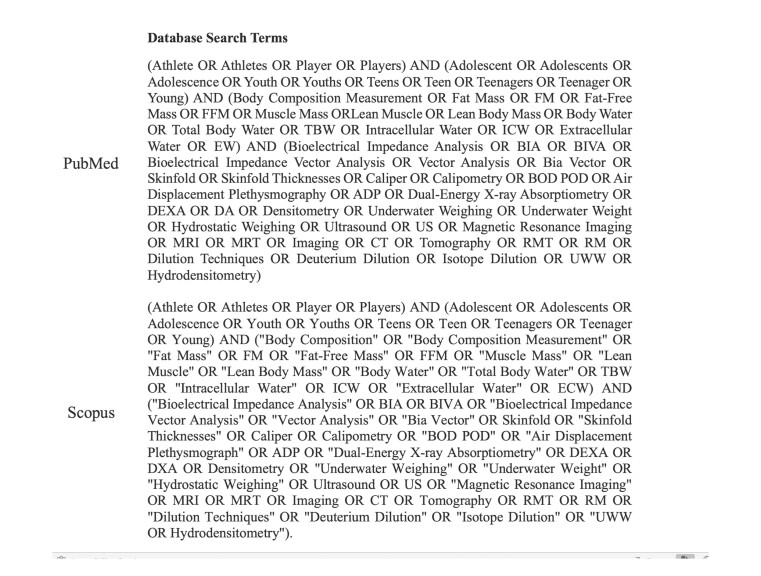 Fig. 1
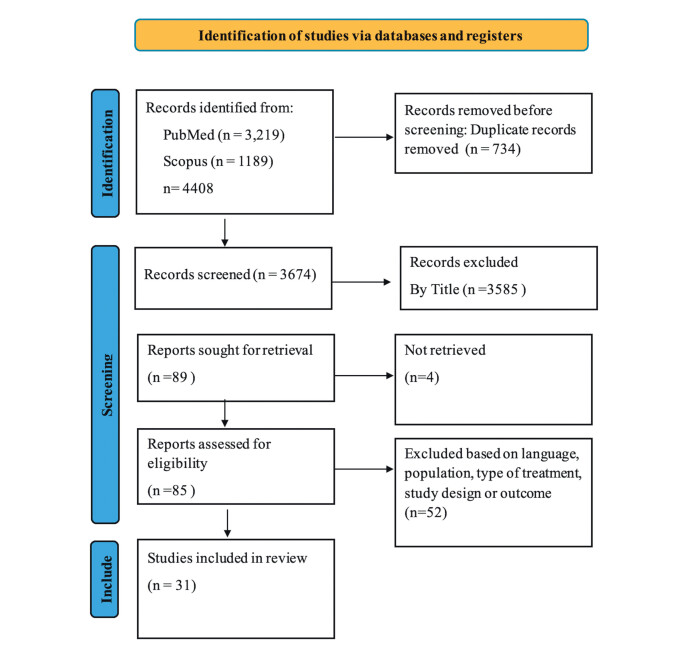 Fig. 2
| Authors and year |
Yes (
|
No (
| Not given | Quality rating |
|---|---|---|---|---|
| Eliakim et al. (2000) | 7 | 6 | 1 | Good |
| Gerasimidis et al. (2014) | 8 | 4 | 2 | Good |
| de Oliveira-Junior et al. (2016) | 9 | 3 | 2 | Good |
| Fonseca-Junior et al. (2016) | 8 | 4 | 2 | Good |
| Leão et al. (2017) | 7 | 2 | 5 | Good |
| Koury et al. (2018) | 7 | 1 | 6 | Good |
| Munguia-Izquierdo et al. (2018) | 7 | 1 | 6 | Good |
| Munguia-Izquierdo et al. (2019) | 9 | 3 | 2 | Good |
| Núñez et al. (2020) | 11 | 1 | 2 | High |
| Utczás et al. (2020) | 9 | 2 | 3 | Good |
| Ramos et al. (2022) | 6 | 6 | 2 | Poor |
| Housh et al. (2000) | 8 | 1 | 5 | Good |
| Utter et al. (2005) | 9 | 0 | 5 | Good |
| Clark et al. (2007) | 8 | 1 | 5 | Good |
| Utter et al. (2007) | 7 | 1 | 6 | Good |
| Moon et al. (2008) | 5 | 1 | 8 | Poor |
| Utter et al. (2009) | 6 | 0 | 8 | Poor |
| Aerenhouts et al. (2015) | 9 | 1 | 4 | Good |
| Küçükkubaş et al. (2019) | 4 | 3 | 7 | Poor |
| Portal et al. (2010) | 7 | 2 | 5 | Good |
| Ferri-Morales et al. (2018) | 7 | 0 | 7 | Good |
| Devrim-Lanpir et al. (2021) | 8 | 0 | 6 | Good |
| Sardinha et al. (2003) | 7 | 0 | 6 | Good |
| Silva et al., et al. (2003) | 4 | 0 | 8 | Poor |
| Fügedi et al. (2023) | 7 | 0 | 7 | Good |
| Silva et al. (2024) | 7 | 0 | 7 | Good |
| Quiterio et al. (2009) | 5 | 5 | 4 | Poor |
| Tuuri et al. (2001) | 7 | 3 | 4 | Good |
| Hetzler et al. (2006) | 8 | 2 | 4 | Good |
| Berges et al. (2017) | 5 | 6 | 3 | Poor |
| Liccardo et al. (2021) | 6 | 6 | 2 | Poor |
| Authors | Participants | Age (y) | Outcomes | Technology and sampling frequency | Result | Agreement and key findings |
|---|---|---|---|---|---|---|
| Eliakim et al. (2000) | 59 female ballet dancers | 15.5±0.1 | %FM | SF (four sites, Siri’s equation), BIA (RJL system, model 101(50 kHz) |
SF
| SF showed closer agreement with DXA |
| Gerasimidis et al. (2014) | 37 (18 females and 19 males) mixed sports | Female: 14.2±1.8 male: 14.4±2.0 | %FM FFM (kg) | Tanita -TBF-300 (two equations) |
FFM female:
| Variable agreement; Tanita overestimated%FM in females |
| de Oliveira-Junior et al. (2017) | 43 male soccer | 13.3±0.7 | %FM FFM (kg) | SF (Slaughter, Lohman); BIA (RJL 101, Houtkooper) |
%FM:
| SF outperformed BIA: Slaughter and Lohman recommended |
| Leão et al. (2017) | 13 male football players | 15.8±0.4 | %FM | BIA: Tanita BC-418 | %FM underestimated by 2.21% | |
| Fonseca-Junior et al. (2017) | 51 (24 females and 27 males) Pentathlon | Females: 14.2±2.5 males: 15.1±1.5 | %FM | SF (six equations) | females: Md=− 2.03; 2 SD=8.44 males: Md=0.98; 2 SD=7.30 | Durnin and Rahaman and Durnin and Womersley equations recommended |
| Koury et al. (2018) | 368 (151 females and 167 males) | Females: 12.8±1.09 males: 12.6±1.02 | FM (kg) FFM (kg) | BIA: three equations (Deuremberg, Horlick, and Pietrobelli) | Horlick: males, Rc=0.91, females: 0.87; others<0.12; R 2 : males: 0.92, females: 0.84; no statistics reported for% FM | Horlick had best agreement; others showed no agreement; high variability. |
| Munguia-Izquierdo et al. (2018) | 44 male soccer | 17.1±0.5 | %FM | BIA (Tanita BC-418, InBody 770); SF (11 equations) |
SF:
| SF performed better than BIA |
| Munguia-Izquierdo et al. (2019) | 00341 male soccer | 17.1±0.6 | FFM (kg) | BIA (Tanita BC-418, InBody 770); SF (11 equations) | Lower bias in SF; Durnin Womersley, Sarría, and Slaughter recommended | |
| Núñez et al. (2020) | 40 male soccer | Pre- season: 16.67±0.5 mid- season; 17.07±0.5 | FFM (kg) | BIA (Tanita BC-418, InBody 770); SF (12 equations) | Minimal bias; multiple SF equations recommended | |
| Utczás et al. (2020) | 738 males (soccer, basketball, and handball players) | 15.8±1.4 | %FM LBM | BIA: InBody 720 (multi-frequency) | Handball:%FM: 8.3±2.4; LBM:−5.0±2.1 kg* Basketball:%FM: 8.8±2.3; LBM:−5.3±1.8 kg* Soccer:%FM: 6.4±2.2; LBM:−3.1±1.4 kg | BIA less accurate in handball/basketball |
| Ramos et al. (2020) | 70>6-month sport participation | 11–16 | FFM (kg) | Biodynamics-450 (50 kHz), four equations | All equations showed a significant correlation*; Koury MAPE=4.23%, LOA=+ 4.0/−2.6 kg | Koury equation showed the best agreement |
| Authors | Participants | Age (y) | Outcomes | Technology and sampling frequency | Result | Agreement and key findings |
|---|---|---|---|---|---|---|
| Housh et al. (2000) | 137 male Wrestlers | 11.3±1.6 | BD | 16 SF modified equations |
Seven equations:
| Moderate agreement across equations |
| Utter et al. (2004) | 129 male Wrestlers | 15.5±1.3 | FFM | Tanita TBF-300 WA (50 kHz), SF (Brozek eq.) |
BIA: 56.9±8.4 kg,
| SF preferred due to higher precision in estimating FFM |
| Clark et al. (2007) | 94 wrestlers | 16.1±1.2 | MWW (based on%FM) | DXA, SF (Brozek equation) |
DXA=60.6±9.0 kg, UW=59.8±9.0 kg,
| No systematic bias; DXA is reliable for MWW |
| Utter et al. (2007) | 70 male wrestlers | 15.5±1.5 | FFM | SF (Brozek eq.), BX-2,000 A-mode ULTRA (2.5 MHz) |
ULTRA: 57.2±9.7 kg
| ULTRA provides comparable FFM estimates to UW in hydrated adolescents |
| Moon et al. (2008) | 30 males | 15.8±1.0 | % FM | Tanita BF860 W NIR Futrex 5,000 BOD POD SF (a, b, and c equations based on Jackson and Pollock) |
BIA:
| SF performed best vs. UW; BP did not yield the lowest TE |
| Utter et al. (2009) | 72 wrestlers | 15.3±1.4 | FFM (kg) | SF (Lohman eq.), InBody 520 (5, 50, 500 kHz) |
MFBIA: 57.2 kg, SK: 56.4 kg, UW: 57.0 kg;
| MFBIA estimates align closely with UW in hydrated youth |
| Aerenhouts et al. (2015) | N/A | 14.8±1.5 females and 14.7±1.9 males | %FM in six time points over 27 mo | Tanita TBF-410 (Slaughter eq.), UW (Siri eq.) |
females: BIA
| Low to moderate correlations, especially low agreement with BIA in males |
| Küçükkubaş et al. (2019) | 61 males (basketball, ski, swimming, and handball) | 15.90±0.79 | Tanita TBF-401 A (50 kHz), Biodynamic 310 (50 kHz), AVIS 333 PLUS (5, 50, 250 kHz) | %FM LBM (kg) |
Tanita:%FM
| Tanita underestimated%BF vs. HW; biodynamics and AVIS overestimated%FM; significant differences between methods |
- —SECA GmbH
Peer Reviews
No public reviews on file for this paper yet. If you reviewed it on a platform where reviews are public (OpenReview, ICLR, NeurIPS, ICML), you can paste yours below so the community can read it here.
Videos
No videos yet. Explain this paper in a talk, walkthrough, or lecture? Add one.
Taxonomy
TopicsBody Composition Measurement Techniques · Nutrition and Health in Aging · Obesity, Physical Activity, Diet
Introduction
Body composition analysis is critical in adolescent athletes (AAs) for evaluating fat mass percentage (%FM), fat-free mass (FFM), and growth status, especially during puberty. These data are fundamental for individualizing training, optimizing performance, and monitoring health-related conditions (e.g., energy deficiency and eating disorders). 1 2 3 However, accurate body composition assessment in youth remains challenging due to rapid growth, sex- and maturation-related differences, and limitations of commonly used methods. 4
Hormonal changes during adolescence significantly affect the FFM and%FM, with differences between sexes. For instance, girls generally show a steady increase in%FM, while boys often experience a temporary decrease in%FM during puberty followed by an increase. 5 6 7
Moreover, different sports might place distinct physiological demands on AAs, potentially influencing body composition. 8 For example, endurance and aesthetic sports are often associated with lower%FM, whereas strength- or power-based sports may promote greater muscle mass. 1 In sports like wrestling, where weight class placement is crucial, inaccurate assessments can result in improper classification or unrealistic body composition goals. 9
Various methods are used to assess body composition. Laboratory-based techniques such as dual-energy X-ray absorptiometry (DXA), hydrostatic weighing (HW), and air displacement plethysmography (ADP) offer high precision but come with limitations including cost, time, and, in the case of DXA, radiation exposure. 10 These methods can also be affected by various factors such as movement, lung volume, and body density assumptions, especially in athletes. 11 12 13
Field methods like bioelectrical impedance analysis (BIA) and skinfold (SF) measurements are cost-effective and easier to access. However, they are prone to greater measurement variability due to the technician skill, hydration status, and reliance on population-specific prediction equations. 14 15 16 17
While laboratory methods are often treated as the gold standard, their relevance and accuracy in AAs remain debatable. 18 Most previous research has focused on adult athletes, leaving a gap in validated methods for AAs. Many field methods are used without full validation in this population. Therefore, this systematic review aims to identify and evaluate recent, reliable, and validated methods for accurately assessing body composition in AAs.
Methods
Procedure, search strategy and selection criteria
This systematic review was conducted in accordance with the Preferred Reporting Items for Systematic Reviews and Meta-Analyses (PRISMA) guidelines to ensure methodological transparency, consistency, and comprehensive reporting. Moreover, it was registered in PROSPERO (CRD420251027825). 19 The protocol was developed and approved before the review process began, ensuring adherence to predefined objectives and eligibility criteria.
A systematic search was performed using PubMed and Scopus, restricted to studies published in English from 2000 onward. By focusing on studies published from 2000 onward, this review ensures the inclusion of more reliable, validated methods that align with current best practices in sports medicine. Older studies, while foundational, often used outdated prediction equations, different reference populations, and methodologies that may not reflect the accuracy of contemporary body composition assessment tools in AAs. 20 The search strategy was based on the PICO framework, incorporating relevant terms and their synonyms, including athletes, adolescents, body composition measurement,%FM, FFM, muscle mass, lean body mass, total body water (TBW), BIA, SF thickness, ADP, DXA, HW, ultrasound (Ultra), magnetic resonance imaging, computed tomography, and dilution techniques (e.g., deuterium dilution). Boolean operators were applied to ensure the comprehensive retrieval of studies assessing body composition in AAs ( Fig. 1 ).
Search terms used for the literature search in PubMed and Scopus databases.
Studies were eligible if they (1) included AAs (<18 y) who were apparently healthy (excluding studies on overweight, obese, or underweight individuals), (2) assessed body composition using measurement methods rather than formula-based estimations, (3) compared or validated at least two body composition assessment methods, (4) reported outcomes related to body composition components, and (5) followed a cross-sectional or longitudinal study design.
Studies were excluded if they (1) included non-athletes or participants older than 18 years, (2) did not compare body composition methods, (3) lack relevant body composition outcomes (%FM, FFM, or related parameters), and (4) were case reports, case series, commentaries, abstracts, or conference proceedings. Moreover, AAs were defined as individuals engaged in organized sport activities, competitions and belonging to an athletic community. This definition was chosen to ensure inclusivity across different levels of sports participation, recognizing that body composition assessments are relevant to both competitive and recreational athletes.
Data extraction
All references were managed using Mendeley, and duplicates were removed. Two independent reviewers screened titles and abstracts, followed by full-text assessments for final inclusion. Discrepancies were resolved through an independent third researcher.
Data were systematically extracted using a structured form, including publication details (title, authors, and year), study characteristics (design and inclusion/exclusion criteria), participant information (sample size, age, sex distribution, and body mass index [BMI] statistics), measurement tools (devices used for DXA, BIA, and other methods; BIA equations applied), results (correlations, limits of agreement, and mean%FM comparisons), and conclusions (key findings and study limitations), missing data were marked as unavailable in the extraction form.
The quality of the studies included in this review was assessed using the NIH Quality Assessment Tool for Observational Cohort and Cross-Sectional Studies. 21 Each study was evaluated based on 14 key questions, with responses categorized as “yes,” “no,” or “not applicable.” The studies were classified as high quality (11–14 “yes” responses), good quality (7–10 “yes” responses), or poor quality (0–6 “yes” responses). A study’s quality rating was determined by the percentage of “yes” answers, with high-quality studies being considered methodologically robust, good-quality studies having a moderate risk of bias, and poor-quality studies being deemed high risk of bias. Disagreements in ratings were resolved through discussion between the reviewers (for a detailed explanation of the quality assessment tool, see Supplementary Appendix A, available in the online version only).
Results
The systematic review initially identified 4,408 records. After removing 734 duplicates, 3,674 records underwent title and abstract screening, leading to the exclusion of 3,585 studies. Of the 89 full-text articles retrieved, 4 were excluded due to missing information on inclusion criteria and participants’ characteristics, leaving 85 studies for eligibility assessment. Fifty-two studies were excluded based on language, population criteria, intervention type, study design, or outcome measures, resulting in 31 studies included in the final analysis ( Fig. 2 ). These studies were categorized as follows:
A flow diagram showing the process used to select the study.
Five studies compared methods without a reference standard, 22 23 24 25 26
Eleven studies used DXA to validate BIA and/or SF methods, 27 28 29 30 31 32 33 34 35 36 37
Eight studies used UW as a reference to validate BIA, DXA, SF, and ultra, 38 39 40 41 42 43 44 45
Three studies involved ADP validation against BIA, DXA, or SF equations, 46 47 9
Two studies compared ADP with four- and five-compartment models, 48 14
One study validated DXA against a six-compartment model, 15
One study employed deuterium dilution to validate BIA, DXA, and three prediction equations. 49
Based on the NIH Quality Assessment Tool for Observational Cohort and Cross-Sectional Studies ( Table 1 ), the studies included in this review were classified into three categories: high, good, and poor quality. Only one study was classified as high quality, with a score of 11 “yes” responses, indicating strong methodological design, robust validation processes, and reliable statistical analysis. Most of the studies (19 studies) were rated as good quality, with scores ranging from 7 to 10 “yes” responses, demonstrating generally sound methodology with some minor limitations. Eight studies were classified as poor quality, scoring fewer than 6 “yes” responses. These studies exhibited significant weaknesses in their methodology, including potential biases in sample size, inconsistent reference methods, missing data, and insufficient statistical analysis.
: Table 1 Analysis of methodological quality according to the NIH quality assessment tool for observational cohort and cross-sectional studies
Several studies have compared body fat percentage (%BF) estimation methods without using a reference standard. In a sample of 31 adolescent swimmers (15.1±1.8 y), minimal average differences (~0.9%) in body fat estimates were observed between hydrodensitometry, SF, and DXA, though the individual variation was greater for DXA. 22 In 208 high school wrestlers (13–18 y), BIA and SF produced significantly different minimum wrestling weight estimates. 23 Among 92 football players (13.4±0.6 y),%BF comparisons across DXA, ADP, BIA, and SF revealed heteroscedasticity and varying errors. 24 A study of 20 basketball players (14.95±0.69 y) found high correlations between SF and ultra, despite site-specific differences. 25 Finally, in 142 elite AAs (11.72±2.33 y), BIA overestimated muscle mass and underestimated%BF compared to anthropometric methods. 26
Among the studies that considered DXA as the reference method, various SF and BIA techniques were evaluated, with agreement levels differing depending on population, device, and prediction equations. 27 28 29 30 31 32 33 34 35 36 37 Detailed characteristics of these studies are summarized in Table 2 .
: Table 2 Descriptive characteristics of the included studies with DXA as a reference
When UW was used as the reference, SF and BIA methods showed variable agreement depending on the population, protocol and prediction equations 38 39 40 41 42 43 44 45 (see Table 3 ).
: Table 3 Descriptive characteristics of the included studies which considered hydrostatic weighing (HW)/underwater weighing (UW) as the reference
ADP-based studies included three investigations: one in 29 adolescent volleyball players (16.1±1.3 y) showing strong correlations between SF and BIA ( r =0.83) but weak correlation with BMI percentiles ( r =0.45); 46 another in 104 male AAs (13.2±1.0 y) comparing ADP with DXA and BIA, concluding that DXA had superior agreement with ADP ( r =0.84 vs. r =0.60 for BIA); 47 and a study in Olympic wrestlers validating SF equations against ADP, recommending sex-specific equations for accurate%BF estimation. 9
Further studies evaluated ADP accuracy using Lohman’s and Siri’s equations in 51 male AAs (15.5±1.2 y), finding Siri’s equation overestimated%BF compared to Lohman’s and the four-compartment model. 48 The agreement between ADP and the five-compartment model was superior to DXA, with DXA overestimating%BF in adolescent girls. 14 The accuracy of the DXA-derived total body protein (TBPro) against a six-compartment model showed that assumed hydration fractions improved accuracy. 15
Quiterio et al. 49 assessed TBW estimation in 118 AAs (15.2±1.5 y) using ADP, DXA, and deuterium dilution. The highest accuracy was observed in Lohman’s hydration constants ( r ^2^ =0.94 for girls and r ^2^ =0.92 for boys), while anthropometric equations showed significant deviations.
Across all included studies ( n =31), a total of 1,475 male athletes were reported, whereas only 252 female athletes were identified. Additionally, five studies did not specify the sex of participants. Notably, three of these five studies focused on wrestling and soccer—sports typically dominated by male athletes—suggesting a high probability that these samples were also male-dominated.
Discussion
The findings reveal substantial variability in accuracy across different techniques, underscoring the importance of selecting context-specific reference methods.
Many studies lacked a consistent reference standard, assessing interchangeability rather than accuracy. 22 24 25 While BIA and SF methods are practical and widely accessible, they showed inconsistent accuracy, often underestimating%FM and overestimating FFM, especially in athletes with atypical body compositions. 23 26 SF equations require sport-specific adjustments due to site dependent variability. 50 51 52 However, BIA’s reliance on generalized equations introduces errors, further influenced by age- and sex-related differences. 53 54
DXA is the most frequently used reference method in the literature. However, its accuracy is affected by hydration status, tissue density variations, and sex-specific factors—particularly in female AAs. 14 Studies comparing BIA with DXA reveal mixed results, with discrepancies driven by the maturity level, and the equations used. 27 32 36 Certain SF equations, such as those developed by Slaughter et al. 51 and Durnin and Womersley, 55 tended to align more closely with DXA in AAs. 31 34 However, variations in fat distribution and hydration still posed challenges. Despite its popularity, DXA validation against multi-compartment models in youth remains limited, warranting caution when interpreting DXA-based results. 54 56 57 For instance, Silva et al. 14 found that DXA overestimated%BF compared to ADP, particularly in females, likely due to software limitations. 56 57 58
UW shows limited accuracy due to assumptions about tissue density and lung volume variability. 58 59 Although several studies considered underwater weighing as a reference, its validity in AAs remains uncertain, as none of these studies compared it against multi-compartment models. This limits confidence in its use as a criterion method in this population. ADP, exemplified by the BOD POD, provides a practical alternative to UW by estimating body density via air displacement. Studies in AAs report strong agreement between ADP, DXA, and SF methods, 52 58 though%BF estimates vary due to density conversion assumptions. 52 ADP tends to overestimate%BF relative to UW and is influenced by clothing, room temperature, and extreme BMI values. 60 Additionally, variability in FFM density, especially in AAs and female athletes, can lead to inaccuracies. Nonetheless, comparisons with four-compartment models suggest that integrating ADP into multi-compartment methods may enhance precision. 14 Deuterium dilution has shown strong agreement with multi-compartment models in adults, confirming its validity for TBW estimation. 61 However, only one study in this review used it in adolescents, without comparison to multi-compartment models. 49 Therefore, its accuracy in this population remains unclear.
Multi-compartment models (e.g., 4C, 5C, and 6C) provide the most accurate body composition assessments by accounting for fat, water, proteins, bone minerals, and other components. 56 They address the limitations of simpler two- and three-compartment methods, which assume a constant FFM density and do not distinguish between bone and soft tissue minerals. 54 59 Although evidence in AAs is limited, findings from adult populations suggest that increasing compartment details—such as including soft tissue mineral (5C) or glycogen (6C)—can improve accuracy. These additions help account for hydration and tissue variability more effectively than simpler models. 59 61 These models rely on specialized methods for each component, such as DXA for bone mineral density measurements, deuterium dilution for total body water, and UW for body volume. This targeted approach reduces assumptions and improves precision. However, these models are resource-intensive and not feasible for routine use in sports. 20 Moreover, no standardized protocols or algorithms currently exist for applying or combining these methods in AAs, highlighting the need for further research to establish practical, age-appropriate assessment strategies.
Various factors such as age, maturation, sex, and athletic discipline must be considered when choosing measurement methods. Using multiple methods is recommended when assessing body compositions in AAs especially when targeting outcomes like%FM or FFM. If only a single method is applied, its limitation should be acknowledged. Additionally, combining body composition data with indicators like energy availability, the risk of relative energy deficiency in sport (REDs) or bone stress injuries can provide a more comprehensive view of athlete health and guide informed decisions in training and nutrition.
Although sex-related differences in measurement accuracy are consistently reported, the evidence base is heavily male-dominated. Across studies, male participants outnumbered females by nearly six to one, limiting the generalizability of findings to female AAs and reinforcing a significant gap in the literature.
A major limitation identified is the inconsistency in study designs and reference methods, which leads to variability and, at times, unreliable results. Differences in measurement protocols, athlete populations, and prediction equations further complicate cross-study comparisons. Variability in sports participation—from general fitness settings to elite competition—as well as differences in anthropometric characteristics, may have influenced the reported accuracy of body composition methods
Based on the NIH Quality Assessment Tool for Observational Cohort and Cross-Sectional Studies ( Table 1 ), most included studies were of good quality, though only one was rated as high quality. Eight studies were classified as poor quality, often due to methodological weaknesses such as small sample sizes, inconsistent reference methods, or limited statistical analysis. Finally, data on AAs remain limited, especially concerning the differentiated effects of sex and age.
Conclusions
Body composition assessment in AAs lacks a universally accepted gold standard. The precision of laboratory methods varied across studies, suggesting the need for improved standardization and protocol harmonization due to developmental variability and methodological limitations. Simpler field methods offer practicality but require sport- and population-specific adjustments and their accuracy against a valid reference need to be investigated. Multicompartment models provide the highest precision, offering a more comprehensive framework by incorporating multiple body components. However, these models are costly, time-consuming, and impractical for routine sport settings. Comparisons involving multiple methods, particularly when advanced models are included, enhance measurement accuracy.
The reference list from the paper itself. Each links out to its DOI / PubMed record.
- 1Malina R M Body composition in athletes: Assessment and estimated fatness Clin Sports Med 20072601376817241914 10.1016/j.csm.2006.11.004 · doi ↗ · pubmed ↗
- 2Copic N Dopsaj M Ivanovic J Nesic G Jaric S Body composition and muscle strength predictors of jumping performance: Differences between elite female volleyball competitors and nontrained individuals J Strength Cond Res 201428102709271624714534 10.1519/JSC.0000000000000468 · doi ↗ · pubmed ↗
- 3Burke L M Loucks A B Broad N Energy and carbohydrate for training and recovery J Sports Sci 2006240767568510.1080/0264041050048260216766497 · doi ↗ · pubmed ↗
- 4Le Gall F Carling C Williams M Reilly T Anthropometric and fitness characteristics of international, professional and amateur male graduate soccer players from an elite youth academy J Sci Med Sport 20101301909510.1016/j.jsams.2008.07.00418835220 · doi ↗ · pubmed ↗
- 5Malina R M Growth and maturation: Normal variation and the effects of training In: Gisolfi CV, Lamb DR, editors Perspectives in Exercise Science and Sports Medicine Vol. II. Youth, Exercise, and Sport Benchmark Press 1989 pp.223265
- 6Malina R M Geithner C A Body composition of young athletes Am J Lifestyle Med 201150326227810.1177/1559827610392493 · doi ↗
- 7Malina R M Rogol A D Cumming S P Coelho e Silva M J Figueiredo A J Biological maturation of youth athletes: Assessment and implications Br J Sports Med 2015491385285910.1136/bjsports-2015-09462326084525 · doi ↗ · pubmed ↗
- 8Grigoletto A Mauro M Toselli S Differences in body composition and maturity status in young male volleyball players of different levels J Funct Morphol Kinesiol 202380416210.3390/jfmk 804016238132717 PMC 10744010 · doi ↗ · pubmed ↗