Speech analytics across the schizophrenia spectrum disorders: multimodal natural language processing and machine learning modelling in a Chinese-speaking population
Jiaqi Liu, Sumiao Zhou, Guangxing Deng, Meng Ji, Xufei Zhu, Xue He, Qijie Kuang, Shenglin She

TL;DR
This study aims to develop speech-based biomarkers for diagnosing schizophrenia spectrum disorders using natural language processing and machine learning in a Chinese-speaking population.
Contribution
The study introduces a new Chinese speech database and integrates machine learning to identify discriminative speech features for schizophrenia spectrum disorders.
Findings
A Chinese speech database will be established for multidimensional analysis of speech characteristics.
Speech features will be quantified using natural language processing to develop objective biomarkers for SSD diagnosis.
Machine learning will be used to identify highly discriminative speech patterns specific to schizophrenia spectrum disorders.
Abstract
Formal thought disorder (FTD) is a core symptom of schizophrenia spectrum disorders (SSDs). As a key representational dimension of FTD, speech features have been shown in previous studies to hold potential as diagnostic biomarkers for SSD. However, relevant research remains limited, and such speech features have not yet been applied clinically for SSD diagnosis. The aim of this research is to establish a Chinese speech database for multidimensional analysis of speech characteristics, quantify these high-dimensional linguistic features using natural language processing (NLP), and ultimately develop objective biomarkers for diagnosing and assessing the severity of SSD. This will be a single-center, prospective, observational study. In accordance with the DSM-5 criteria, a total of 300 inpatients or outpatients meeting the diagnostic criteria for SSD are planned to be included. Healthy…
Genes, proteins, chemicals, diseases, species, mutations and cell lines named across the full text — each resolved to its canonical identifier and authoritative record.
Click any figure to enlarge with its caption.
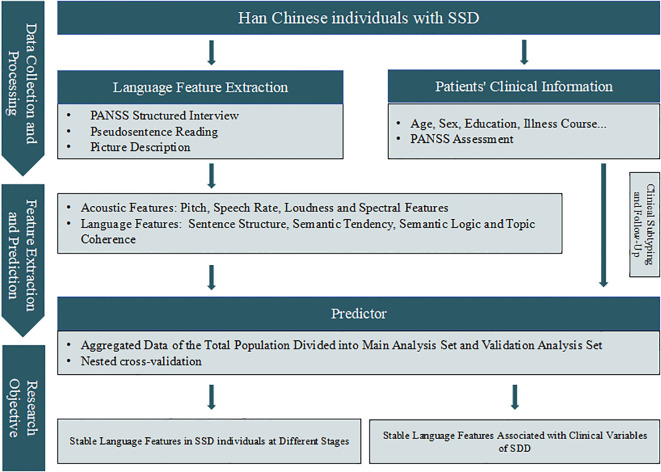 Figure 1
Peer Reviews
No public reviews on file for this paper yet. If you reviewed it on a platform where reviews are public (OpenReview, ICLR, NeurIPS, ICML), you can paste yours below so the community can read it here.
Videos
No videos yet. Explain this paper in a talk, walkthrough, or lecture? Add one.
Taxonomy
TopicsSchizophrenia research and treatment · Voice and Speech Disorders · Emotion and Mood Recognition