The role of immunoglobulin E in non-atopic disorders
Kujtim Thaçi, Aron Gyorgypal, Robert M. Anthony, Michelle E. Conroy

TL;DR
This paper explores how immunoglobulin E (IgE) functions beyond allergies, focusing on how sugar modifications affect its role in non-allergic immune processes.
Contribution
The paper highlights the importance of glycosylation in modulating IgE's function in non-atopic immune responses.
Findings
IgE glycosylation influences its stability and biological activity.
Variations in IgE glycosylation contribute to immune response diversity.
Glycoproteomic analysis of IgE could reveal disease-specific molecular signatures.
Abstract
Immunoglobulin E (IgE) and its corresponding Fc epsilon receptors (FcϵRs) are essential components of the immune system. The constant, crystallizable fragment (Fc) region of IgE binds with high affinity to its specific receptor, FcϵRI, anchoring IgE molecules to the surface of effector cells such as mast cells and basophils. Once bound, IgE uses its antigen-binding fragment (Fab) to recognize specific antigens. Antigen-induced crosslinking of cell-bound IgE triggers activation of these effector cells. Over fifty years ago, intensive research identified IgE as a key mediator of allergic reactions. Subsequent studies have demonstrated that the production of antigen-specific IgE and its interactions with innate immune cells are critical not only for allergic responses but also for certain non-atopic immune processes. N-glycosylation, a crucial post-translational modification, has been…
Genes, proteins, chemicals, diseases, species, mutations and cell lines named across the full text — each resolved to its canonical identifier and authoritative record.
Click any figure to enlarge with its caption.
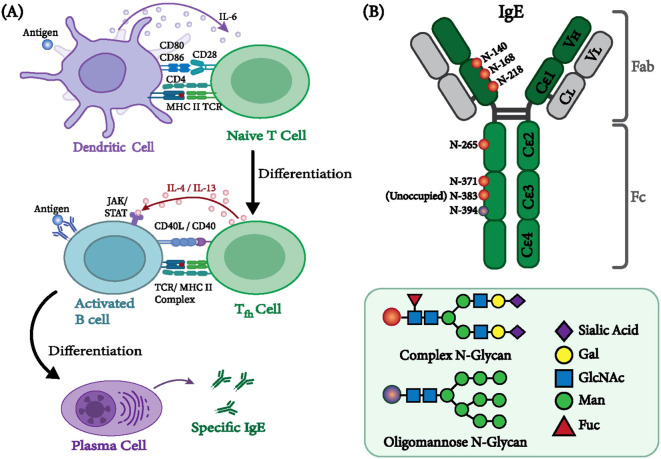 Figure 1
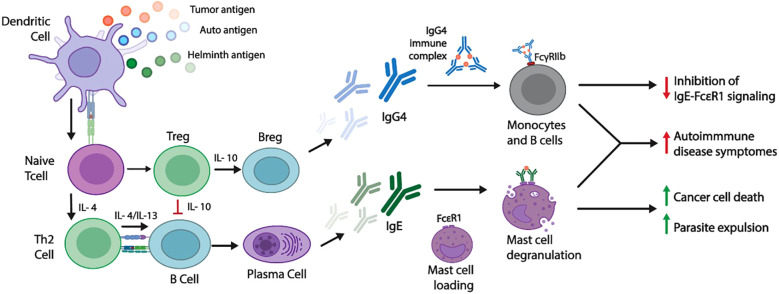 Figure 2
Peer Reviews
No public reviews on file for this paper yet. If you reviewed it on a platform where reviews are public (OpenReview, ICLR, NeurIPS, ICML), you can paste yours below so the community can read it here.
Videos
No videos yet. Explain this paper in a talk, walkthrough, or lecture? Add one.
Taxonomy
TopicsMast cells and histamine · Monoclonal and Polyclonal Antibodies Research · Asthma and respiratory diseases