Time-course of neuropsychological functioning in aneurysmal subarachnoid hemorrhage and its association with vasospasm
Giorgia Abete-Fornara, Claudia Fanizzi, Elena Scagliotti, Giorgio Fiore, Valeria Conte, Fabrizio Ortolano, Tommaso Zoerle, Marco Locatelli, Giulio Andrea Bertani

TL;DR
This study tracks cognitive recovery in patients with aneurysmal subarachnoid hemorrhage and finds that most impairments improve over 18 months, despite initial severe effects.
Contribution
The study provides a detailed time-course of cognitive recovery and the impact of vasospasm in aSAH patients over 18 months.
Findings
High cognitive impairments were observed immediately after aSAH, especially in memory and executive functions.
Most cognitive functions showed gradual improvement over 18 months, with vasospasm's effects diminishing over time.
Chronic phase showed low prevalence of impairments, suggesting significant recovery potential in aSAH survivors.
Abstract
Aneurysmal subarachnoid hemorrhages (aSAH) and related vasospasm often cause several neurological and cognitive impairments in survivors. The long-term impact of aSAH and vasospasm on cognition remains a topic of debate. This study aims to describe cognitive functioning, focusing on the acute phases after bleeding and for 18 months, and to investigate the immediate and long-term effects of vasospasm. Seventy adult patients were prospectively recruited and tested at different time points: within 48/72 h after bleeding (T1); between 7 and 10 days after bleeding (T2); and five long-term follow-ups from 1 (T3) to 18 months (T7). An extensive neuropsychological evaluation was administered, including the level of daily functional independence. At T1, all tests showed high percentages of impairments (ranging from 38 to 100%), in particular for visual and verbal long-term memory,…
Genes, proteins, chemicals, diseases, species, mutations and cell lines named across the full text — each resolved to its canonical identifier and authoritative record.
Click any figure to enlarge with its caption.
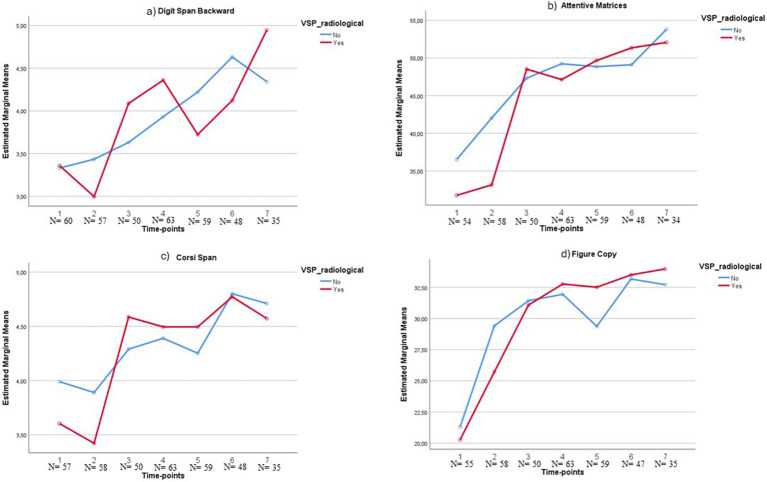 Figure 1
Peer Reviews
No public reviews on file for this paper yet. If you reviewed it on a platform where reviews are public (OpenReview, ICLR, NeurIPS, ICML), you can paste yours below so the community can read it here.
Videos
No videos yet. Explain this paper in a talk, walkthrough, or lecture? Add one.
Taxonomy
TopicsIntracranial Aneurysms: Treatment and Complications · Intracerebral and Subarachnoid Hemorrhage Research · Spatial Neglect and Hemispheric Dysfunction