Understanding psychiatric-legal disagreements in not criminally responsible on account of mental disorder cases: a gradient boosting model perspective
Aymane Haddou, Coralie Sergerie-Dufresne, Patrycja Myszak, Stéphanie Borduas Pagé, Alexandre Hudon

TL;DR
This study uses machine learning to explore why mental health tribunals sometimes disagree with psychiatrists' recommendations in criminal cases.
Contribution
A novel application of gradient boosting models to analyze decision-making patterns in psychiatric-legal disagreements.
Findings
The CatBoost model achieved 82% accuracy in predicting psychiatrist–tribunal agreement or disagreement.
SHAP analysis identified prior tribunal decisions and risk factors as key predictors of agreement.
Judicial decisions show a tendency toward path dependence and risk aversion.
Abstract
According to the Canadian Criminal Code, when a court or a mental health review board makes a disposition for an individual found not criminally responsible on account of mental disorder (NCRMD), it must consider several factors: foremost, the safety of the public, as the paramount concern, as well as the mental condition of the accused, their reintegration into society, and their other needs. While psychiatric evaluations are central to these hearings, the CETM does not always follow the psychiatrist’s recommendations. This study aims to identify variables that predict agreement or disagreement between psychiatric recommendations and CETM decisions, using machine learning to better understand this decision-making process. We retrieved all CETM judgments from 2023 (N = 1,327) from the publicly accessible SOQUIJ database. Cases were included based on NCRMD status and judgment type…
Genes, proteins, chemicals, diseases, species, mutations and cell lines named across the full text — each resolved to its canonical identifier and authoritative record.
Click any figure to enlarge with its caption.
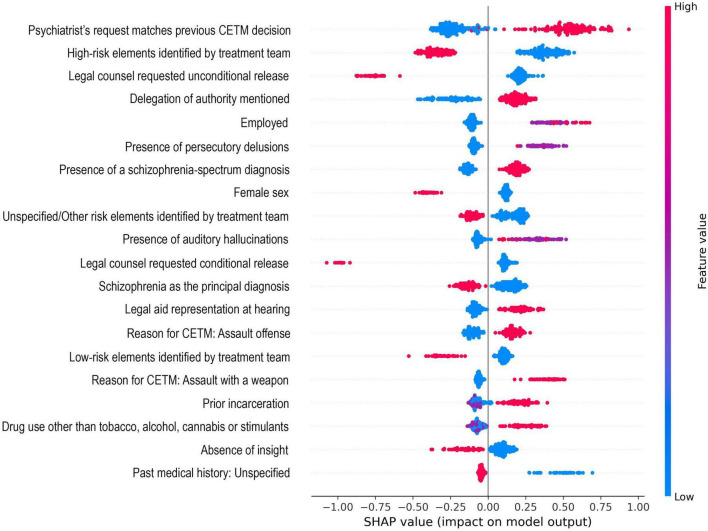 Figure 1
Peer Reviews
No public reviews on file for this paper yet. If you reviewed it on a platform where reviews are public (OpenReview, ICLR, NeurIPS, ICML), you can paste yours below so the community can read it here.
Videos
No videos yet. Explain this paper in a talk, walkthrough, or lecture? Add one.
Taxonomy
TopicsPsychopathy, Forensic Psychiatry, Sexual Offending · Medical Malpractice and Liability Issues · Healthcare Decision-Making and Restraints