Body composition measures assessed by bioelectrical impedance analysis and dual-energy X-ray absorptiometry in a sample of Brazilian adults and older adults
Vivian Wahrlich, Agnes Ciafrino, Amina Chain, Francine Moreira Bossan, Valéria Troncoso Baltar, Luiz Antonio dos Anjos

TL;DR
This study compares body composition measurements using bioelectrical impedance analysis (BIA) and dual-energy X-ray absorptiometry (DXA) in Brazilian adults and older adults, finding significant discrepancies and developing calibration equations to improve BIA accuracy.
Contribution
The study develops and validates new calibration equations to correct BIA estimates of fat-free mass in a diverse Brazilian population.
Findings
BIA overestimates fat-free mass and underestimates fat mass compared to DXA.
Calibration equations significantly improve BIA accuracy when validated against DXA measurements.
The multivariate prediction model effectively aligns BIA-derived fat-free mass with DXA values.
Abstract
Bioelectrical impedance analysis (BIA) is a common technique for assessing body composition in clinical and epidemiological settings. However, its accuracy is limited compared to reference methods such as dual-energy X-ray absorptiometry (DXA). This study aimed to evaluate the agreement between fat-free mass (FFM) and fat mass (FM) measured using BIA (Tanita BC-418) and DXA and to develop a calibration model to correct BIA estimates in a heterogeneous sample of Brazilian adults and older adults. We analyzed data from 945 participants (aged≥18 years; 611 female participants) who underwent both BIA and DXA assessments across multiple cross-sectional research projects. Agreement between the BIA and DXA measures of FFM (BIAFFM and DXAFFM) and fat mass (FM) was assessed using Pearson correlation coefficients (r) to evaluate precision and Lin’s concordance correlation coefficients (CCCs) to…
Genes, proteins, chemicals, diseases, species, mutations and cell lines named across the full text — each resolved to its canonical identifier and authoritative record.
Click any figure to enlarge with its caption.
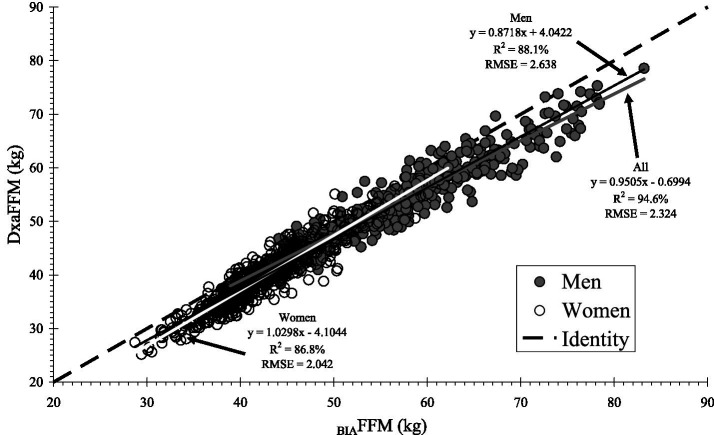 Figure 1
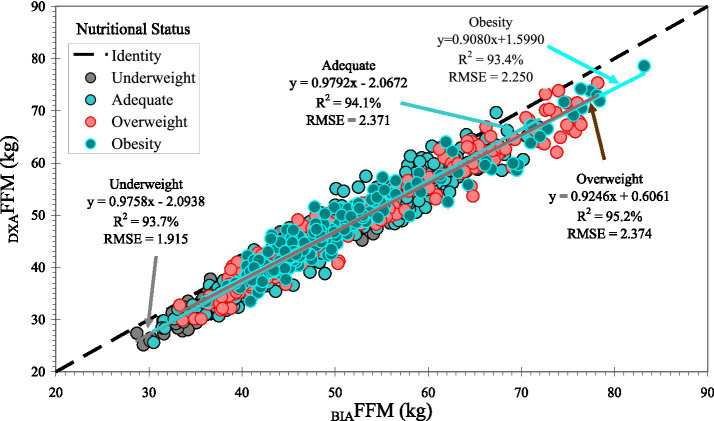 Figure 2
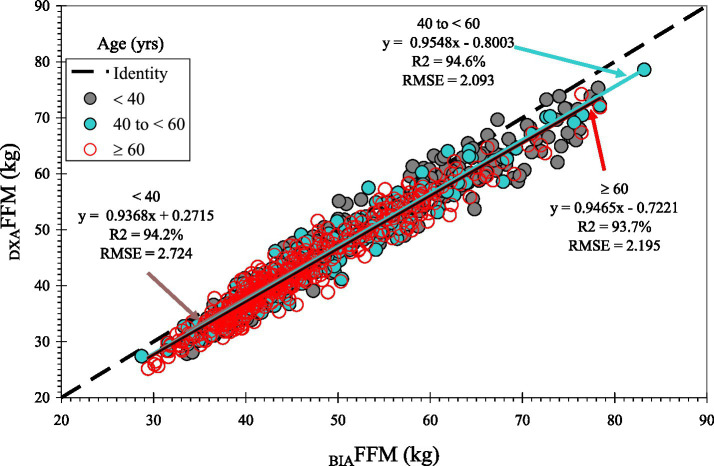 Figure 3
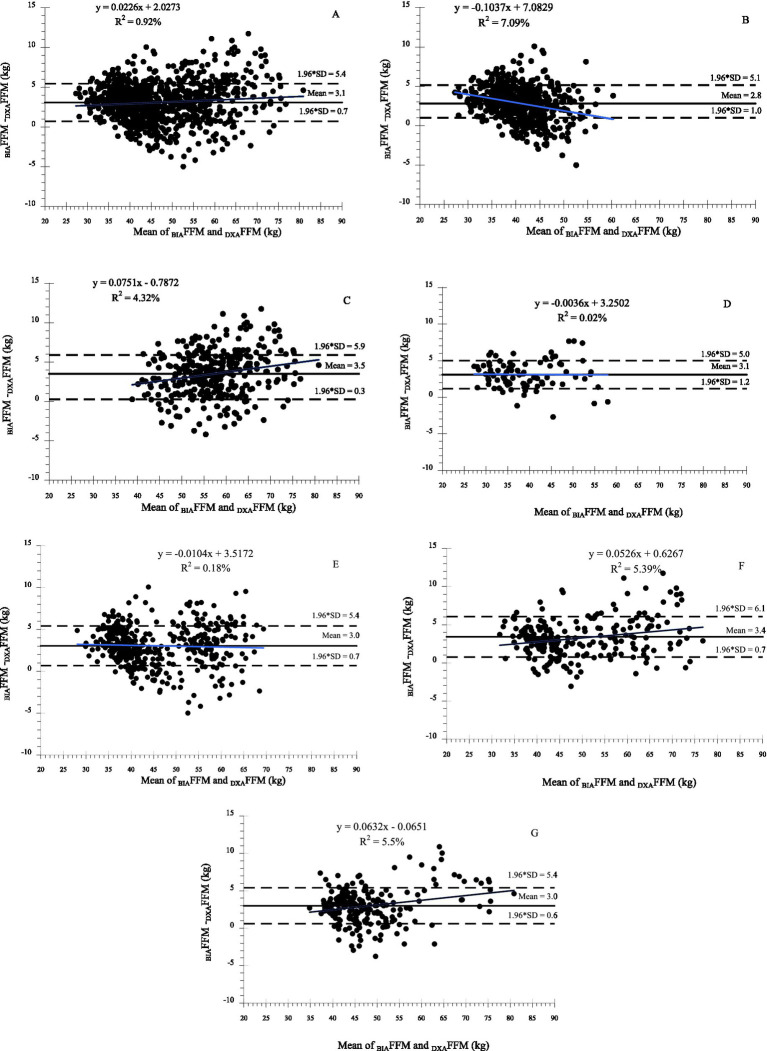 Figure 4
Peer Reviews
No public reviews on file for this paper yet. If you reviewed it on a platform where reviews are public (OpenReview, ICLR, NeurIPS, ICML), you can paste yours below so the community can read it here.
Videos
No videos yet. Explain this paper in a talk, walkthrough, or lecture? Add one.
Taxonomy
TopicsBody Composition Measurement Techniques · Nutrition and Health in Aging · Electrical and Bioimpedance Tomography