Automated item‐level measures of verbal fluency in semantic and logopenic primary progressive aphasia
Jet M. J. Vonk, Franco J. Ferrante, Brittany T. Morin, Diana Alejandra Rodriguez, Mia Lin, Rian Bogley, Jessica de Leon, Boon Lead Tee, Miguel Ángel Santos‐Santos, Zachary A. Miller, Maria Luisa Mandelli, Maria Luisa Gorno‐Tempini, Adolfo M. García

TL;DR
This study shows that analyzing specific features of verbal fluency responses can better distinguish between two types of primary progressive aphasia compared to traditional methods.
Contribution
The paper introduces an automated, scalable computational framework for item-level verbal fluency analysis to improve differential diagnosis of PPA subtypes.
Findings
Item-level features outperformed total correct responses in classifying semantic and logopenic variant PPA.
Features were associated with temporal lobe atrophy, while total correct responses linked to angular gyrus involvement.
A fully automated pipeline was developed for clinical integration and disease monitoring.
Abstract
Verbal fluency tasks are widely used in primary progressive aphasia (PPA), but most studies rely only on total correct responses, overlooking qualitative features of the words produced. We applied a scalable computational framework to extract item‐level features from fluency responses in semantic variant (svPPA) and logopenic variant PPA (lvPPA) to test their value for differential diagnosis. We analyzed animal fluency responses from 113 participants (40 svPPA, 40 lvPPA, 33 controls) using an automated pipeline extracting nine psycholinguistic features. Group differences were examined with (co)variance models, classification with logistic regression, and brain–behavior associations via structural magnetic resonance imaging. All features except semantic variability distinguished svPPA from lvPPA. Models including features outperformed (area under the curve [AUC] = 0.86) those using…
Genes, proteins, chemicals, diseases, species, mutations and cell lines named across the full text — each resolved to its canonical identifier and authoritative record.
Click any figure to enlarge with its caption.
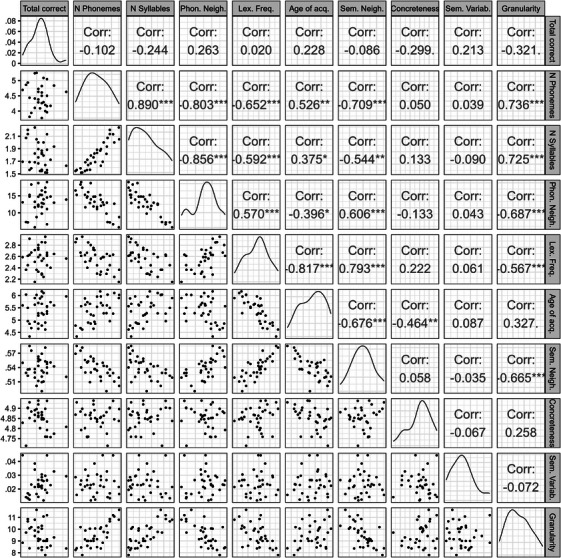 Figure 1
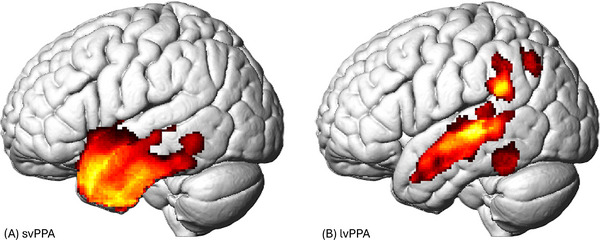 Figure 2
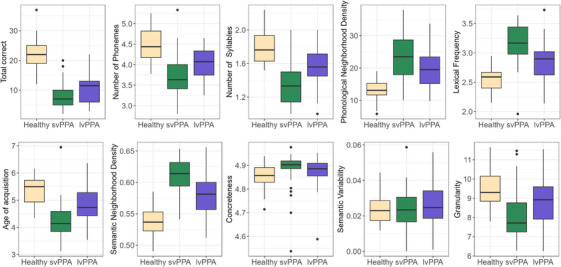 Figure 3
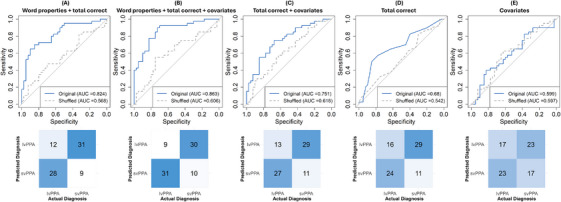 Figure 4
Peer Reviews
No public reviews on file for this paper yet. If you reviewed it on a platform where reviews are public (OpenReview, ICLR, NeurIPS, ICML), you can paste yours below so the community can read it here.
Videos
No videos yet. Explain this paper in a talk, walkthrough, or lecture? Add one.
Taxonomy
TopicsNeurobiology of Language and Bilingualism · Epilepsy research and treatment · Dementia and Cognitive Impairment Research