Retrospective Comparison of Empiric Antivenom vs. Expectant Treatment for Eastern Coral Snakebites
Reeves Simmons, Chiemela Ubani, Gerard Garvan, Molly Stott, Dawn Sollee, Jay Schauben, Alexandra Derr, Colleen Cowdery, Lindsay Schaack Rothstein, Hayley Gartner, Ashton Federico, Sophia Sheikh

TL;DR
This study compares treating coral snakebites with immediate antivenom versus waiting for symptoms, finding that immediate treatment increases ICU admissions and allergic reactions.
Contribution
The study provides new evidence comparing empiric antivenom use with expectant treatment for coral snakebites during and after antivenom shortages.
Findings
Empiric antivenom treatment was linked to a threefold higher likelihood of ICU admission.
Adverse reactions to antivenom occurred in 19.9% of patients treated with NACSA.
No significant difference was found in intubation rates or ICU length of stay between treatment groups.
Abstract
The coral snake is the only native elapid in North America. Their venom contains potent neurotoxins. Historically, all confirmed/presumed bites were treated with antivenom whether or not symptoms were present. Production of antivenom ceased in 2003. The resultant national shortage prompted clinicians to investigate alternative treatment strategies such as a wait-and-see approach where antivenom is held until signs of systemic toxicity manifest. Now that production has resumed there is limited research available comparing these two treatment paradigms, empiric administration vs the wait-and-see approach. Our objective in this study was to compare outcomes of the two treatment paradigms to determine whether one is associated with better patient outcomes. This was a retrospective analysis of coral snakebite cases reported to the Florida Poison Information Center Network from January 1,…
Genes, proteins, chemicals, diseases, species, mutations and cell lines named across the full text — each resolved to its canonical identifier and authoritative record.
Click any figure to enlarge with its caption.
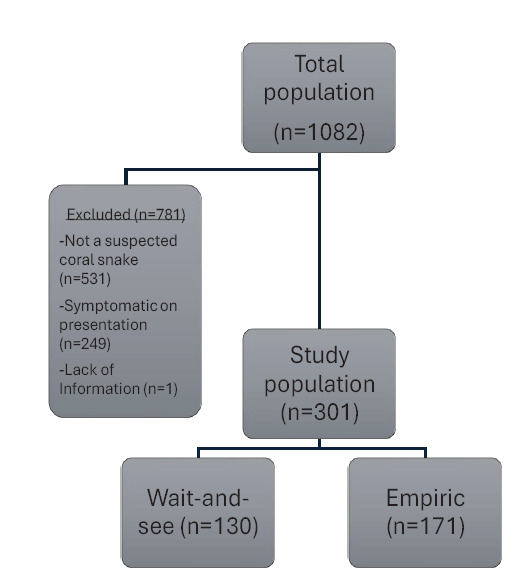 Figure 1
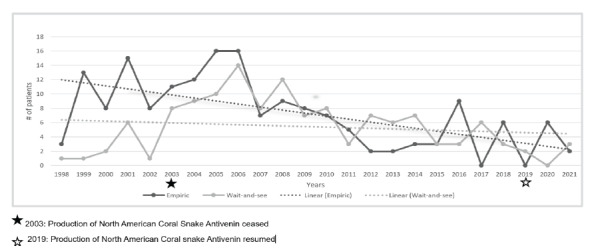 Figure 2
Peer Reviews
No public reviews on file for this paper yet. If you reviewed it on a platform where reviews are public (OpenReview, ICLR, NeurIPS, ICML), you can paste yours below so the community can read it here.
Videos
No videos yet. Explain this paper in a talk, walkthrough, or lecture? Add one.
Taxonomy
TopicsVenomous Animal Envenomation and Studies · Marine Invertebrate Physiology and Ecology · Healthcare and Venom Research