The Dr. House Effect: Experts' Impoliteness Influences Persuasion
Teresa Garcia‐Marques, Rita Silva, Filipe Loureiro, Ana Lapa

TL;DR
This paper shows that experts using impolite language can be more persuasive than when being polite, similar to the TV character Dr. House.
Contribution
It introduces the 'Dr. House Effect' as a novel concept linking impoliteness and persuasion in expert communication.
Findings
Impolite language by experts increased persuasiveness compared to polite language.
The effect was observed consistently across three studies.
The findings challenge traditional views on politeness and persuasion.
Abstract
We examine whether polite or impolite speech affects experts' persuasiveness. Across three studies, experts using impolite language proved more persuasive than when polite (as portrayed by the Dr. House TV character) informing persuasion and politeness research.
Genes, proteins, chemicals, diseases, species, mutations and cell lines named across the full text — each resolved to its canonical identifier and authoritative record.
Click any figure to enlarge with its caption.
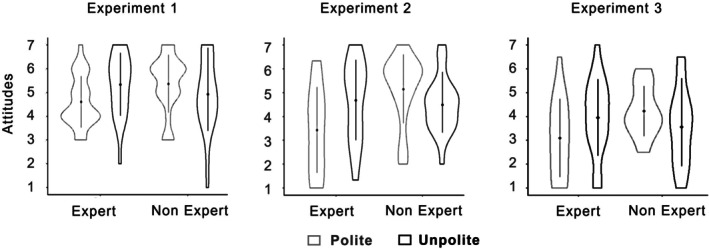 Figure 1
Peer Reviews
No public reviews on file for this paper yet. If you reviewed it on a platform where reviews are public (OpenReview, ICLR, NeurIPS, ICML), you can paste yours below so the community can read it here.
Videos
No videos yet. Explain this paper in a talk, walkthrough, or lecture? Add one.
Taxonomy
TopicsLanguage, Discourse, Communication Strategies · Discourse Analysis in Language Studies · Swearing, Euphemism, Multilingualism