A Data‐Limit Account of Release From Masking During Speech‐on‐Speech Listening
Sarah Knight, Yue Zheng, Georgie Maher, Ronan McGarrigle, Sven Mattys

TL;DR
This study explores how people understand speech in noisy environments and finds that both spatial and spectral separation help, with cognitive abilities playing a bigger role when the speech is clearer.
Contribution
The study provides new evidence supporting the data-limit account of speech perception in noisy environments.
Findings
Spectral release from masking provides at least as much benefit as spatial release from masking.
Cognitive scores correlate more strongly with performance when release from masking is present.
The weakest cognitive-performance relationship occurs when no release from masking is available.
Abstract
Speech‐on‐speech listening involves selectively attending to a target talker while ignoring a simultaneous competing talker. Spatially separating the talkers improves performance, a phenomenon known as spatial release from masking (spatial RM). The same is true of spectral separation, that is, filtering the talkers into non‐overlapping frequency bands (spectral RM). The relative benefit of spatial versus spectral RM is currently unknown. Furthermore, it is unclear how listeners’ ability to exploit spatial versus spectral cues is related to individual differences in cognition. The resource‐limit account suggests that cognitive resources are required to support the processing of degraded speech, implying the strongest cognition/performance relationship when RM is limited or absent. However, an alternative claim, referred to as the data‐limit account, suggests that cognitive resources…
Genes, proteins, chemicals, diseases, species, mutations and cell lines named across the full text — each resolved to its canonical identifier and authoritative record.
Click any figure to enlarge with its caption.
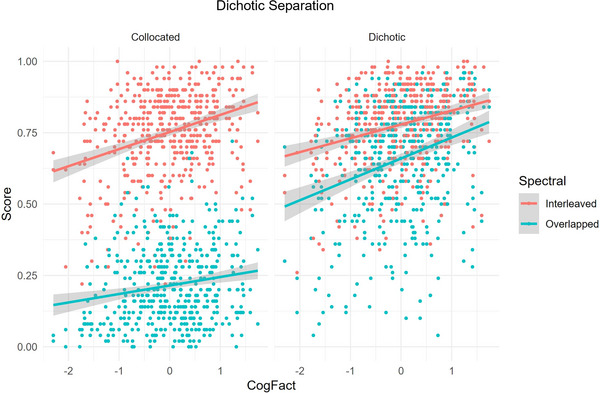 Figure 1
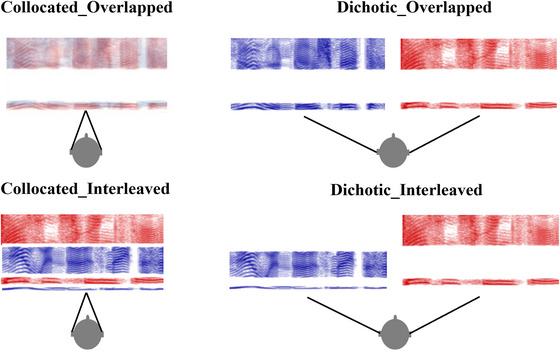 Figure 2
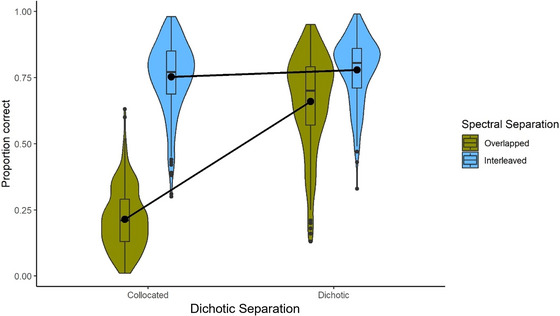 Figure 3
Peer Reviews
No public reviews on file for this paper yet. If you reviewed it on a platform where reviews are public (OpenReview, ICLR, NeurIPS, ICML), you can paste yours below so the community can read it here.
Videos
No videos yet. Explain this paper in a talk, walkthrough, or lecture? Add one.
Taxonomy
TopicsPhonetics and Phonology Research · Hearing Loss and Rehabilitation · Stuttering Research and Treatment